System Design Interview: Relational Database for a Dating App Pun
Why is this Databases meme funny?
Level 1: Trying Not to Laugh
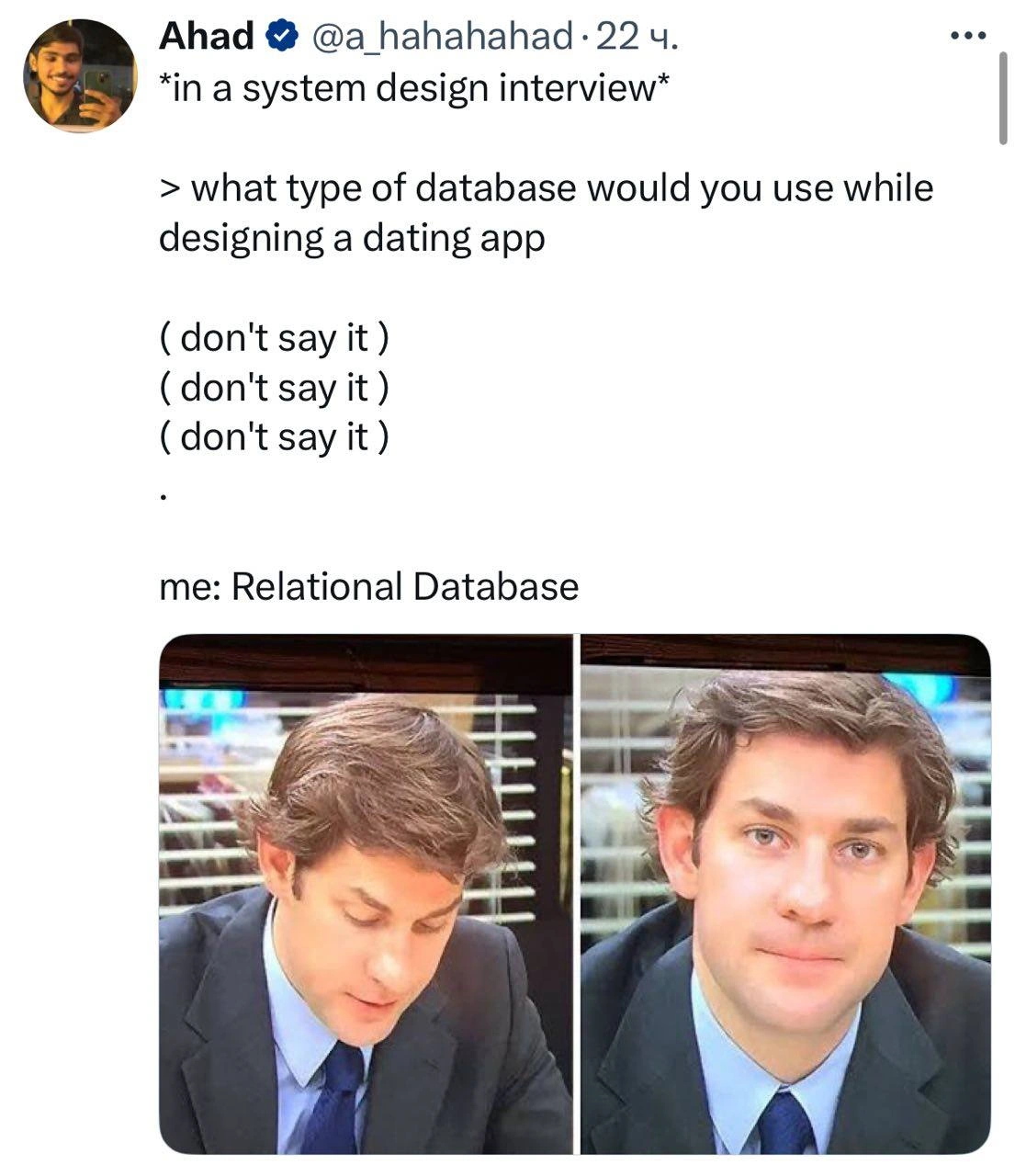
Imagine you’re in a very serious situation – like a big job interview or an important class presentation – and someone asks you a question. You know you’re supposed to give a thoughtful, correct answer, but the way they asked the question sets up a really silly joke in your mind. You try so hard not to say the joke out loud… but you just can’t help it. You blurt out the joke answer. There’s an awkward pause. You then straighten your face, pretending you didn’t just crack a pun. That’s exactly what’s happening here. The interviewer asked a person what kind of database they would use for a dating app – basically, they wanted to know how the person would store all the app’s information. The funny part is that the person answered “relational database” simply because the word “relational” sounds like it has to do with relationships and dating. It’s like if your teacher asked, “What’s the strongest kind of bond in chemistry?” and you cheekily answered, “James Bond!” instead of giving the real answer. It’s a goofy response in a serious setting.
We find this meme humorous because we can all relate to that temptation to make a pun. It’s the kind of joke your dad might make – a real dad joke – and doing it in a professional interview makes it even more absurd. The guy in the picture is shown first trying to hide a smile and then forcing a neutral, serious look. That’s the face of someone who just realized they said something silly when they weren’t supposed to. It’s funny and a bit adorable because you can almost feel his internal struggle: he’s thinking “Oh no, I shouldn’t have said that, keep a straight face!” We laugh because we’ve been there: trying not to laugh at our own joke in a quiet room. In the end, this meme is all about that universal feeling – when you accidentally let a joke slip out at the wrong time, and then do your best to act all serious. It’s a little story of a good-natured slip-up, and it makes us grin because it’s so human and so relatable.
Level 2: Date-a-Base 101
Let’s break down what’s happening in this meme in simpler terms. The scenario is a system design interview – that’s when you’re asked in a job interview to plan out a big application’s architecture (how all the parts of a system work together). Here, the interviewer asks: “What type of database would you use for a dating app?” A database is basically an organized collection of information – like a digital filing cabinet or a bunch of spreadsheets where an app stores all its data (user profiles, messages, matches, etc.). There are different types of databases, and each type is good for certain tasks. For example, a relational database is one common type that stores data in tables (rows and columns) and lets you link information through relationships between tables. It’s called “relational” because of these relationships (in the data sense). Popular examples of relational databases are MySQL, PostgreSQL, or Oracle – they use SQL (Structured Query Language) to manage the data. In a relational database, you might have one table for users, another for user profiles, and a relationship table that connects users who have matched with each other. It’s like storing data in an Excel sheet, and using a common ID to say “User A is matched with User B.”
Now, dating app brings another meaning to mind: dating is all about human relationships. There’s a pun lurking here. The word “relational” (the technical term) sounds like it’s about “relationships” (the human term). In reality, if someone is designing a dating app’s backend, they might consider other databases too: maybe a graph database because it’s great for mapping connections between people (imagine each user as a point, and a line connecting two people if they match or interact – that’s a graph structure). Or perhaps a NoSQL database for handling a huge volume of swipe records and messages quickly across the world. In a solid answer, you’d discuss these options. But in the tweet, the person being interviewed can only think about the cheeky literal answer. The meme shows that inner monologue: “(don’t say it) (don’t say it) …” – they know it’s a corny response. Despite that, they answer with “Relational Database.”
Why is this funny? Because it’s like a play on words overriding good sense. It’s as if the interviewee heard “dating app” and immediately their brain yelled “relationships! use a relational database because it has the word relation!” – ignoring the intent of the question. It’s a classic dad joke style response happening at the worst possible time (a serious interview). The reaction images of the man in a suit show him first looking down with a suppressed smirk (he’s trying not to laugh or show that he just made a joke) and then looking up all serious, as if he’s trying to pretend nothing funny happened. We find it humorous because maintaining that straight face after dropping a silly answer is an awkward, relatable moment. Many of us have been in a situation where we accidentally said something goofy in a professional setting and then had to play it cool.
Let’s clarify a couple of terms to fully appreciate the joke: In tech interviews, when they ask about “types of trees you know,” they usually mean tree data structures – a fundamental concept in computer science (like binary trees, which are like family trees but for data, organizing information in a hierarchy). But the follow-up joke answer lists maple, ash, larch, baobab, which are literal tree species you find in nature. The moon emoji “🌚” at the end signifies a sly, joking tone. So the interviewee continues the pattern of misunderstanding deliberately – treating technical language as everyday language. It’s as if the interviewer moved on to a question about computer science trees, and the candidate doubled down on the silly approach by talking about forest trees. For a new developer or anyone watching this, the humor comes from knowing the difference between the technical meaning and the common meaning. “Relational” in databases has nothing to do with dating relationships, just like tree data structures aren’t about oak or maple trees. By mixing them up on purpose, the meme creates a goofy scenario.
In simpler words: The candidate responded with an answer that is technically a real thing (relational databases exist and are widely used) but clearly not what the interviewer was aiming for, at least not in that one-word, pun-driven way. It’s the equivalent of being asked a serious question and giving a joke answer that just sounds relevant. This resonates with developers because interviews can be stressful, and sometimes your brain desperately wants to grab onto anything – even a lame joke – to ease the tension. InterviewHumor like this is popular since it pokes fun at those nerve-wracking moments. Plus, databasehumor isn’t something you see every day; mixing dry tech terms with dating jokes is unexpected and thus gets a laugh. For someone newer to tech, just remember: “relational” in computing is about data tables and keys – it’s a coincidence that it sounds like it’s about dating. The meme is funny because the interviewee pretends not to know the difference for the sake of a laugh (or maybe genuinely slips up). And as the audience, we’re laughing with them, not at them, because we’ve all had moments of confusion or comic relief in learning and interviews.
Level 3: The Relational Reflex
Picture yourself in a high-pressure system design interview at a tech company. You’re at the whiteboard (yes, one of those classic WhiteboardInterviews), and the interviewer throws a broad question at you: “What type of database would you use to design a dating app?” They’re expecting you to discuss pros and cons of different storage solutions – maybe talk about NoSQL vs SQL, mention graph databases for connecting people, or describe how to handle millions of user records across regions. Basically, it’s a chance to show off architectural savvy. But in this meme scenario, there’s an inner voice in the candidate’s head chanting, “Don’t say it... don’t say it... don’t say it...” – because a punny answer is sitting right there. The word “dating” instantly makes them think of relationships, which sounds just like “relational” as in relational databases. It’s the perfect setup for a cheeky answer. Finally, unable to resist that InterviewHumor impulse, they blurt out with a straight face: “Relational Database.”
The two-panel reaction image below the tweet says it all. In the first panel, the guy in the suit (recognizable as Jim from The Office) is looking down, suppressing a grin – that’s the moment the pun crosses his mind. In the second panel, he’s staring forward with an exaggeratedly neutral expression, lips pursed, trying to play it cool after letting the joke slip. We can almost hear the silence in the room. It’s cringe-worthy and hilarious at the same time. Every developer who’s been in a tough interview can relate to that mix of nervousness and comic relief. You know you should be talking about sharding databases or how to ensure low latency for user matches, but your brain latches onto a one-liner. It’s a relatable developer experience: under stress, sometimes your mouth runs on autopilot or your inner dad-joke aficionado emerges. The meme pokes fun at that shared anxiety – the fear of saying something absurd in a serious setting and then having to maintain a poker face.
From a senior engineer’s perspective, the humor also comes from how simplistic the answer is. A dating app at scale likely needs a mix of data solutions. Simply saying “Relational Database” without context would be a huge oversimplification in a real interview. It’s the kind of answer a nervous junior might blurt out, or a deliberate dad-joke by someone mischievous. Interviewers usually expect you to ask clarifying questions and perhaps propose using a combination: maybe a reliable relational DB (SQL) for storing user accounts and transactions, plus a fast NoSQL store for session data or chats, and perhaps a graph database or clever indexing for matchmaking queries. Throwing out “relational DB” just because of the word “relationship” is hilariously off-target. It’s like the candidate took the question way too literally. Seasoned devs chuckle because we’ve all seen moments where someone answers the question they wanted to hear instead of the one asked – in this case, indulging in a pun rather than focusing on system requirements. It’s a form of DatabaseHumor meeting interview parody.
And let’s be honest, many of us have a soft spot for puns. This meme leverages a relational_puns gimmick that’s so obvious it’s hard not to snicker. It’s the kind of joke you’d groan at if it were a stand-up routine (“Dating app? Use a relational database, get it?” rimshot). In the pressure cooker of an interview though, that joke becomes a guilty temptation. The tweet’s author, Ahad, effectively narrates that internal battle: the repetitions of “(don’t say it)” represent the brain desperately trying to hold the pun back. When he finally says “Relational Database,” it’s the comic release – we, the tech audience, instantly get the play on words and why it’s facepalm-worthy in context.
What amplifies the hilarity is the follow-up post_message joke someone added:
Interviewer: “Let’s move on, what types of trees do you know?”
Candidate: “Out of my mind it will be maple, ash, larch... My favorite one is baobab 🌚.”
Here the interviewer likely meant tree data structures (like binary trees, B-trees, etc., common in algorithm interviews). But our pun-loving candidate intentionally responds with actual tree species you’d find in a forest. 😄 It’s a perfect extension of the meme’s theme – misunderstanding (or pretending to misunderstand) technical terms as everyday words. For developers, this is comic gold because it satirizes the sometimes absurd mismatch between what interviewers ask and how interviewees might nervously respond. It also showcases that peculiar DatabaseHumor and InterviewHumor we trade on tech Twitter and forums – turning stressful experiences into light-hearted memes. In short, the “relational database” quip in a dating app interview is a tongue-in-cheek lesson: know your system design basics, but also know when not to let a pun slip out. And if you do slip, at least have Jim-from-The-Office level composure to fake a straight face afterward!
Level 4: Not That Kind of Relational
Under the hood of this joke lies a data modeling twist. In computing, a relational database isn’t about love or dating at all – it refers to the formal relational model introduced by E. F. Codd. In this model, a relation is basically a table of data (think of a spreadsheet) following strict rules of normalization. The term “relational” comes from mathematical relations (sets of tuples) – not from human relationships. So when someone blurts out “Relational Database” in a dating app discussion, they're unintentionally mixing a precise technical term with a casual meaning of relationship. It’s a classic case of relationship_vs_relational confusion, and that double meaning is the crux of the humor here.
From a system architecture perspective, a dating app’s data isn’t an obvious fit for a plain relational model. Dating apps deal with a web of connections: users liking or matching with other users form a graph of relationships. In pure theory, that’s a graph structure – nodes (people) connected by edges (likes, matches). A seasoned system designer might suggest a graph database for this, since graph databases (like Neo4j or Amazon Neptune) excel at traversing relationships. For example, finding “friends of friends” or common interests is straightforward with graph queries but can require complex JOIN operations in SQL. The meme’s punchline ironically ignores these nuances. It’s funny because in a systems design context you’d expect talk about specialized data stores or sharding strategies for millions of users – not a one-liner answer.
Let’s get a bit theoretical: relational databases use SQL and enforce ACID properties (guaranteeing each transaction is Atomic, Consistent, Isolated, Durable). That’s great for consistency (your profile updates and match actions are reliably stored), but a globally distributed dating app might relax some of that strictness for speed. Here’s where the CAP theorem whispers in a senior engineer’s ear: in a partitioned network, you trade off consistency vs. availability. A dating service with users worldwide might employ an eventually consistent, distributed data store (a type of NoSQL) for things like swipe data or messages, ensuring high availability even if it means some data is slightly out-of-date for a moment. In contrast, a traditional relational database is often centralized or tightly coupled, which can become a bottleneck at Tinder-scale swipe volumes. This is why an interviewer expects a discussion about trade-offs – maybe using a NoSQL store for scaling user activity, a relational store for critical transactions (like subscriptions or user credentials), and possibly a graph component for recommendation algorithms (“People You May Like”). The humor is that instead of diving into any of these technical complexities, the interviewee defaults to the textbook term “Relational Database” simply because dating involves relationships. It’s an almost too perfect pun on relational_puns.
In sum, on the deepest level, this meme highlights a collision between formal computer science terminology and natural language. It tickles us because the word “relational” means one thing in database design (sets and schemas) and another in everyday life (dating and relationships). A veteran architect knows that designing a dating_app_system_design is a challenging exercise involving distributed databases, data modeling for matchmaking, and perhaps clever graph algorithms. Yet here we are – chuckling at the idea of picking a database purely because its name sounds like it’s made for love. Even the gods of database theory (from Codd’s relational algebra to graph theory and beyond) can’t resist a good pun when presented in an interview setting. The interplay of rigorous RelationalDatabaseDesign principles with a silly dating pun creates that special kind of nerdy humor. It’s a reminder that even in high-level technical discussions, our brains sometimes latch onto a dad joke – proving that techies can appreciate both data and dating humor in one go.
Description
A tweet from Ahad (@a_hahahahad, verified) showing a classic setup-punchline meme. The text reads '*in a system design interview* > what type of database would you use while designing a dating app (don't say it) (don't say it) (don't say it) . me: Relational Database'. Below is a two-panel image of Jim Halpert from The Office, first looking down trying to contain himself, then looking up with a knowing smirk. The joke is the double meaning of 'relational' -- technically a relational database (SQL) and 'relational' as in human relationships for a dating app
Comments
25Comment deleted
The real senior move is recommending a graph database -- because relationships are complicated, many-to-many, and eventually everyone ends up connected to everyone else through at most six degrees of swiping
Any senior dev knows the right answer is a graph database to model complex user connections, but also knows the 'relational database' pun will get a bigger laugh from the hiring committee
Nothing like a 100-table JOIN to prove you really believe in long-term relationships
The real question is whether you'd use optimistic or pessimistic locking for those relationship status updates
When the interviewer asks about databases for a dating app and you know they want to hear 'graph database' or 'distributed NoSQL,' but your 20 years of experience screams that a properly indexed PostgreSQL instance would handle millions of swipes before you'd even need to think about sharding
Go ahead, say relational - nothing says love at scale like an N-to-N join and a global write hotspot on likes. In prod you still bolt on a graph and a cache
They crave Neo4j for relationship graphs, but relational nails it: foreign keys enforce commitments better than NoSQL flings
Sakura of course Comment deleted
I mean, is there something wrong with using relational DB for dating apps ? Comment deleted
The only database I trust is base 8 Comment deleted
Nothing, the only problem is access lists. Comment deleted
What this about ? Comment deleted
Storing and checking for relations (same pun) between users for showing/hiding parts of the profile is PITA in RDBMS. Comment deleted
well, it kinda useless, because main thing is matching people, so you need vector database for it. of course you can use relational db and build custom vector index on top, but why ? Comment deleted
It's all fun and giggles until the curse of dimensionality kicks in. Comment deleted
Still better than scan full table and find matching keywords, lol Comment deleted
Indices are forbidden? Comment deleted
Just google google history and why they moved from matching keywords approach. Comment deleted
just google google dating app Comment deleted
I agree with you on that. But for managing user - post, user-chats, user-comments, other stuff non-related to the user-to-user connections with strong consistency guarantees, the relational DB is a go-to choice obviously. Could easily be combined with vector DB, though. Comment deleted
Exactly. IIRC Badoo used 5 different DBMSs with relational one as the root source for others. Comment deleted
☃️☃️☃️ Comment deleted
It is technically correct. The best way to be correct Comment deleted
Out of my mind lmao Comment deleted
https://youtu.be/daZCDGYKi74 Comment deleted