
The Astrophysics of Technical Debt: Spaghettified Code
Description
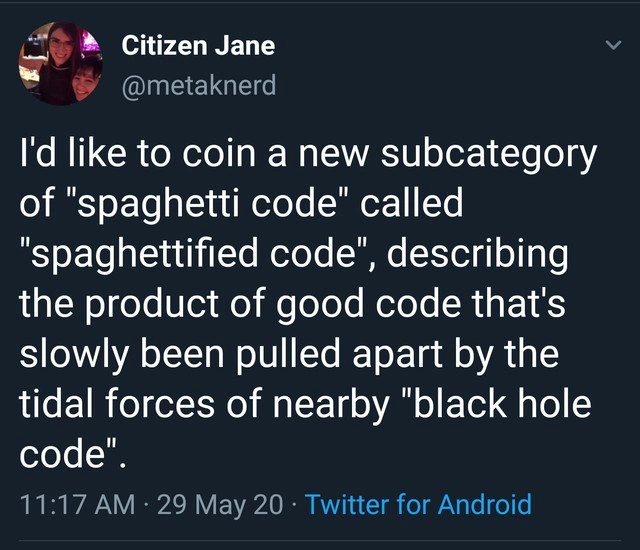
A screenshot of a tweet from user Citizen Jane (@metaknerd). The tweet reads: 'I'd like to coin a new subcategory of "spaghetti code" called "spaghettified code", describing the product of good code that's slowly been pulled apart by the tidal forces of nearby "black hole code".' The tweet was posted on May 29, 2020. This post introduces a clever and insightful metaphor for a specific type of code degradation. It uses the astrophysics concept of spaghettification - where an object is stretched apart by a black hole's gravity - to describe how a well-structured piece of code can become tangled and unmaintainable when forced to integrate with a large, poorly designed legacy system (the 'black hole code'). This concept is highly relatable to senior engineers who have witnessed their clean code's architecture erode over time due to the gravitational pull of technical debt in other parts of the system

Comments
7Comment deleted
Every legacy codebase has a 'black hole' module. Its gravity is so strong that not even light (documentation) can escape, and any new code that gets too close gets spaghettified into an unreadable mess
The billing module crossed its Schwarzschild radius last quarter - any well-structured PR that drifts within two directories gets spaghettified past the git-blame event horizon
The real tragedy isn't the spaghettified code itself, it's watching your perfectly abstracted service layer slowly add seventeen different workarounds for that one critical legacy module nobody's allowed to touch because Dave from 2008 hardcoded the CEO's email in it
This brilliantly captures the phenomenon every senior engineer has witnessed: you inherit a pristine microservice with clean architecture, SOLID principles, and 90% test coverage. Six months later, after 'just a few quick fixes' to integrate with that legacy monolith everyone's afraid to touch, your beautiful code has been stretched into an unrecognizable mess by the gravitational pull of the 200K-line God class with cyclomatic complexity approaching infinity. The event horizon is when you realize refactoring would take longer than a complete rewrite, but the business will never approve either
Spaghettification is what happens after three quarters of “temporary” utils, a god object, and a microservices migration that still orbits the monolith - nothing escapes the Common module’s gravity well
Our core repo is a black hole: sprints dilate at the event horizon, logs never escape, and any clean module crossing it spaghettifies into a 900-line Utils
Spaghettified code: LGTMs acting as tidal forces, turning pristine lambdas into an event horizon of untraceable side effects