Software Evolution: From Clean Architecture to a Tangled Mess
Why is this TechDebt meme funny?
Level 1: Tidy to Tangled
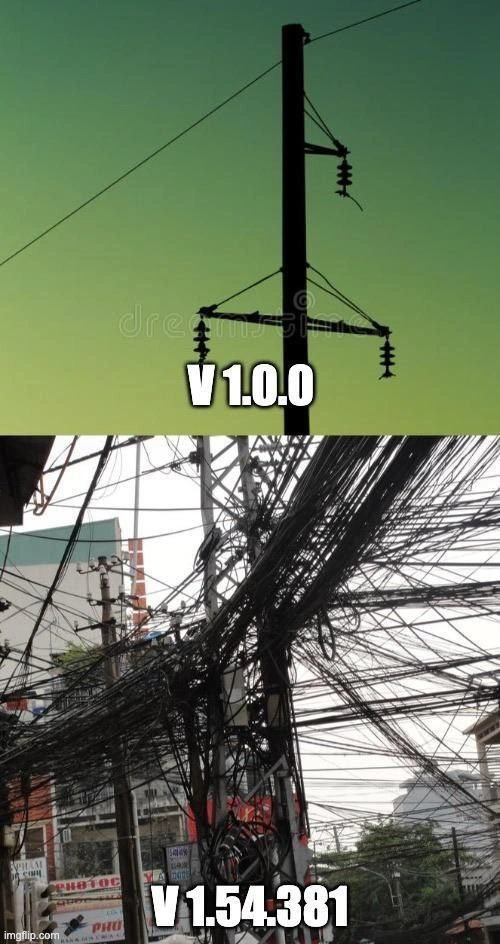
Imagine you built a simple little tower of blocks. In the beginning, it’s just three blocks stacked nicely – super neat and stable. That’s like the first version of a program: clean and simple. Now, as time goes on, you keep sticking more and more blocks and toys onto that tower, without ever removing or rearranging anything. Eventually, your once tidy tower is this huge, wobbly heap of pieces going in every direction. It’s messy, it’s hard to tell how it even stays up, and one wrong move might make it all fall. That’s what happened here with the code. The meme is showing a before-and-after: first, a nice orderly setup (only a few wires = easy to manage), and later, a crazy tangled mess (tons of wires all knotted up = hard to manage). It’s like cleaning your room on day one, versus never cleaning it for a year while you keep throwing new toys and clothes on the floor. By the end, you can’t see the floor because it’s covered in stuff! In the same way, a program that starts simple can turn into a jumbled mess after adding lots of new things without cleaning up. The picture is funny because the “before” and “after” are so dramatically different. It’s basically saying: the more things you keep adding without organization, the messier it gets – and that’s true whether it’s wires, toys, or code!
Level 2: Spaghetti Code City
Now let’s break this down in simpler terms. The meme compares two stages of a project: an early Version 1.0.0 and a much later Version 1.54.381. Those numbers are written in a format called semantic versioning (Major.Minor.Patch). Version 1.0.0 typically means “our first official release” – the product is new, and the code inside is often relatively simple and clean. In the image, this is shown as a single utility pole with just three neat wires. Fewer wires = simpler system. The second panel is labeled 1.54.381, which implies this software has gone through 54 minor updates and 381 patch fixes since the initial release! That’s an extreme example of version sprawl, but it gets the idea across: over time, many changes have been made. The picture for v1.54.381 shows a city street pole practically drowning in a chaotic mass of criss-crossed cables. So, what is it telling us? Essentially, the code has turned into a tangled mess.
In software, when we say code is “spaghetti code”, we mean it’s all tangled up, hard to follow, and has a structure as messy as a bowl of spaghetti. In the meme, those knots of wires are a perfect metaphor for spaghetti code. Early on (v1.0.0), the design was likely straightforward – maybe the project had only a few components talking to each other in a clear way (like those few straight wires). But as new features were added and quick fixes applied (each new version from 1.1.0, 1.2.0, ... all the way to 1.54.381), the codebase just kept growing in complexity. Perhaps every new feature meant connecting another module or special case into the program – like stringing a new wire each time. Without reorganizing or simplifying, all those connections pile up. By version 1.54.381, the software probably has a ton of modules and logic paths, many of which depend on each other in convoluted ways (analogous to those hundreds of cables wrapping around the pole). This is what we call codebase complexity – the system has so many intertwined parts that it’s difficult to understand or change any one piece in isolation.
Let’s talk about technical debt in simple terms: it’s like taking shortcuts in code – maybe skipping proper design or not refactoring a quick fix – which makes the code “messier.” It’s called a debt because those shortcuts make future development harder, just like real debt makes future finances harder. Over time, technical debt accumulates interest: you end up spending more and more time dealing with the consequences of those earlier shortcuts (for example, debugging weird issues or adding even more code to patch the holes). In our meme’s story, by version 1.54.x, the team likely accumulated a lot of technical debt. Every patch (the third number in the version) might have been a quick fix slapped on without cleaning up, and each minor release (the second number) added new features that perhaps weren’t perfectly integrated. All this would lead to poor code quality by the end – meaning the code is harder to read, maintain, and trust. You can imagine new developers joining that project and feeling totally lost in that jungle of wires (code).
Think of it like this: suppose you started with a simple app that does one thing well. Over time, people ask for new features, and you keep adding them. “Oh, can we also have a report generator? Sure.” Add one more module. “We found a bug in the login – quick, patch it!” Add a quick check somewhere. “Now can it integrate with email and calendars?” Add two more connections. If you never take time to reorganize or trim down the unnecessary parts, you end up with an app that does a lot but has a really convoluted inner structure. It’s over-engineered in the sense that it has way more going on under the hood than a clean design would have, and dependency-laden meaning it might rely on a bunch of external libraries or modules all wired together. The versioning tells the tale: by v1.54.381, this project must have gone through countless revisions. Without a moment to breathe and refactor, the result is a giant hairball of code. The meme is basically a warning (with humor): “Look what can happen to your beautifully clean code after too many versions!” Seasoned devs laugh (perhaps a bit ruefully) because they’ve seen initially clean projects turn into unrecognizable tangles as features pile on. Newer devs can learn the underlying message: keep an eye on code quality as you add features, or else your code might end up as crazy as that pole with a million wires.
Level 3: Big Ball of Mud
From a senior developer’s perspective, this meme hits painfully close to home. It’s depicting the classic trajectory of a codebase that started as a clean, elegant design (version 1.0.0) and over time morphed into a spaghetti code nightmare (by version 1.54.381). The top panel’s neatly strung wires are like a brand-new project with just a few modules communicating – simple, focused, nothing extraneous. But fast-forward through dozens of minor updates and hundreds of patches, and you get that bottom scene: a utility pole drowning in a grotesque overgrowth of cables. This is a visual metaphor for a "big ball of mud" architecture – an infamous term for systems with haphazard structure and tangled dependencies. Every experienced coder has seen this happen: the codebase acquires new features and bug fixes in each release, but nobody has time to properly refactor or untangle the design. Deadlines loom, so we keep duct-taping new wires onto the pole. Over 54 minor versions and 381 patch releases, those once-straight lines of code have turned into a knotted mess. Why? Scope creep and feature creep are big culprits – that tendency for the project to keep expanding beyond its initial scope (just like a city’s wiring grid expanding without a plan, leading to a snarled cluster of wires). By v1.54.x, the product likely does way more than it did at v1.0.0, but much of it was bolted on in ad-hoc ways. Each quick fix (patch) added another little branch in the logic; each new feature (minor release) introduced new modules or special-case code paths. Without careful architecture oversight, these additions start interacting in unpredictable ways, forming a dense web of dependencies. Hence the wire tangle metaphor – it perfectly represents how classes, functions, and modules in a legacy system can end up insanely intertwined (“spaghetti code city” vibes).
Importantly, the semantic version jump from 1.0.0 to 1.54.381 also implies the team never opted for a clean-slate v2.0.0 rewrite. They clung to major version 1, likely for backward compatibility or fear of breaking things, and just kept cranking out minors and patches. In practice, that often means no major refactor ever happened – the original structure had to accommodate everything thrown at it. Over time, this drives CodeQuality into the ground. Imagine all those cables as dependencies and quick hacks: a new library here, a plugin there, copy-pasted code for that one client’s request, a global flag to toggle some experimental module – it accumulates. The result is a lot of technical debt: all the “We'll fix it later” decisions from the past are now the maintainers’ daily headache. By version 1.54.381, making a simple change might require navigating a rat’s nest of function calls and side effects. Every part of the system is so tightly coupled (like wires twisted together) that touching one thing risks bringing down something else across the street. The humor is in the absurdity: we all fantasize about that pristine Version 1 release where everything is beautifully engineered… and then reality punches our perfect architecture in the face, release after release. The meme captures that contrast visually – the purity of v1.0.0 versus the chaotic entropy of v1.54.381. It’s funny because it’s true: given enough versions, any sufficiently complex application starts to look like that sketchy telephone pole that makes you say, “How is this thing even working?!”
To drive it home, consider a simple function from the initial release and what it might look like after countless updates:
// v1.0.0: Clean and simple implementation
function processData(data) {
return transform(data);
}
In the first release, processData is straightforward – one clear responsibility. But as features and bug fixes accumulate, that same function grows more arms and legs:
// v1.54.381: Overgrown with patches and features
function processData(data) {
// Quick patch: support legacy format (added in v1.12.0)
if (typeof data === 'string') {
data = parseData(data);
}
// New feature toggle (added in v1.30.0)
if (config.enableExtraMode) {
data = extraTransform(data);
}
// Bug fix: handle missing data (patched in v1.40.5)
if (!data) {
return getDefaultValue();
}
return transform(data);
}
Now processData has to handle legacy input types, optional new behaviors, and guard against nulls – all those conditions piled on through dozens of versions. It’s not atrocious by itself, but imagine hundreds of such functions, plus interdependent modules all compensating for each other’s quirks. The codebase turns into a fragile Jenga tower of workarounds and add-ons. This growth of release complexity is what the meme humorously illustrates. Seasoned devs chuckle (or maybe groan) at the meme because they’ve lived this: the proud, minimalist v1.0 design slowly collapsing under the weight of unrelenting enhancements and bugfix patches. It’s a mix of dark humor and cautionary tale – a reminder that without periodic cleanup and paying down technical debt, any project can become that infamous tangle of wires nobody wants to touch.
Level 4: The Thermodynamics of Code
At the most theoretical level, this meme is a lesson in software entropy. Just as physical systems tend toward disorder (the second law of thermodynamics), codebases tend toward complexity unless we expend energy (refactoring effort) to impose order. In the 1970s, Meir Lehman formulated laws of software evolution; one law essentially says that complexity (codebase complexity) increases over time unless active work is done to reduce it. In other words, a clean initial architecture will inexorably slide into chaos if you keep piling on changes without restructuring – exactly what the image humorously depicts. The top image with a few straight wires symbolizes a low-entropy system (simple, well-organized clean architecture). The bottom image’s nightmare jumble of cables represents a high-entropy system where everything is tangled. This isn't just metaphor – it’s practically a fundamental law of long-lived software. Each new feature, quick fix, or dependency adds a bit of accidental complexity. Over dozens of releases, these bits accumulate into a snarled web of interconnected modules (much like those hopelessly knotted wires). The meme exaggerates the version sprawl (v1.0.0 → v1.54.381) to drive the point home: many small iterative changes can snowball into a giant ball-of-mud system. Interestingly, the decision to stay on major version 1 (never releasing a v2.0 with a clean slate) means backward compatibility was maintained at all costs, allowing entropy to keep increasing internally. The joke nails a truth seasoned engineers know well: without periodic redesign, software complexity only moves in one direction – toward disorder – as features are bolted on. It’s essentially the Thermodynamics of Code: if you don’t refactor, chaos wins. Even the concept of Technical Debt (coined by Ward Cunningham) reflects this academic idea – shortcuts taken early on accrue “interest” in the form of added complexity later. By version 1.54.381, that interest has compounded into a sprawling tangle of logic and connections. In short, the meme illustrates a kind of inevitable code entropy, a fate that can be postponed (with good practices) but, humorously, appears as unescapable as gravity in long-lived projects.
Description
A two-panel 'before and after' meme that uses electrical utility poles as a metaphor for software evolution. The top panel, labeled 'V 1.0.0', shows a clean, simple silhouette of a utility pole with a single, straight wire against a clear green sky, representing the initial, clean release of a product. The bottom panel, labeled 'V 1.54.381', depicts a real-world utility pole completely engulfed in a chaotic, tangled mess of countless black cables, signifying a mature product that has accumulated significant technical debt after numerous updates, patches, and feature additions. The meme humorously and accurately visualizes the concept of software entropy, where a system's complexity and disorder increase over time without dedicated refactoring and maintenance
Comments
7Comment deleted
Version 1.0.0 was a beautiful microservice. Version 1.54.381 is a distributed monolith held together by undocumented dependencies, a single CI script nobody dares to touch, and the sheer willpower of one engineer who left the company three years ago
v1.0.0: one repo, three clean services. v1.54.381: thirty-eight microservices, eleven orphaned feature flags, circular Kafka topics, and a deploy script so tangled it needs its own incident runbook - compound interest, but for technical debt
After 154 minor versions and 381 patches, we've successfully transformed our elegant microservice into a distributed monolith with more circular dependencies than a Bangkok power grid - but hey, at least we maintained backward compatibility with that one customer still running IE6
Ah yes, the classic journey from 'elegant monolith with clear separation of concerns' to 'we can't remove this dependency because it's load-bearing for seventeen other services we forgot existed.' V1.0.0 was three microservices and a dream; V1.54.381 is a distributed system held together by duct tape, prayer, and that one engineer who's been here since the beginning and is the only person who understands why the authentication service talks to the logging database. Every minor version added 'just one small feature' and 'a quick workaround' until the dependency graph looks like a bowl of ramen and the onboarding docs start with 'first, let me tell you about the dark times before Kubernetes.' The real kicker? It still works in production, and nobody dares touch it because the last time someone tried to refactor, they discovered the payment system depends on a race condition that's been there since V1.2.7
SemVer says patches shouldn’t add features; by 1.54.381 we’d accidentally evolved a service mesh - and the rollback plan is “don’t touch any wire.”
V1.0: Clean monolith. V1.54.381: 'It works on my machine' distributed regret after skipping every major refactor
SemVer IRL: v1.0.0 is architecture; v1.54.381 is archaeology - every “temporary” hotfix, vendor SDK, and feature flag fossilized into a production wiring harness we now call backward compatibility