
Bugs Post #4803 · source on Telegram
When a Simple Bug Fix Turns Into a Major Refactor
Description
A meme using the 'Domino Effect' meme format. A small domino is labeled 'Fixing a simple bug.' A series of increasingly larger dominoes are labeled with things like 'Realizing the bug is in a legacy module,' 'Discovering the module has no tests,' 'Finding out the original developer left the company 5 years ago,' and 'Deciding to rewrite the entire module from scratch.' The final, giant domino is labeled 'Spending the next 3 months on a massive refactoring project.' This meme perfectly captures the 'yak shaving' that can occur when a seemingly simple task snowballs into a much larger project. Senior developers are all too familiar with this scenario, and have learned to be wary of 'simple' bug fixes in legacy code



More like this
More like this in Bugs →
Use J and K for navigation
Comments
7Comment deleted
The best way to avoid a yak shave is to never fix a bug in the first place
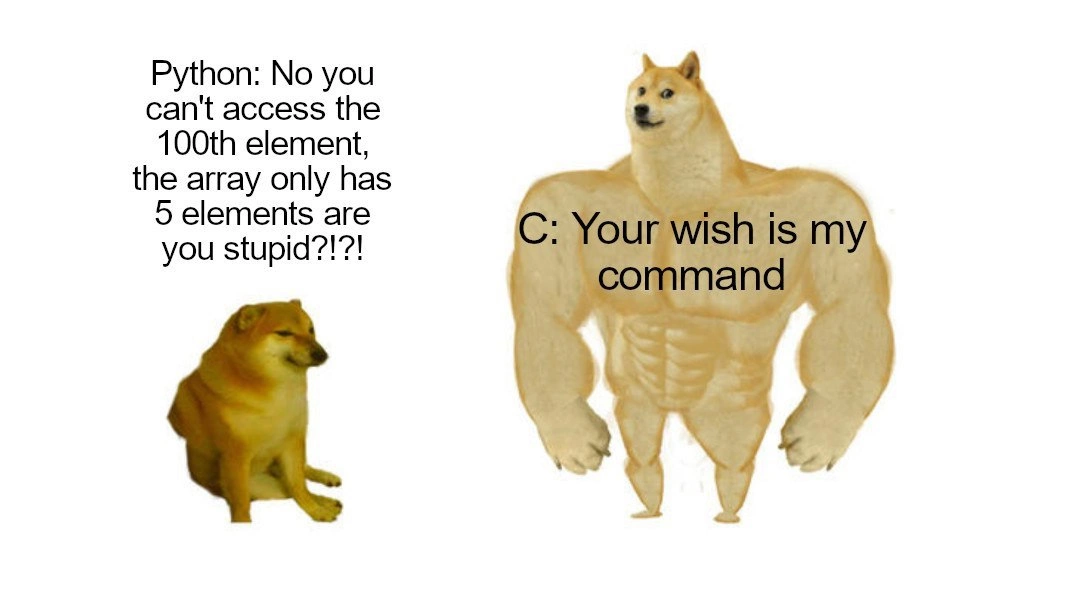
Python slaps you with IndexError; C quietly hands you whatever’s after the array and schedules the post-mortem for 3 AM - performance is just undefined behavior that hasn’t paged you yet
C giving you undefined behavior is just its way of implementing eventual consistency across your entire address space
Ah yes, the eternal dichotomy: Python treats you like a junior dev with training wheels, throwing IndexError exceptions when you try to access array[99] in a 5-element array. Meanwhile, C is that grizzled systems programmer who hands you a loaded gun (raw pointer) and says 'sure, go ahead and dereference whatever address you want - I'm not your babysitter.' Python's bounds checking is the language equivalent of 'we need to talk about your life choices,' while C just shrugs and lets you walk off the cliff into undefined behavior territory, potentially overwriting the stack, corrupting heap metadata, or summoning nasal demons. The real kicker? Both approaches are 'correct' for their use cases - Python prioritizes developer safety and rapid iteration, while C gives you the rope to either climb to performance nirvana or hang yourself with a buffer overflow. Senior engineers know the punchline: the segfault you get at 3 AM in production because someone forgot array bounds in C is exactly why we invented languages with runtime checks, but also why embedded systems still run C - because sometimes you need that raw, unfiltered access to memory, consequences be damned
Python babysits your indices; C hands you the pointer and a prayer for no Valgrind fireworks
Bounds checking is a runtime error in Python; in C it’s a social construct - until ASan shows up with receipts
Python throws IndexError; C lets arr[100] compile - then defers the exception to prod as “undefined behavior,” delivered via the SRE’s pager