Skip to content
DevMeme
4389 of 7435
When You're Trying to Concentrate But Keep Getting Interrupted
DeveloperProductivity Post #4804, on Aug 15, 2022 in TG

When You're Trying to Concentrate But Keep Getting Interrupted

Why is this DeveloperProductivity meme funny?

Level 1: Overthinking a Name

Imagine your friend’s dad loves rules so much that even when naming their new baby, he acts like he's following a secret rulebook. He doesn’t want to name the baby "Mary-Jane" with a hyphen, even though that’s a totally normal way to write it. Instead, he wants it to be MaryJane (all one word) or mary_jane (with an underscore line). He’s so serious about this that he covers an entire wall with papers and strings, trying to prove why his way is better – like he’s solving a big, crazy mystery! It’s funny because picking a baby’s name is usually about what sounds nice or has meaning, but this dad is treating it like a huge puzzle or a coding problem. He’s basically turning something simple into something super complicated. The joke is that he cares way too much about a little detail (the punctuation in the name) that most people wouldn’t worry about. Even if you don’t know anything about coding, you can laugh at how silly it is: it’s as if he’s saying the baby’s name has to follow some nerdy formatting rule. In simple terms, the dad is overthinking the name so much that it becomes ridiculous – and that’s why it’s funny!

Level 2: Snake vs Camel vs Kebab

Let’s break down the naming styles at the heart of this meme. In programming, a naming convention is a set of rules for how to format names of things like variables, functions, or files. Consistent naming is part of good coding practice because it makes code easier to read and understand. Here are the three “name styles” being joked about, using "Mary Jane" as the base name:

  • snake_case – Written in all lowercase with underscores between words, like mary_jane. This style is common in languages like Python (per PEP 8 style guide), Ruby, and C for variable_names and function_names. The underscores act like spaces, making multi-word names readable. It’s called "snake case" because the underscore characters kind of resemble a snake slithering along the ground connecting the words. 🐍
  • CamelCase – Written with no spaces or underscores, and each word after the first starts with a capital letter. For example, MaryJane or in typical variable form maryJane. The capital letters in the middle are like the humps of a camel’s back – that’s where the name comes from! This style (specifically lowerCamelCase where the first letter is lowercase, e.g., maryJane) is often seen in Java, JavaScript, and C# for variables and method names. A variant is PascalCase (upper camel case) where even the first letter is capital, often used for Class names (e.g., MaryJane as a class or component name).
  • kebab-case – Written in lowercase with hyphens (-) between words, like mary-jane. The name “kebab case” is a fun nickname: the hyphens look like a skewer sticking through the words, like pieces of meat on a kebab stick. This style is not used in most programming languages for variable names because the - character is reserved (in virtually all languages, - means the subtraction operator). However, kebab-case does appear in contexts like URLs, CSS class names (e.g., main-content in HTML/CSS), and sometimes file or folder names.

In the meme, the husband (a developer) is effectively treating baby names as variables in code. The normal way to write the name would be "Mary-Jane" (with a hyphen, as often seen in English for double names), but to a programmer’s eye that hyphen is problematic or “incorrect” in a way that’s hard to unsee. He proposes mary_jane or MaryJane instead, which follow programming-friendly naming styles. It’s as if he wants his baby’s name to comply with a code style guide! In a dev team, you might have a document or linter rules that say “use snake_case for variable names” or “use CamelCase for class names”. Here, he’s applying those same CodeQuality rules at home.

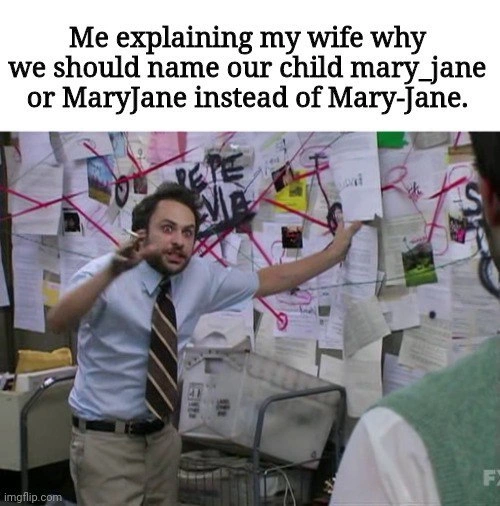
The image of the man gesturing at a chaotic board with red strings is actually a famous meme format. It comes from a TV show scene where the character (played by Charlie Day) is wildly showing a conspiracy theory he’s concocted. In developer circles, this image is used to poke fun at ourselves when we get way too deep explaining something complicated or obsessive. The red yarn connecting pins on the board symbolizes how he's linking every tiny detail to build his grand explanation. In the context of this joke, he might have pinned printouts of style guide documents, code screenshots, and examples of why one should never use hyphens in names – all connected with red thread like he’s uncovering a huge scandal (conspiracy_board_explanation). Meanwhile, his poor wife (seen from behind, listening) represents the bewildered non-tech person who just wanted a nice baby name and instead got a lecture on variable naming syntax.

For a junior developer or someone new to coding, the humor also lies in how seriously developers can take these small decisions. Naming things in code is actually important: a clear, consistent name can make code easier to maintain. That’s part of improving the Developer Experience (DX) on a project – future developers (and your future self) can read the code without stumbling over inconsistent naming. But this meme is laughing at the extremes: normally you wouldn’t justify a baby’s name with a full-on tech presentation. By understanding the terms (snake_case vs CamelCase vs kebab-case) and how each is used, you can see why the programmer feels so strongly. In his mind, “Mary-Jane” with a hyphen just violates the rules he follows 8 hours a day at work. The clash between tech logic and normal life is what makes it funny. Even if you’re new to coding, you probably sense that writing Mary-Jane in a program might cause an error. And you’re right – try naming a variable Mary-Jane in Python or Java and the computer will get confused because it thinks you mean Mary minus Jane! So our dev dad is basically saying: “Honey, that name just doesn’t compile for me.” It’s an absurdly literal take on naming, played for laughs.

Level 3: Bikeshedding Baby Names

Developers are notorious for obsessing over naming conventions – to the point that it becomes a running joke in tech. This meme exaggerates that obsession by carrying it into real life. It shows a frantic programmer treating the choice of his baby's name like a heated code review discussion. In the caption, he’s insisting on writing the name as mary_jane or MaryJane instead of the normal "Mary-Jane". To non-devs, that looks hilariously over-the-top, but any seasoned coder can recognize the pattern: this is classic bikeshedding over formatting, just taken out of the office and into the nursery.

Why is this so funny to experienced devs? Because we’ve all been in those debates that feel as convoluted as a conspiracy theory. The image – Charlie Day from "It’s Always Sunny in Philadelphia" gesturing manically at a wall of notes and red strings – nails the vibe of a programmer passionately justifying a trivial preference. In real projects, tiny style issues like snake_case vs. CamelCase (underscores_between_words vs. CapitalizingEachWord) can spark surprisingly long arguments. Teams might spend an hour in a meeting or dozens of messages on Slack deciding whether their JSON keys or function names should use under_scores or CamelCase. It’s the infamous paradox of software development: naming things should be simple, yet it’s one of the hardest problems (“There are only two hard things in Computer Science: cache invalidation and naming things.” as the old joke goes). So when this dad-to-be starts a NamingConventions crusade over his child's name, developers see a reflection of their own overly zealous moments. It’s an absurd scenario rooted in a very real developer experience – deeply relatable to anyone who has nitpicked a variable name during a code review.

On a technical level, the meme highlights the snake_case vs CamelCase vs kebab-case battle that many coders know well. Different programming languages and frameworks have different style guides: for example, Python and Ruby communities prefer snake_case for variable names, while Java and JavaScript often use camelCase (or PascalCase for class names, like MaryJane). Hyphenated or kebab-case names (mary-jane) are common in contexts like CSS classes or data-attributes in HTML, but are actually invalid in most programming languages for variable names – a hyphen would be read as a minus sign by the compiler! So when our intrepid developer-dad vetoes "Mary-Jane", he's treating his future daughter's name like a code identifier that has to pass a linter. It’s as if he’s worried the hyphen will throw a syntax error in the CodeQuality checker of life. The humor here is that he’s so steeped in developer thinking that even his baby-naming process becomes an exercise in code style correctness. It’s a jab at how programmers can sometimes carry itsy-bitsy technical fixations into absurd places.

To a senior developer, the scene also brings to mind Parkinson’s Law of Triviality (a.k.a. bikeshedding): the tendency to give disproportionate weight to trivial issues. Debating variable naming or brace styles is safe territory – everyone has an opinion and it doesn’t require deep domain knowledge, so it often gets more attention than it deserves. In real-life dev culture, we’ve seen passionate threads about whether to use tabs or spaces, or whether a function should be named get_user_name vs getUserName. Here that minutiae-fanaticism is lampooned by showing a guy basically performing a whiteboard lecture to his baffled wife about baby name formatting. The red yarn on the conspiracy board in the meme image hilariously represents the mental gymnastics and elaborate justifications behind something as simple as “no hyphen, please.” It’s a DeveloperHumor masterpiece because it takes an internal software-team squabble – the kind of thing that might happen in a pull request comment or an architecture meeting – and plops it into domestic life. The result is absurdity that rings true: we laugh because we’ve either been that person, or worked with that person, who just cannot let go of an aesthetic code detail. In short, the meme is poking fun at our penchant for turning even a baby-naming discussion into a full-on design review, complete with charts, proofs, and a borderline insane level of enthusiasm for something most people would find trivial.

Description

A meme showing a person trying to meditate, but being constantly interrupted by a series of annoying notifications. The person is sitting in a serene and peaceful setting, but the notifications are popping up all around them, with messages like 'New email,' 'Slack message,' 'Jira update,' and 'Meeting reminder.' The person is trying to ignore the notifications and focus on their meditation, but they are clearly becoming more and more agitated. This is a relatable scenario for any developer who has tried to get into a state of 'flow,' only to be constantly interrupted by the demands of a modern work environment. Senior developers, in particular, can appreciate the importance of uninterrupted time for deep work, and the frustration of being constantly pulled out of the zone

Comments

7
Anonymous ★ Top Pick I've started using the Pomodoro Technique, but I've modified it slightly. I work for 25 minutes, and then I get interrupted for 5 minutes. Then I work for another 25 minutes, and then I get interrupted for another 5 minutes...
  1. Anonymous ★ Top Pick

    I've started using the Pomodoro Technique, but I've modified it slightly. I work for 25 minutes, and then I get interrupted for 5 minutes. Then I work for another 25 minutes, and then I get interrupted for another 5 minutes...

  2. Anonymous

    “Mary-Jane? Hyphens are just cache-invalidation bugs in human form - let’s ship her as mary_jane and spare future SREs (a.k.a. school admins) the post-mortem.”

  3. Anonymous

    Wait until she finds out you've already registered the GitHub username and npm package name just in case

  4. Anonymous

    When you've spent 15 years enforcing linting rules and now you're genuinely concerned that 'Mary-Jane' won't pass your family's CI/CD pipeline because hyphens aren't valid identifiers in most languages. Meanwhile, your wife is wondering if she married a human or a particularly verbose ESLint configuration

  5. Anonymous

    Kebab-case baby name? That's eighteen years of technical debt compounding till college

  6. Anonymous

    Mary-Jane? That’s kebab-case - great for CSS, but I’d prefer a kid who doesn’t need quotes in JSON and won’t evaluate to Mary minus Jane in Bash

  7. Anonymous

    Hyphenated first names are fine IRL, but in our stack they evaluate to “Mary” - “Jane”; I’m not raising a subtraction

Use J and K for navigation