The Never-Ending Cycle of Software Updates
Why is this Tooling meme funny?
Level 1: Candy for Chores
Imagine your parent offers you a deal: if you clean your room and do all your chores, they’ll give you a huge bag of candy. You might say, “I want to clean my room because it’ll make it look nice and I’ll learn to be responsible.” That sounds like a smart, grown-up answer, right? But really, deep down, you’re mostly excited about one thing – the big bag of candy! 🍬
This meme is joking about the same idea, but with jobs. Big famous tech companies (like the ones that make your phone or your favorite websites) promise a lot of cool things, like working on neat projects or having fun offices. People often talk about those cool things as the reason they want the job. But the meme says most folks are really thinking about the money they’d get. It’s like Mr. Krabs from SpongeBob – he’s a cartoon character who loves money more than anything. In the picture, when asked why someone would want that fancy job, Mr. Krabs just blurts out “MONEY.” He’s basically saying what a kid might say about chores: I’m doing it for the reward!
So in super simple terms: The meme is funny because it points out that, just like a kid who really just wants the candy for doing chores, adults sometimes really just want the big paycheck for doing a job – even if they pretend it’s for other reasons. It’s a silly way to tell the truth that many people think but don’t always say out loud.
Level 2: Big Tech, Big Bucks
Let’s break down the key pieces for a newer developer or someone outside the industry. FAANG is an acronym for five powerhouse tech companies: Facebook (now called Meta), Amazon, Apple, Netflix, and Google. These companies are famous not just for their products but also for being dream workplaces in tech. People talk about FAANG as the pinnacle of a software engineering career. Why? Well, one big reason is compensation – basically how much you get paid in salary, bonuses, and stock. These firms generate huge profits and competes fiercely for talent, which leads to very high salaries and equity packages (shares of company stock) for employees. In the tech world, it’s well-known that a mid-level engineer at a FAANG might make as much as a fairly senior engineer at a smaller company. This meme’s core joke revolves around that well-known fact: big tech means big bucks.
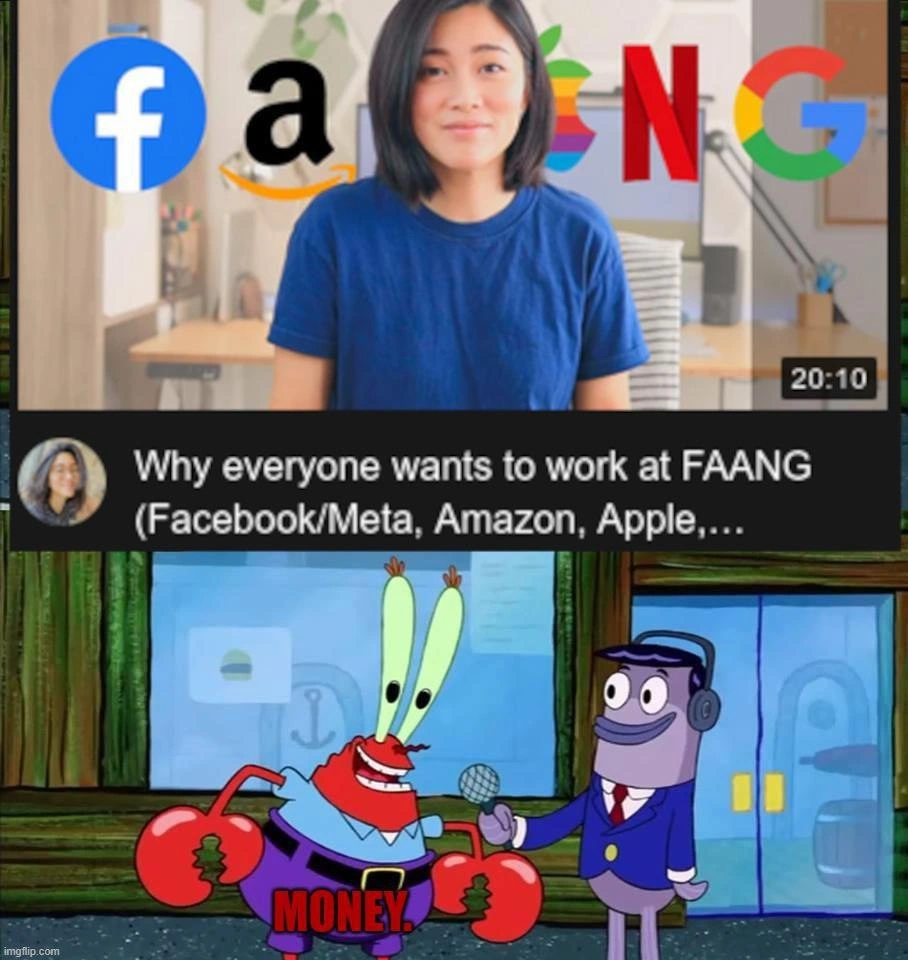
The top half of the meme looks like a YouTube video thumbnail. It shows a friendly presenter in a home office setting, with the word “FAANG” stylized in each company’s branding. The title of the video is “Why everyone wants to work at FAANG (Facebook/Meta, Amazon, Apple, …”, implying the video will list all these reasons people aspire to join those companies. Typically, such reasons might include: exciting projects, great company culture, learning opportunities, prestige of having a famous company on your resume, and so on. This reflects a lot of CareerExpectations for newcomers — there’s a whole cottage industry of career coaches and YouTubers telling you why you should aim for these big names. They often talk about things like changing the world with technology or access to brilliant mentors. That’s the IndustryTrends_Hype side of things, building up FAANG roles as almost magical. It’s also referencing CorporateCulture narratives: every big company loves to say their culture is amazing, their mission is noble, etc., which attracts idealistic applicants.
Now, the bottom half is a scene from SpongeBob SquarePants, a popular cartoon. The character in focus is Mr. Krabs (the red crab with big claws). In the show, Mr. Krabs is obsessed with money – it’s a running joke that he’ll do almost anything to get more money or save a dime. The image shows Mr. Krabs being interviewed by a fish reporter outside his restaurant (the Krusty Krab). The reporter is holding a microphone, as if asking “Why do people want to work at FAANG?” or maybe “What’s so great about this job?”. Mr. Krabs’ answer is shown simply as “MONEY.” in bold red text right under him. This is a classic meme format where you have a setup (in this case, a complex question or a clickbait video topic) and then a punchline (a very straightforward answer). Here the punchline is that after all the talk about fancy reasons, it really just comes down to money.
This hits home for developers because FAANG companies are known for huge salaries and benefits. There are entire websites and forums where people discuss faang_compensation packages and compare offers. For example, a new grad at Google or Amazon can earn a total compensation much higher than at a small startup. A senior engineer at Apple or Meta might have a salary plus stock grants that peak into the several hundreds of thousands of dollars per year. These are sometimes called “big tech salaries” and they set the standard in the industry. Hearing about those numbers makes many devs dream of landing such a job. So when someone asks “Why do you want to work at Google (or any FAANG)?”, even if we say things like “I admire the technology and the culture,” a lot of us are also thinking “Well, it would secure me financially!”
The meme uses Mr. Krabs saying “MONEY” as a funny, slightly cynical answer. It implies that many developers, deep down, prioritize the paycheck (and possibly the stock that could grow in value) over the other factors. It’s not that those other factors aren’t real or important – FAANG companies do work on cool problems and often have nice perks (free meals, nice offices, etc.). But the joke is that the primary motivation for “dreaming about FAANG jobs” can be boiled down to dollars. After all, Mr. Krabs is a cartoon character known for being pretty one-track-minded about money, and putting that trait onto developers is an exaggeration for comic effect. Still, it resonates because many developers have at least considered the financial boost of a FAANG job.
In simpler terms: the top image represents all the fancy talk and reasons people claim they want a big tech job. The bottom image says, “Actually, it’s just the high salary.” This contrast is what makes it funny – it’s pointing out an uncomfortable or less noble truth in a lighthearted way. If you’re new to tech, the meme is basically teaching you a bit of insider cynicism: big tech jobs pay a lot, and that’s often the elephant in the room when people gush about wanting them.
Level 3: Prestige vs Paycheck
The meme wittily juxtaposes corporate hype with blunt reality. In the top panel, we see a polished YouTube-style thumbnail titled “Why everyone wants to work at FAANG (Facebook/Meta, Amazon, Apple, …)”. It's the kind of video that promises 20 minutes of career wisdom about innovation, impact, and prestige at big tech companies. Each letter of FAANG is rendered in its company’s iconic style (the blue Facebook F, Amazon’s orange a with the smile, the Apple logo for the next A, Netflix’s red N, and Google’s multicolor G), emphasizing the brand-name allure. This top image satirizes how the tech industry wraps Career_HR advice in flashy visuals and inspirational fluff. We’ve got the IndustryTrends_Hype of chasing FAANGCompanies jobs, complete with a friendly vlogger face and a timestamp, as if there’s so much to say. But then comes the punchline: the bottom panel cuts through the noise with a classic SpongeBob scene. Mr. Krabs, famously obsessed with money, is being interviewed outside the Krusty Krab. The reporter fish asks a question (implied off-screen), and Mr. Krabs’ answer is emblazoned in bold red text: “MONEY.” 🦀💰 This single word bluntly answers Why everyone wants to work at FAANG. No lengthy explanation about world-changing missions or cutting-edge tech. Just “MONEY.”
This speaks to senior engineers who’ve been around the block. We’ve sat through countless town halls and recruiting videos where executives drone on about “empowering the planet” or “innovative culture”. But let’s be real: those lofty narratives often mask the elephant in the room — the big_tech_salaries. The meme resonates as CareerHumor because it confirms what many experienced devs joke about privately. FAANG compensation has become almost mythical, with base salaries, hefty bonuses, and eye-popping equity packages that dwarf what most companies offer. The term “glass-ceiling salaries” in the description hints that at non-FAANG places, you eventually hit a pay cap no matter how good you are. Meanwhile, a senior engineer switching into a FAANG role might suddenly double their total compensation, thanks to generous RSUs (restricted stock units) and refreshers (yearly stock grants). It’s a night-and-day difference that everyone in the industry is acutely aware of.
So the meme’s humor lies in calling out the obvious: despite all the CorporateCulture talk of “prestige” and “working with the smartest minds”, a huge motivator is the potential payday. It’s a TechIndustryHumor reality check. Everyone talks about wanting to solve big problems at scale, but it doesn’t hurt that doing so at Google or Amazon also comes with a seven-figure stock plan. The SpongeBob reference is perfect here: Mr. Krabs is a caricature of greed, and he’s basically the inner voice of many developers when they hear FAANG job offer. It’s a darkly funny acknowledgment: sure, the projects are cool and the resume sparkle is nice, but the pay — the MONEY — is the real hook. Senior devs chuckle because they’ve seen colleagues jump ship for offers that include life-changing amounts of equity. They know that for all the idealistic chatter, when a recruiter asks “Why are you interested in BigTech Corp?”, most folks are internally echoing Mr. Krabs.
Entire online communities and tools (like levels.fyi, which tracks salary data) exist because of this exact phenomenon. There’s an almost folk knowledge that FAANG = high compensation. The acronym itself became famous not just for the companies’ influence but for their pay packages and perks. There’s even a bit of an arms race in offers – startups brag about “we pay at least 90th percentile of FAANG” to lure talent, and candidates use a Facebook offer to negotiate a higher Google offer, and so on. It’s a cycle that veterans recognize. The meme distills that cycle into one word. It’s hilariously true-to-life that after all the interviewing hoops and the big decision to maybe uproot your life for a FAANG gig, the justification can often be as simple as a hefty direct deposit every two weeks.
In short, the meme is saying: The real reason developers dream of FAANG isn’t the free gourmet meals or the fancy projects or the resume clout. Those are nice, but they’re icing. The cake is cold hard cash (and stock). It’s poking fun at the contrast between the IndustryTrends marketing (top panel’s verbose video title) and the actual CareerExpectations reality (bottom panel’s Mr. Krabs yelling “MONEY”). Seasoned engineers find this funny because it’s an open secret — one often cloaked in polite interview answers about growth and culture. The meme just says it out loud.
Description
A meme showing a person trying to relax on a couch, but being constantly bothered by a series of software update notifications. The notifications are for all sorts of different software, from the operating system to the web browser to the text editor. The person is getting more and more annoyed as the notifications keep popping up. The meme is a humorous take on the never-ending cycle of software updates that we all have to deal with. It's a relatable experience for anyone who uses a computer, but it's especially relevant for developers, who are often working with a large number of different tools and technologies. Senior developers, in particular, can appreciate the irony of being a software developer and still being annoyed by software updates

Comments
7Comment deleted
I have a love-hate relationship with software updates. I love the new features, but I hate the fact that I have to spend the next two days fixing all the things that the update broke
When a FAANG recruiter asks what tech stack excites me, I say “RSU” - it shards quarterly, auto-scales with refreshers, and never triggers a Sev-1
After 20 years of optimizing for impact and scale, you realize the most efficient algorithm is still TC = base + RSUs + (soul * 0)
After 15 years in the industry, you realize that all those Medium articles about 'passion-driven development' and 'changing the world through code' at FAANG are really just elaborate justifications for why you're willing to grind LeetCode for three months straight - because at the end of that rainbow isn't just any pot of gold, it's RSUs that vest over four years with a one-year cliff, and a total comp package that finally makes your CS degree's ROI look reasonable
FAANG TC: where RSUs vest reliably, unlike startup equity that ghosts harder than a flaky microservice
During the “Why FAANG?” loop I wax about distributed systems, but the offer spreadsheet performs short‑circuit evaluation to a single value: total compensation
FAANG: we say “impact at scale” - we mean RSUs, sharded over four years with quarterly exactly-once delivery