
Architecture Diagram vs. Implementation Reality
Description
This is a two-panel meme contrasting an idealized software architecture with its complex reality. The top panel is labeled 'How I draw the architecture' and shows a very simple, clean diagram: three circles connected by straight arrows in a neat flow. The bottom panel, labeled 'How it's actually implemented', shows a chaotic explosion of interconnected shapes, icons, and arrows, representing a 'spaghetti architecture'. This tangled diagram includes various cloud service icons, database symbols, and countless overlapping lines, symbolizing the immense and often messy complexity of real-world systems. The humor lies in the stark difference between the elegant design and the convoluted reality, a situation familiar to any experienced engineer who has seen projects evolve with new requirements, quick fixes, and accumulating technical debt
Comments
49Comment deleted
The first diagram is what we show the new hires. The second is what we show the SRE team when they ask why the latency is so high
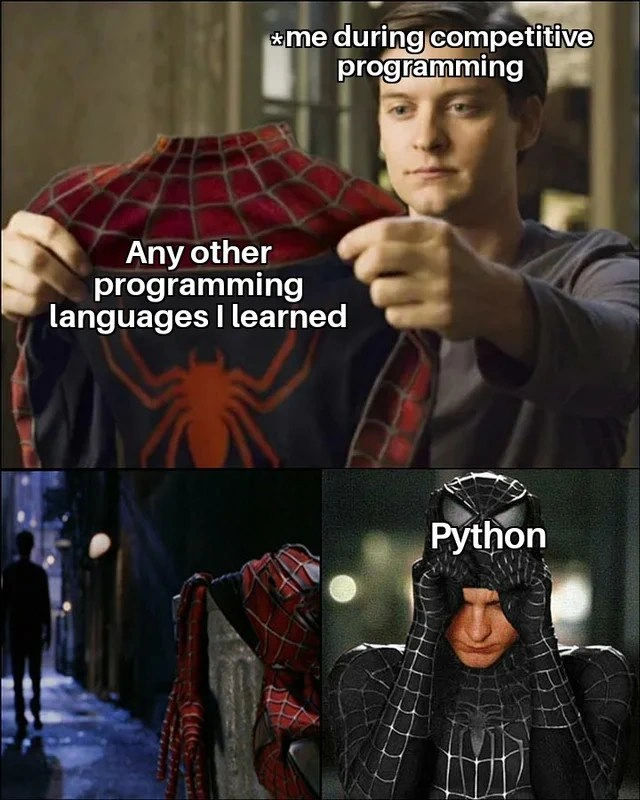
I’ll advocate zero-copy C++ and strict typing all week, but the moment the contest clock shows 2 s, I slip into the black suit called “from collections import *” and pray PyPy’s JIT forgives my O(n³) confession
After 15 years of optimizing C++ templates and hand-tuning assembly, you realize the real competitive advantage in programming contests is typing 'sorted()' instead of implementing quicksort for the 500th time - because apparently, O(n log n) is O(n log n) whether it takes 5 lines or 50
The irony is palpable: you spent years mastering C++ templates, Rust's borrow checker, and Java's enterprise patterns, but when that LeetCode timer starts counting down, suddenly Python's `from collections import defaultdict` becomes your entire personality. It's not that the other languages aren't powerful - it's that when you're racing against the clock to implement Dijkstra's algorithm for the third time this week, nobody has time for manual memory management or verbose type declarations. Python's standard library is basically competitive programming on easy mode, and we've all made peace with that Faustian bargain
Competitive programming: I ditch every language, put on the Python suit, and start writing C++ in an accent - heapq, preallocated arrays, sys.stdin.buffer.readline - just to outrun TLE
Picking Python for competitive programming is the black‑suit move: 10x developer speed, 0.5x runtime - then the judge reminds you that constant factors are part of the system budget
CP pros shed langs like old suits for C++ speed; Python clings symbiote-style, seducing with readability until TLE rips your heart out
It do be like that sometimes Comment deleted
Some still prefer C Comment deleted
except it’s C++ Comment deleted
i was puzzled when pip install asked me for a Rust compiler even Comment deleted
God bless python ) Comment deleted
>>competitive programming >>python Ok Comment deleted
beat me this fall and then start talking Comment deleted
Why tho? I thought STL was richer than other libraries; does python have an equivalent of STL? Comment deleted
python built-ins are way above STL Comment deleted
Like 100-1000× instructions per operation above, yes Comment deleted
Or you never understood how python works or you just didn't really attend programming competitions, like ICPC Except like international competitions when there is no way to find or craft good algh out of STL python Comment deleted
I'm an international master in codeforces if that matters and can say doing competitive programming in Python is effectively shooting yourself in a leg Comment deleted
Looks like someone lied in that message Comment deleted
I know only two grandmasters maining Python, one of them being pajenegod and he uses PyPy with his 100-200 lines template for fast io and data structures Comment deleted
Like guys who use C++ doesn't use pre-templated solutions 😂 Comment deleted
You either copy-paste a template or just type it out with your hands the same way everytime you need to use it Comment deleted
But if the last one is true you wouldn't say this Comment deleted
Thanks, I might give them a more thorough look I've always avoided python for competitive programming because I thought it's not fast enough Comment deleted
Just to impress yourself, ask python to calculate 2 raised to the power of 20000 or something Comment deleted
(until it has a precision error lol) Comment deleted
ew Comment deleted
yo boost MP does that, too ;) Comment deleted
military police? Comment deleted
multiprecision 😁 Comment deleted
ngl haskell best competitive lang Comment deleted
rich std fast execution time high-level Comment deleted
And he usually switches to C++ after div1C or so Comment deleted
Here I would agree! Comment deleted
Such switch could be painful be essential for sustainability of skills growth Comment deleted
But it's usually about advanced algorithms and data structures Comment deleted
Anyway might be helpful for those who's going to do CP in python: https://github.com/cheran-senthil/PyRival/tree/master/pyrival Comment deleted
It's better to implement algorithm by yourself at least once and even better few times, before usage of ready-to-go solutions, but it's up to mind of everyone :) Comment deleted
most competitions do not allow external libs Comment deleted
Those are templates, no external libs Probably Didn't look into it much Comment deleted
well, then that's not even interesting Comment deleted
It's for people who are doing competitive programming in a script language what did you expect Comment deleted
They chose this path already Comment deleted
…no? I don't use templates at all. Comment deleted
Path of making their experience not interesting Comment deleted
why exactly do you think that? Comment deleted
No particular reason, just a part of humor Comment deleted
:/ aight then Comment deleted