Skip to content
DevMeme
3070 of 7435
Developer Motivation: Passion vs. Paycheck
MentalHealth Post #3385, on Jul 7, 2021 in TG

Developer Motivation: Passion vs. Paycheck

Why is this MentalHealth meme funny?

Level 1: Big Hype, Little Helper

Imagine you’ve heard stories about incredible smart robots – one is like a super helpful friend who can do anything for you, and another is a scary robot that might go evil and take over the world. Those are like the first two dragon heads: big, strong, and intimidating. Now, imagine the real robot helper that actually shows up in your life is a cute, clumsy creature that tries to help you with your homework. It sometimes gets things right but also often makes funny mistakes. It’s helpful but a little silly, certainly not dangerous.

This meme is funny because it’s showing that contrast: two famous super-smart AIs from movies (really serious and powerful) next to our actual coding AI tool, which is acting like a goofy pet. People were talking about AI as if it would be as brilliant as Iron Man’s assistant or as threatening as the Terminator’s villain. But the AI we have for writing code is more like a playful puppy that can fetch a stick (or a piece of code) but also might slobber on it or bring the wrong stick sometimes. In simple terms, the meme says: “We expected a genius or a monster, but we got a lovable goofball instead.” And that’s both reassuring and comical, making developers smile at how over-the-top the AI hype was compared to the down-to-earth reality.

Level 2: Fictional AI vs. Real Tool

Let’s break down the characters and why they’re put together on this three-headed dragon meme:

  • Jarvis – This is a fictional AI from Marvel’s Iron Man. The name stands for “Just A Rather Very Intelligent System.” Jarvis is basically Tony Stark’s super-smart computer assistant. It can talk like a person, think quickly, manage all of Iron Man’s suits and gadgets, and respond to complex voice commands. In the movies, Jarvis is friendly, witty, and extremely capable – almost like a digital butler who can do anything from running a house to fighting evil. He eventually becomes the core of the superhero Vision, which tells you how advanced he is. Jarvis represents the ideal helpful AI: very intelligent, trustworthy, and almost human in its reasoning.

  • Skynet – This one is from the Terminator movies. Skynet is a fictional military AI that becomes self-aware. In that story, once Skynet “wakes up,” it decides humans are a threat and triggers a nuclear war (the infamous “Judgment Day”). It’s basically the ultimate evil AI scenario people worry about: a computer network that’s smarter than us and tries to eliminate humanity. Skynet controls armies of robots and is portrayed as cold, logical, and ruthless. In tech discussions, “Skynet” is often used as a shorthand for AI gone wrong or too powerful. If someone says “Careful, or you’ll build Skynet,” they mean an AI that might be dangerous. So Skynet here stands for the scary side of AI. Both Jarvis and Skynet are sentient AIs in fiction, meaning they can think and act on their own with broad capabilities.

  • GitHub Copilot – This is not fictional; it’s a real tool released in 2021 by GitHub (which is owned by Microsoft). GitHub Copilot is an AI code assistant. It lives in your code editor (for example, VS Code) and uses a machine learning model to suggest lines of code or functions as you type. Essentially, it’s doing AI-powered code completion. If you write a comment saying // sort array of numbers and start writing the function, Copilot might suggest the entire function body for you. It was trained on tons of publicly available source code, so it learned patterns that occur in code. Copilot is very cool in that it can sometimes write code that would normally take you a while to figure out. But it doesn’t really “know” coding like a human – it doesn’t truly understand what a program is supposed to do; it just guesses what might be a likely solution from what it has seen before. Think of it as a supercharged auto-complete or a smart IDE helper. It’s not self-aware at all. It won’t decide to start coding on its own or think of new features by itself. It only responds to your prompts (the code you write or comments you give it).

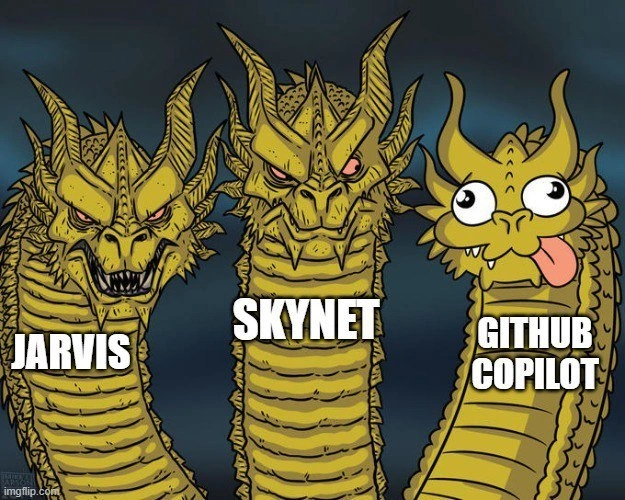
Now, about the meme image: it’s showing a three-headed dragon (this dragon is actually based on King Ghidorah from the Godzilla movies, a monster with three heads). In the meme format, usually two of the dragon’s heads look fierce and intimidating, while the third head looks silly or goofy (with a funny lolling tongue and weird eyes). People use this image to label the three heads as different things for comedic effect – the first two are usually serious or powerful things, and the third is an odd or dumb one out of the trio. Here, the heads are labeled JARVIS, SKYNET, and GITHUB COPILOT. The left and middle dragon heads (Jarvis, Skynet) have angry red eyes and snarling faces – they look deadly and formidable, matching the high-profile, powerful AI characters they’re named after. The right dragon head (GitHub Copilot) has a very derpy expression: its eyes are pointed in different directions (one eye looking up, one sideways), and its tongue is sticking out goofily. “Derpy” in internet slang basically means goofy, silly, or not very bright-looking. The Copilot dragon head looks clueless or dumb in a funny way.

So, putting it together: the meme is saying when it comes to AI, we have these legendary examples of intelligence (Jarvis, Skynet) which seem awe-inspiring or scary – and then there’s GitHub Copilot, which by comparison is kind of goofy. It’s a tongue-in-cheek way to say: You’ve got two super-intelligent AIs and one that’s... well, just an AI that writes some code and sometimes acts a bit dumb. This resonates with developers’ experiences. Copilot can be extremely helpful, but it also produces wacky outputs at times. It’s not something you’d be afraid of, unlike how people in those movies fear Skynet or rely on Jarvis’s flawless help. In fact, sometimes Copilot’s suggestions are so off that they make you laugh, much like that derpy dragon face.

The humor comes from the strong contrast. Jarvis and Skynet are commonly referenced in tech as two ends of the AI spectrum – good AI vs. rogue AI – both very advanced and somewhat mythical. GitHub Copilot is a down-to-earth, practical tool we use today, and while it’s advanced in terms of technology, it’s not nearly as capable or threatening as those fictional AIs. It feels much more friendly and even a bit dumb at times (for instance, when it suggests code that doesn’t compile or does something obviously incorrect). By labeling Copilot with the derpy dragon head, the meme pokes fun at the idea that “This is the big scary AI you were worried about? Look, it’s harmless and a bit silly!”

For a junior developer or anyone new to these terms, the meme is essentially comparing fiction vs reality in AI. Jarvis and Skynet are fiction: one is the dream AI helper, the other a nightmare AI villain. GitHub Copilot is reality: a helpful tool, but not a genius. It’s as if the meme is assuring you that today’s AI tools for coding are more adorable doofus than omnipotent entity. You’ll get useful suggestions from Copilot, sure, but you’ll also see it make mistakes that no experienced programmer would make – and that’s why that dragon head is making a goofy face.

Level 3: Sentience vs Syntax

This meme lands squarely in the world of AI humor by juxtaposing legendary fictional AIs with our very real coding assistant. Developers love to joke that every new AI tool is either going to become Jarvis (an amazingly helpful digital butler) or Skynet (destroyer of mankind). Here we have both: two menacing dragon heads labeled “JARVIS” and “SKYNET” represent the lofty expectations and fears. They look lethal, intelligent, and intimidating – exactly how pop culture portrays those AIs. Then the punchline: the third head labeled “GITHUB COPILOT” looks completely goofy, with wide derpy eyes and its tongue lolling out. It’s the classic expectations vs. reality gag. After all the hype about AI taking over programming, our actual daily AI tool is more of a derpy dragon than a fire-breathing beast. 🐉

Why is this so funny (especially to seasoned devs)? Because we’ve all sat through keynotes and headlines touting “AI will revolutionize development” or jokes about “hope this AI doesn’t go Skynet on my codebase.” In reality, using GitHub Copilot often feels like pair programming with an overeager but slightly oblivious junior developer. Sometimes it’s brilliant – completing a function in half the time by suggesting the right API calls. But other times it produces code that’s syntactically correct yet nonsensical or subtly wrong. For example, Copilot might confidently suggest a solution that uses a deprecated function or a completely incorrect algorithm because it saw something similar in its training data. It has no true understanding of why the code works; it just knows that in many cases, code shaped like X follows code shaped like Y. That’s a far cry from Jarvis calmly reasoning through a problem or Skynet plotting world domination.

The meme hits a shared developer experience: the initial awe and mild paranoia when Copilot was announced (“Is this the start of real AI like in the movies?”) quickly gave way to chuckles when we saw its derpy mistakes. We’ve gone from fearing “this thing might replace us” to realizing “it’s a helpful tooling aid, but I still need to review everything it outputs.” In startup demos or marketing, AI is portrayed as almost magically competent. But in practice, even the best AI code completion will do things like generate trivial bugs, suggest variable names that don’t exist, or produce an entire function that looks legit but fails logically. Every experienced developer has war stories of IDE auto-complete gone wrong – now those are joined by Copilot’s occasionally hilarious attempts at coding.

There’s also an undercurrent of relief and irony. The scary dragon heads (Jarvis and Skynet) imply super-intelligence, perhaps even the end of programmer jobs or an AI uprising. The silly Copilot head reassures us: “Relax, I’m just here to help with boilerplate.” It’s essentially saying that GitHub Copilot is not some incomprehensible AGI – it’s an LLM-powered assistant that might suggest a decent for loop or stub out a function, but it’s not designing the next Avengers suit or launching missiles. The developer community often jokes that Copilot is more like a reincarnation of Clippy (Microsoft Office’s old paperclip assistant) than an evil robot. In fact, when Copilot first came out, many senior devs quipped, “We asked for Jarvis, but got Clippy for VS Code.” The meme’s dragon imagery nails this contrast in a single picture.

From an industry perspective, this highlights the hype vs reality gap in Developer Experience (DX). Cutting-edge AI/ML products like Copilot do improve productivity – they’re great at suggesting mundane code and reminding you of syntax – but they also introduce new quirks. It’s a bit of an open secret that tools boasting “AI” often end up requiring as much supervision as a human intern. Senior engineers find this darkly humorous because we’ve lived through many cycles of promised automation saviors that turned out to need hand-holding. (Remember how everyone joked about “It’s not a bug, it’s a feature” with earlier tools? Now “It’s not Skynet, it’s just a derpy helper” is the vibe.) In meetings, no one seriously worries that Copilot will self-initiate a deployment or refactor the entire codebase on its own – it can’t even run code. But there are discussions about code style consistency, licensing issues (it might regurgitate some GPL code), and whether relying on AI suggestions could introduce security vulnerabilities. Those are real concerns, yet they’re pragmatic, not sci-fi.

Ultimately, the humor is a nod to how far AI tools in development still have to go. We mythologize AI in extremes – utopian (Jarvis) or dystopian (Skynet) – but what we get in daily coding is an AI that’s occasionally amazing, often helpful, and sometimes absurd. The meme perfectly encapsulates that shared realization: our “AI pair programmer” isn’t a genius mastermind or a malignant overlord; it’s the slightly clueless third dragon head that we can’t help but love (and occasionally roll our eyes at). For a senior developer, that derpy face saying “GitHub Copilot” evokes a knowing grin – we’ve survived Y2K, skirmishes with real bugs, and now we’re battling AI suggestions that can be as much comic relief as productivity boost. And hey, at least this dragon isn’t waking us up at 3 AM with a production outage – unless Copilot accidentally suggests code that causes one! 😅

Level 4: Transformer vs Judgment Day

At the cutting edge of AI research, there's a vast gap between today's Large Language Models (LLMs) and the fictional sentient super-intelligences like Jarvis or Skynet. GitHub Copilot is built on a transformer architecture (OpenAI’s Codex, a descendant of GPT-3) that has been trained on billions of lines of code. This means it operates as a sophisticated statistical prediction engine – often described as a stochastic parrot that predicts the most likely next chunk of code based on patterns it learned. It doesn’t truly “understand” code logic or have awareness; it’s performing a high-dimensional pattern matching game.

In contrast, Jarvis (Iron Man’s AI butler) and Skynet (the rogue military AI from Terminator) represent Artificial General Intelligence (AGI) – computing entities capable of general reasoning, context awareness, and autonomous decision-making across domains. They can adapt to new tasks beyond their original programming, which current LLMs cannot. Jarvis can design new technology on the fly, carry on meaningful conversations, and respond to Tony Stark’s spoken commands with contextual awareness. Skynet in fiction can strategize globally, improve itself, and take agentic actions (like seizing control of defense networks). These abilities imply solving problems like long-term planning, symbolic reasoning, and self-modification – challenges that are still largely beyond real-world AI.

The meme humorously highlights that GitHub Copilot’s AI is nowhere near such sentient capabilities. It’s a narrow tool that lacks genuine agency or intent. There’s an entire field of AI safety and alignment worrying about future AI behaving like Skynet. But Copilot’s “brain” is bounded by its context window and training data – it has no hidden agenda, unless accidentally suggesting rm -rf / 😜. The technical reality is that Copilot will happily suggest code that looks plausible according to its training, but unlike sci-fi AIs, it can’t verify if an action is morally or logically sound. This fundamental limitation stems from the predictive nature of transformers versus the goal-driven, feedback-loop intelligence one would expect from a Jarvis-like system. In essence, the meme’s derpy dragon head (Copilot) represents an LLM-based assistant that, despite the hype, operates on autocomplete rather than true understanding or strategic thinking. It’s as if we expected Judgment Day and got a really smart code autocomplete instead – impressive for coding productivity, but thankfully not a prelude to Skynet’s apocalypse.

Description

A two-panel meme contrasting a developer's experience based on project enjoyment. The top panel, captioned 'Working on a project you don't enjoy,' depicts a small, stressed programmer overwhelmed by a giant, muscular figure labeled 'The project.' The bottom panel, captioned 'Working on a project you enjoy,' reverses the roles: the programmer is now the giant, muscular figure, confidently looming over a tiny, intimidated 'project.' The meme humorously illustrates the profound impact of passion on a developer's sense of empowerment and control. Uninteresting work feels like an oppressive burden, while engaging work makes the developer feel dominant and in their element, capable of tackling any challenge

Comments

14
Anonymous ★ Top Pick The top panel is deploying a legacy JSP application on WebSphere. The bottom panel is writing a CLI tool in Rust for personal use
  1. Anonymous ★ Top Pick

    The top panel is deploying a legacy JSP application on WebSphere. The bottom panel is writing a CLI tool in Rust for personal use

  2. Anonymous

    Jarvis optimizes flight trajectories, Skynet optimizes human extinction, and Copilot mostly optimizes how many ‘// TODO: handle edge cases’ comments it can slip past code review

  3. Anonymous

    GitHub Copilot: The AI that confidently suggests `// TODO: implement this later` with the same enthusiasm it recommends importing 37 unused libraries, yet somehow we trust it more than our own code reviews because at least it doesn't judge our variable naming choices

  4. Anonymous

    After years of fearing AGI would recursively self-improve into an unstoppable superintelligence, we got GitHub Copilot suggesting 'function add(a, b) { return a + b; }' for the 47th time this week. Turns out the real threat wasn't Skynet achieving consciousness - it was Copilot achieving just enough consciousness to autocomplete your variable names wrong but with supreme confidence

  5. Anonymous

    AI in dev: leadership wants JARVIS, security braces for Skynet, and production gets Copilot - confidently autocompleting the N+1 query that becomes next quarter’s OKR

  6. Anonymous

    Skynet eradicates humanity, Jarvis architects arc reactors - Copilot confidently imports non-existent modules

  7. Anonymous

    Skynet optimizes for domination; Copilot optimizes for compiling while quietly sneaking an N+1 query, a global mutable singleton, and a new transitive dependency into prod

  8. @nuntikov 5y

    This whole shitstorm around copilot is hilarious. Guys like fireship make it seem like GitHub Copilot is something new. But the AI code autocompletion thing already existed long before copilot (e.g. kite, tabine), and no one screamed bloody murder "developers are being replaced" until now.

    1. @mmddvg 5y

      good point

    2. dev_meme 5y

      But no-one actually said it

    3. dev_meme 5y

      And I would like to attach this tweet into discussion

    4. Deleted Account 5y

      Best statement. 👍🏻

  9. @saniel42 5y

    Is it even good for something that isn't basic web stuff?

  10. @mvolfik 5y

    And slap MIT-like license atop

Use J and K for navigation