The Original Cloud Computing Pioneer
Why is this Cloud meme funny?
Level 1: Old Story, New Words
Imagine taking a really old story and retelling it with modern gadget words — that’s exactly why this meme makes people laugh. In the Bible story, Moses climbs a mountain and comes back with stone tablets that have important rules (the Ten Commandments) carved on them, supposedly given to him by God from a cloud on the mountaintop. The joke is saying this in a goofy way: as if Moses used an iPad-like tablet and downloaded files from a cloud in the sky. Of course, back then there were no electronics or internet, but picturing it that way is silly and fun. It’s like joking that the first person who ever sent a handwritten letter was actually sending the first email – obviously not true, but it’s funny to compare the old method to the new terms. Here, Moses’s stone slabs become the “tablet device” and the heavenly cloud becomes the “cloud storage.” We know that’s not what really happened, and that absurd mismatch is what makes it humorous. Basically, the meme makes a serious ancient story sound like a tech setup, and that surprise in mixing old and new makes people smile.
Level 2: Stone Tablet Interface
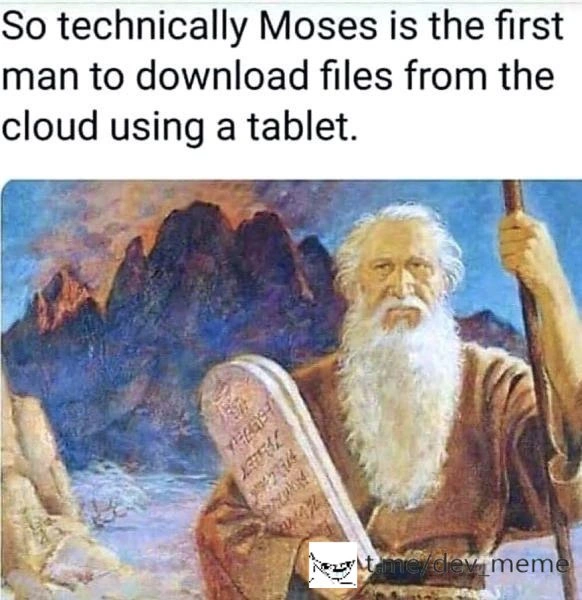
Let’s break down the joke in simpler terms. The meme text says: “So technically Moses is the first man to download files from the cloud using a tablet.” It’s taking modern tech language and applying it to a famous old story. Here’s what those terms mean in a normal tech context versus the Moses context:
The Cloud (computing) – In tech, “the cloud” means data centers full of servers provided by companies like Amazon, Google, or Microsoft. When you save something “to the cloud,” you’re really saving it on those companies’ computers via the internet. For example, if you upload a photo to Google Drive or iCloud, that photo is stored in a remote server farm (not a fluffy cloud in the sky, even though we draw a cloud icon for it!). In everyday talk among developers, downloading from the cloud means copying a file from one of those internet servers to your own device.
Tablet (device) – A tablet is a portable touchscreen computer, like an Apple iPad, Samsung Galaxy Tab, or Microsoft Surface. It’s basically a flat slate you can run apps on, browse the web, read e-books, etc., without a physical keyboard. We call it a tablet because it resembles a pad or slab you write on — in fact, the term comes from old-fashioned writing tablets (like chalk slates or even ancient clay/stone tablets). So the name “tablet” for a computer is borrowed from those flat writing surfaces of antiquity.
Download – This means to transfer data from a central computer (for example, a cloud server on the internet) to your local device. If you click “download” on a file from Google Drive, your tablet or PC pulls a copy of that file down over the internet and stores it on your device. It’s called “down-loading” because conceptually the information is coming down from a higher system to your personal machine.
Now, here’s why the meme is funny: Moses’s story has a literal cloud, literal tablets, and him receiving something (the commandments) from above. It’s as if he “downloaded” data from a cloud in the sky onto stone tablets. Those stone tablets with the Ten Commandments were essentially the files he got. Of course, Moses wasn’t using technology – he’s a figure from ancient religious texts – but the wording makes it sound like he performed a modern tech action. It’s a classic case of a historical pun or an ancient download joke. The top part of the meme text sets up that idea, and the image below (a painting of Moses with the tablets and a cloud overhead) visually drives the comparison home.
To see the parallel clearly, compare the modern tech meaning of each term to the literal elements in the Moses tale:
| Term | Modern Tech Meaning | Literal Meaning in Moses’s story |
|---|---|---|
| Cloud | A network of remote servers on the Internet where data is stored. It’s represented with a cloud symbol in diagrams, but it’s really just someone else’s computers in data centers (e.g. Amazon AWS or Google Cloud). | An actual cloud in the sky on Mount Sinai. In Exodus, a cloud on the mountain represented God’s presence. Moses went up into that cloud to receive the law. |
| Tablet | A handheld touchscreen computer (like an iPad or Android tablet). It’s an electronic device for reading, apps, etc., named after the flat writing tablets of old. | A flat piece of stone with words carved into it. Moses’s “tablets” were two slabs of stone inscribed with the Ten Commandments — literally heavy stone documents. |
| Download | Copying or retrieving a file from a remote system (like a cloud server) down to your local device. We use it to mean “get a copy over the internet.” | Taking something down from a higher place. Moses went up and brought down the tablets from the mountaintop. Figuratively, he received information from Heaven and carried it down to the people. |
So when the meme says “Moses is the first man to download files from the cloud using a tablet,” it’s humorously equating:
- Moses’s stone tablets = a modern computer tablet device
- The cloud on the mountaintop = a modern cloud server or cloud storage in the sky
- The Ten Commandments = the “files” being downloaded (some important data)
In reality, Moses didn’t have any electronics, but the joke pretends he did, by using our tech lingo to describe what happened. This blend of contexts is a great example of CloudHumor in developer circles. It’s tagged as both Cloud and TechHistory because it combines a cloud computing joke with an ancient historical (biblical) reference. Developer meme culture loves these sorts of inside jokes and puns — you’ll often see tech humor that imagines historical figures using modern technology or refers to ancient events as if they were computer operations. It’s funny to people in IT and development because it’s a lighthearted way to look at our everyday terminology (download, cloud, tablet) from a completely different angle. Essentially, the meme is a cloud_computing_pun wrapped in a biblical_meme format: it takes a serious, well-known story and gives it a tech twist, which is both nerdy and playful.
Level 3: Cloud Commandments
At first glance, this meme is a clever mashup of biblical history and cloud computing jargon. It quips that Moses essentially performed the first cloud download onto a tablet. Of course, in Exodus, Moses ascends Mount Sinai and receives stone tablets inscribed with the Ten Commandments from a divine presence in a cloud. The meme plays on this double meaning: in tech speak, “downloading files from the cloud using a tablet” is a mundane daily task, but here it’s applied literally to an ancient story. This witty overlap tickles seasoned developers because it retrofits modern terminology onto a well-known historical (and religious) event.
From a senior developer’s perspective, the humor comes from recognizing how our everyday tech terms have origins or parallels in much older concepts. The term “cloud” in computing actually comes from the cloud-like shape used in network diagrams to represent the nebulous internet. We say “the cloud” to mean someone else’s computers (remote servers) doing the storage or computation. Meanwhile, “tablet” in tech (like an iPad or Surface) deliberately harkens back to the flat slabs people used to write on in antiquity. Here the meme takes those meanings full circle: Moses downloads divine “data” from a cloud (literally a cloud on a mountaintop) onto tablets (literally slabs of stone). It’s an anachronistic analogy — essentially calling a biblical event the earliest instance of cloud computing.
For those of us with a bit of TechHistory knowledge, there are extra layers to appreciate:
- Divine Service Provider: The meme frames God (atop Mount Sinai’s cloud) as a cloud service provider, a sort of ancient AWS. It’s like Moses engaged with "Sinai-as-a-Service (SaaS)", retrieving data (the commandments) from a remote celestial server.
- Data Transfer Latency: According to the story, Moses spent a long time (40 days) on the mountain. In tech terms, that’s one slow download – a high-latency link! No high-speed internet, just a one-off divine connection.
- Client Device (Tablet): The stone tablet interface Moses used is humorously contrasted with a modern tablet device. Instead of a sleek touch-screen and Wi-Fi, Moses’s tablet had a chiseled user interface (literally carving text in stone) with extremely low throughput (each character had to be engraved). It’s basically a read-only device — once chiselled, you can’t easily update or delete content (no backspace on a stone!).
- Storage Medium: A stone tablet has very limited storage capacity (only 10 “files” fit, and that was pushing it). It’s heavy and not exactly portable by today’s standards — imagine lugging your data center down a mountain. In contrast, modern cloud storage can sync thousands of files to a lightweight tablet computer instantly. The meme exaggerates how stone-age storage comically pales next to modern solid-state drives, and yet calls them the same thing (“tablet”).
- Error Handling: In the biblical account, Moses actually broke the first set of tablets in anger, shattering the data. That meant he had to go back and re-download the commandments onto new tablets – arguably the first recorded instance of a backup restore or retry after a failed deployment. Seasoned devs see the parallel: even in ancient times, version 1.0 had to be replaced by an update because of “user error.” It’s a tongue-in-cheek nod to how catastrophic failure led to the second edition of the tablets (let’s call it Ten Commandments v2.0).
All these parallels make the meme hilariously relatable to cloud engineers and devs. It’s poking fun at our own jargon. We talk about “files in the cloud” in such a casual way, but if you interpret the phrase literally, it sounds absurd – like a man on a mountain pulling files out of a puff of vapor with a stone iPad! This sort of CloudHumor and historical pun shows up often in developer meme culture. It resonates because it underscores how far technology has come (from stone tablets to silicon tablets) while also implying that the idea of sharing information from on high isn’t so new after all. The meme’s punchline lands well with experienced developers: it’s a geeky form of wordplay that reframes an ancient event as an early tech “download,” making us smirk at how perfectly the terminology overlaps.
Description
This meme features a classical painting of the biblical figure Moses, depicted with a long white beard, holding a staff in one hand and two stone tablets inscribed with text in the other, set against a mountainous backdrop. Above the image is the caption: 'So technically Moses is the first man to download files from the cloud using a tablet.' A small watermark with a troll face and the text 't.me/dev_meme' is visible in the bottom right corner. The humor is a clever pun that anachronistically applies modern tech terminology to the biblical story. The 'cloud' refers to God in the heavens, the 'files' are the Ten Commandments, and the 'tablet' is the stone slate. This joke resonates with tech professionals by playfully mapping their everyday jargon onto one of the oldest stories in Western culture, highlighting how terms evolve and take on new meanings

Comments
13Comment deleted
The latency was high and the UI was literally set in stone, but at least there were no GDPR pop-ups
Moses basically pioneered WORM storage - pulled 10 lines from the “Sinai” bucket onto read-only stone media and made every future change request a theological fork
And he still had better uptime than AWS us-east-1 - forty years in the desert with zero outages on those stone tablets
Moses really pioneered the concept of immutable infrastructure - those stone tablets had zero configuration drift, no version control conflicts, and the ultimate write-once-read-many storage medium. Though I hear the initial sync took 40 days and the error handling involved some pretty dramatic rollback procedures
OG cloud: edge-delivered WORM tablets with ten hardcoded policies, 40-day cold start, and rollback procedure = smash and request re-provision
Original immutable infrastructure: rewriting those tablets demanded divine intervention
Moses shipped the first air-gapped cloud-to-tablet deployment: immutable storage, no versioning, and a rollback plan that involved smashing prod
wow! Insulting of religious people's feelings Comment deleted
you are insulting my freedom of speech feeling Comment deleted
if you are not religious, you can't be offended since you have no human rights Comment deleted
dude wtf Comment deleted
God is dead. Comment deleted
I am going to allow it Comment deleted