
Stakeholders Clients Post #4564 · source on Telegram
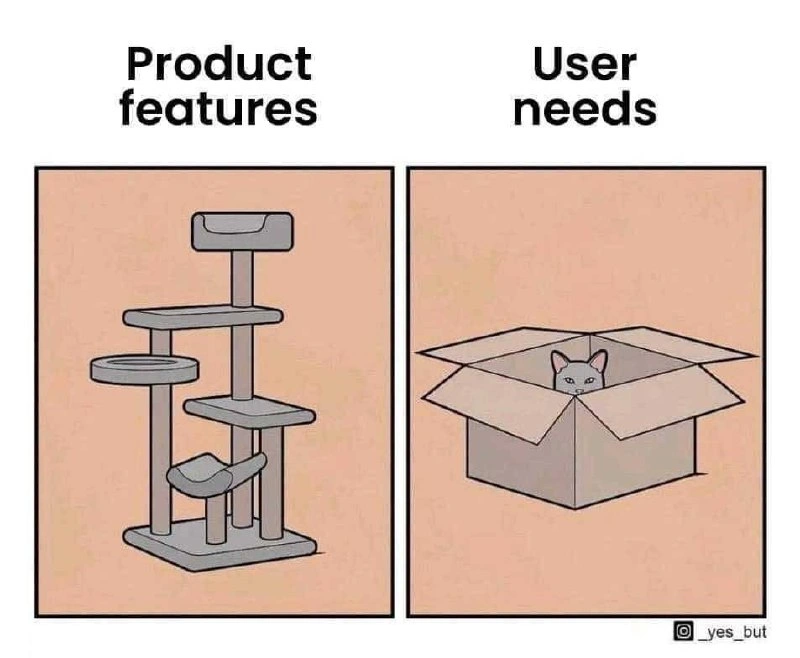
All those sprint features, yet the user just wants a cardboard box
Description
Two side-by-side panels share a flat peach background. The left panel is titled "Product features" and depicts a tall, multi-level grey cat tree with shelves, ramps, and a bed - clearly an elaborate construction. The right panel is titled "User needs" and shows a lone cardboard box with a cat peeking out, content inside the simplest possible enclosure. The contrast humorously exposes the gap between over-engineered product backlogs and genuine customer value. For developers it’s a reminder to fight scope creep, validate requirements early, and keep UX at the center of feature planning
More like this
More like this in Stakeholders Clients →
Use J and K for navigation
Comments
6Comment deleted
We spent two quarters decomposing the cat tree into event-driven micro-perches; the customer still curls up happily in the legacy cardboard monolith
We spent six sprints building a distributed event-sourcing architecture with CQRS, GraphQL federation, and real-time WebSocket subscriptions when all they wanted was a CSV export button
This is the architectural equivalent of building a microservices mesh with service discovery, circuit breakers, and distributed tracing when the user just needed a REST endpoint that returns 'Hello World' - but hey, at least we're cloud-native and the cat's happy in production
Architects built a microservices cat tree for ultimate scalability; the cat ignores it for the monolith box MVP
We shipped a five-service CatTree with feature flags and analytics; the user’s entire spec was POST /box - classic feature-factory vs outcome mismatch
Built a five-tier, feature-flagged cat tree; the box achieved 100% DAU. YAGNI remains undefeated