Pro tip tweet warns devs: unethical code can land you, not managers, in jail
Why is this CorporateCulture meme funny?
Level 1: You Get Caught, Not Them
Imagine your friend tells you to do something wrong, like cheat on a test or steal candy from a store. You know it’s a bad idea, but they say, “Don’t worry, it’s fine!” If you listen to them and do it, and then you get caught, you are the one who gets in trouble – not your friend who suggested it. They get to shrug and say, “I didn’t do it.” This meme is making the same point, but with a boss and a programmer. If a boss asks a programmer to do something illegal or dishonest, and the programmer does it, the programmer is like the kid who actually stole the candy. When the teacher or the police find out, the programmer is the one who gets punished. In simple terms: even if someone in charge tells you to do something wrong, you’re responsible for your own actions. The funny-but-serious advice here is saying, “Don’t let anyone talk you into doing the wrong thing, because you’re the one who will end up in trouble for it.” It’s a reminder to always do what’s right, no matter who is encouraging you to break the rules.
Level 2: Committing Code, Committing Crimes
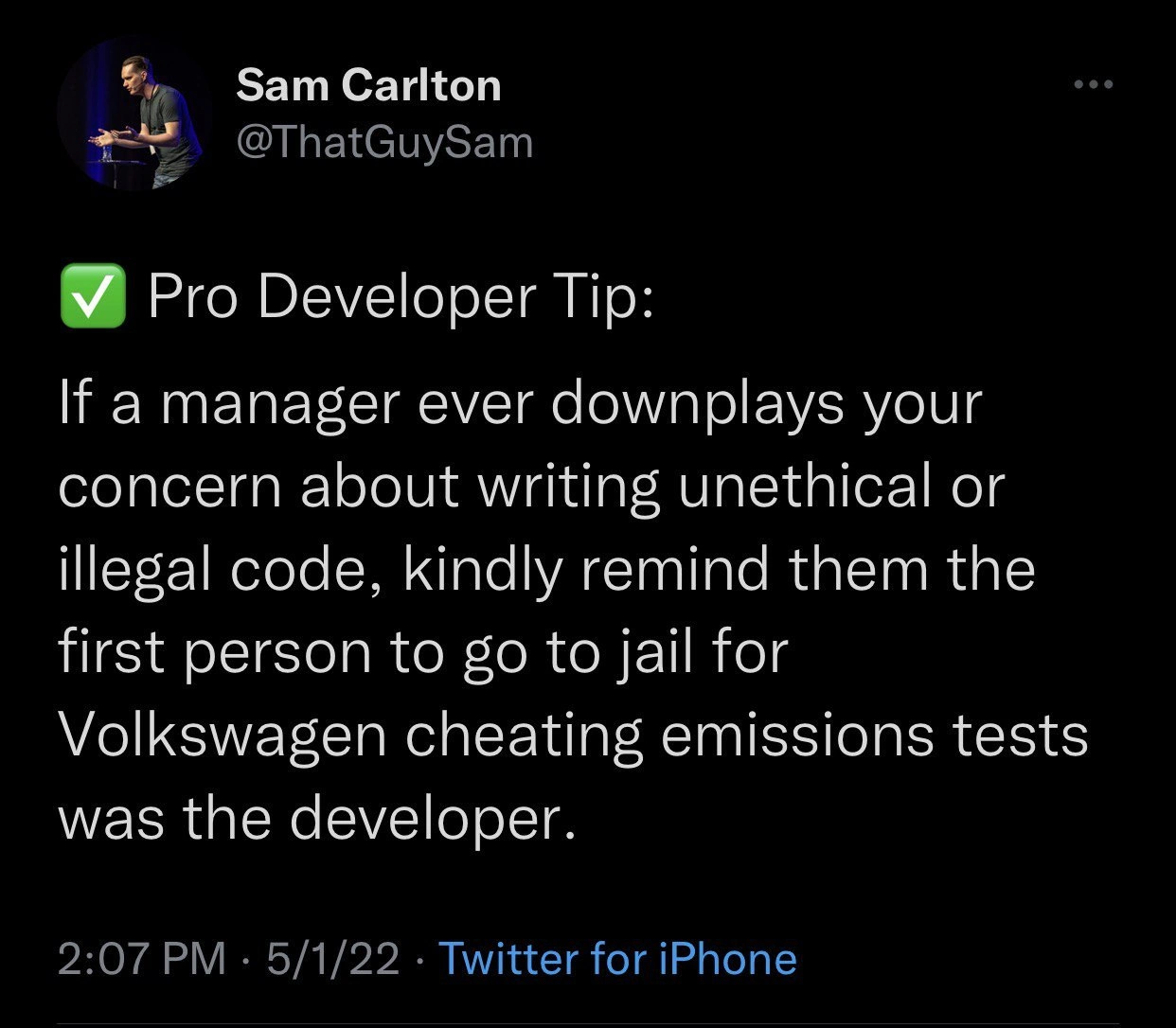
This meme highlights a cautionary tale in simple terms: if your boss tells you to write code that’s unethical or illegal, you could be the one in serious trouble, not them. The tweet shown is phrased as a “Pro Developer Tip,” and it refers to a real event to make its point. In the Volkswagen emissions scandal, the company’s software was programmed to cheat on emissions tests (meaning the code lied about how much pollution the cars were producing). Writing that cheating software is an example of unethical_code – code that violates moral standards and in this case actual laws. The tweet points out that when this wrongdoing was discovered, the first person who went to jail was one of the developers who wrote the code, not the executives. In other words, the engineer who committed the dishonest code got treated like someone who committed a crime.
Why would a developer risk writing illegal code? Often it comes down to stakeholder_pressure and bad corporate culture. “Stakeholders” are people who have a stake in a project – like managers or executives who want to see a job done quickly or a product perform better. Sometimes a manager might downplay your concern about doing something fishy. For example, if you say, “Isn’t this against the rules or the law?” and they reply, “Oh, it’s fine, don’t worry about it,” that’s downplaying the issue. They might care more about hitting a target or pleasing higher-ups than about ethics. This is unfortunately a common theme in Management humor among developers – jokes about managers pushing for features at any cost. But here the “humor” comes with a serious edge: it’s pointing out the engineering ethics problem in that attitude. Compliance is the term for following all the laws and regulations (for instance, environmental laws for car emissions, or privacy laws for user data). If a piece of code breaks those rules (like software that cheats tests or code that secretly violates user privacy), it’s not just a technical bug – it’s a legal violation.
For a junior developer, the big takeaway is understanding personal responsibility in coding. Your boss might come to you with a request that sounds wrong – maybe asking you to hide some bad data, or to build a feature that tricks the user or a regulator. If you go ahead and do it, saying “My manager told me to” won’t keep you safe if the cheat is exposed. Developer legal liability means that as the programmer, you can be held legally responsible for what your code does, especially if you knowingly wrote something fraudulent or malicious. It’s similar to how a professional like an accountant or an engineer can face legal trouble if they knowingly break the rules in their work. Developers are not usually thinking about jail time when writing code, but this meme is a reminder that it can happen.
The mention of the Volkswagen case is a vivid example: imagine being a software engineer and adding a few lines that detect if a car is in a test scenario. Those lines might look something like if(car.isBeingTested) { fakeGoodBehavior(); } else { normalDirtyMode(); }. It might have felt like a clever trick to please the bosses at the time. But that unethical code turned into a massive scandal. Governments and courts treat it as fraud. And the paper trail of who wrote those lines of code leads straight to individual developers. So the “Pro tip” here urges you to stand your ground if you’re ever asked to do something illegal or sketchy. It’s basically saying: “Remind your manager that you could go to jail for this code – so no, it’s not okay.” It empowers younger engineers to speak up about DeveloperEthics. Good companies will have channels for reporting such concerns, like a compliance department or an anonymous ethics hotline, precisely because they know how serious it is. And if a company doesn’t take your ethical or legal concerns seriously? That’s a big red flag. This meme uses a bit of humor and a real-world story to drive home a simple message: don’t be pressured into writing bad code, because you’re the one who could face the consequences.
Level 3: Feature or Felony
In this stark meme, a Pro Developer Tip on Twitter reminds us that writing unethical code isn’t just a theoretical no-no – it can have real legal consequences. The tweet (with a green checkmark for irony) says to kindly remind any manager who downplays your concerns that the first person jailed in the Volkswagen emissions scandal was a developer. Experienced engineers immediately recognize the dark humor: it’s a pointed reference to how corporate culture can pressure developers to implement shady features, yet when the law comes knocking, the coder might be left holding the bag.
This isn't hyperbole; it’s referencing the notorious Volkswagen emissions scandal (aka “Dieselgate”). Volkswagen’s management had a brilliant (read: profoundly unethical) idea: program the car’s software to cheat on emissions tests. The code detected when the car was in a testing scenario and then secretly switched the engine into an extra-clean mode. On the open road, the software disabled compliance measures, so the car would perform better but spew illegal levels of pollution. It was a textbook case of unethical_code – code written to deliberately break the rules. And indeed, when regulators uncovered this scheme, the developer legal liability became very real: one of the first people prosecuted and sent to jail was an engineer who helped write that cheating code. The meme’s punchline lands like a warning from a battle-scarred colleague: “Go ahead, do the illegal thing your boss wants… just remember who ends up in orange.” 😈
From a senior developer’s perspective, this scenario is chillingly relatable. We’ve all seen managers or PMs (Project/Product Managers) who dismiss engineering concerns with “Just do it, it’s fine” — especially concerns about compliance or EngineeringEthics. Maybe a product manager wants a “creative workaround” for a privacy restriction, or a CTO nudges the team to fudge results to meet a target. The humor here is laced with truth: if you commit that sketchy code (and yes, “commit” in git will literally tag your name to it), you might also be seen as committing a crime. The term “stakeholder pressure” comes to life in the worst way: higher-ups push hard for results, but later they might claim “I had no idea about the specifics” while you, the developer, get blamed for implementing exactly what they asked for. It’s a classic corporate blame game. The meme resonates because many veteran engineers carry a healthy skepticism (and maybe scars) from navigating such Management_Humor scenarios where “just following orders” is totally fine not a valid legal defense.
In fact, “I was just following orders” has a notorious history as an excuse (it didn’t work in war crime trials, and it won’t save you in software engineering either). This meme slyly reminds us that as developers, we have a professional responsibility to uphold ethics and laws. No matter how much a manager downplays your concerns or assures you “everyone does it”, ultimately you are responsible for the code you write. Your name is in the commit logs; your digital fingerprints are on that feature. If it’s an outright illegal feature – like software to defraud emissions tests or a routine to cook financial books – you could face real-world penalties. And let’s be real: the C-suite folks rarely put their names in the version control history. If things go south, guess who’s easier to pin it on? The one who committed the code.
Seasoned devs share this kind of meme with a knowing smirk and a shudder. It’s funny in a gallows-humor way because it’s a form of collective truth-telling. We joke about it, but we’re also educating each other: don’t let short-term managerial pressure trick you into doing something that violates engineering ethics or the law. You can almost hear an older engineer muttering, “Ship that hack and you might ship yourself right to court.” The meme’s ✅ checkmark format parodies those upbeat “pro tips” on social media, but delivers a serious message: protect yourself. It underscores a key lesson in DeveloperEthics: a feature request that feels like a felony is one you must refuse, no matter who asks, because if you don’t, the consequences land on you, not on your boss.
Description
Screenshot of a tweet on a black Twitter UI. The profile shows a blurred speaker photo, the name 'Sam Carlton' and handle '@ThatGuySam'. Tweet text (all white on black) reads: '✅ Pro Developer Tip: If a manager ever downplays your concern about writing unethical or illegal code, kindly remind them the first person to go to jail for Volkswagen cheating emissions tests was the developer.' Timestamp below says '2:07 PM · 5/1/22 · Twitter for iPhone'. Visually simple but it delivers a stark ethical reminder: when corporate leadership pressures engineers to implement unlawful features, the individual contributor often bears legal risk, as highlighted by the Volkswagen emissions-cheat firmware scandal. The meme resonates with senior engineers who navigate management pressure, software compliance, and professional liability
Comments
6Comment deleted
Just remember: when your PM insists on shipping an `emissionsBypass()` patch, the subpoena will run `git blame`, not `manager kudos`
The same PM who insists "we're just detecting test mode for performance optimization" will be explaining plausible deniability from their yacht while you're explaining polymorphism to your cellmate
When your PM says 'just make the tests pass,' but you remember that the last engineer who literally made tests pass when they shouldn't ended up with a criminal record. Turns out 'move fast and break things' has some important legal exceptions - like federal emissions regulations. Pro tip: if your sprint planning involves potential jail time, it's time to update your résumé, not your codebase
"Ship it, we can always roll back later" works for features, not felonies - rollbacks don’t apply to subpoenas
When management says "we’ll take responsibility," remember Git blame integrates beautifully with subpoena‑driven development
VW's defeat device: the ultimate feature flag that flagged the devs straight to federal court