When a coworker asks to watch, and your coding confidence evaporates instantly
Why is this DeveloperProductivity meme funny?
Level 1: Coding Stage Fright
Imagine you’re practicing a piano piece all by yourself at home and you’re playing it perfectly. But then your friend or your mom comes in and starts watching you. Suddenly, you get nervous and you start hitting all the wrong notes. Your fingers feel stiff, and the song that sounded great a minute ago now feels hard. This meme is showing that same kind of thing, but with coding instead of piano. The programmer was writing code just fine when alone, but as soon as their coworker asks to watch, the programmer gets stage fright. It’s like when you know the answer to a homework problem, but when the teacher asks you to solve it on the board in front of everyone, your mind goes blank. The comic is funny because we can all relate to that feeling: doing something confidently in private, then freezing up when someone is peering over our shoulder. In simple terms, a task (like coding, singing, or even tying your shoes) can feel easy when you’re alone and hard when you realize everyone’s eyes are on you. The poor coder in the meme basically got shy and forgot how to code the moment he had an audience. It’s a silly reminder that even grown-up programmers can feel the same kind of butterflies in their stomach that you might feel on stage – and that’s why we can laugh at it.
Level 2: Pair Programming Pressure
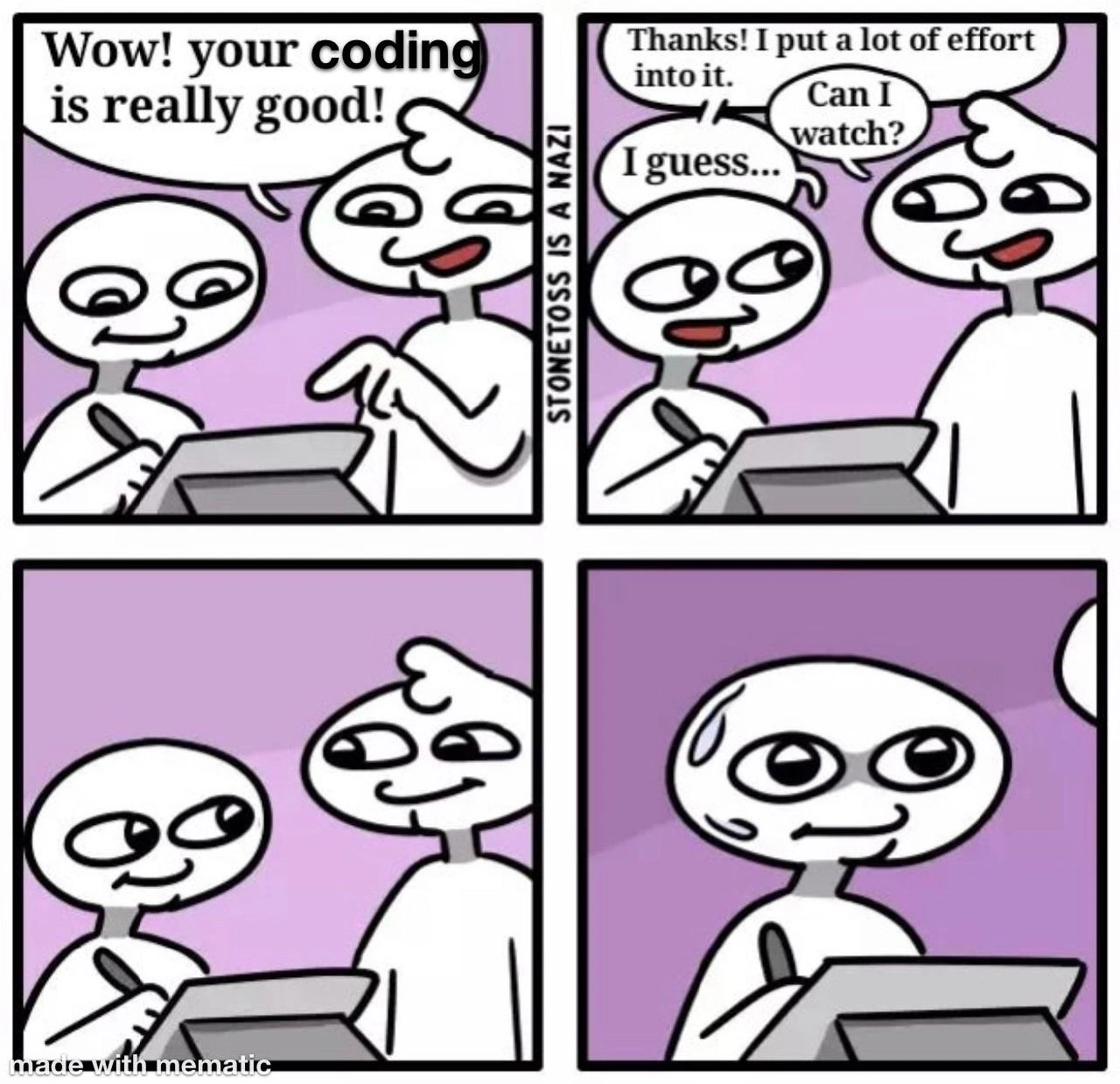
This meme shows a situation that many developers — especially newer ones — find incredibly relatable and nerve-wracking. Let’s break down what’s happening in simpler terms. In the first panel, a coworker walks up and compliments the developer’s coding: “Wow! your coding is really good!” That feels great! The coder is happily working on their tablet, likely in the middle of coding something. They even reply, “Thanks! I put a lot of effort into it.” So far, so good. But then the coworker says, “Can I watch?” and the coder reluctantly says, “I guess…”. This is the key moment that sets up the rest of the comic. The coder’s not jumping for joy at the offer — you can tell they’re a bit uneasy (saying “I guess…” with a hesitant look) because now there’s going to be someone literally watching them work.
Panels 3 and 4 show exactly why the coder was hesitant: as soon as the coworker is actively watching, the coder seizes up with anxiety. The coder’s eyes go wide, and sweat drops appear on their face — a cartoon way to show someone is really nervous. The tablet is in front of them, but notably, they’ve stopped typing. The once-confident developer suddenly can’t write any code with their coworker standing there. The coworker isn’t saying or doing anything aggressive; they’re just silently observing. Yet that’s enough to break the coder’s concentration completely. This scenario is an example of over-the-shoulder coding, where someone literally looks over your shoulder at your screen while you work. It’s also a form of live coding pressure – the pressure you feel when you have to write code in real-time while someone else is watching or waiting.
Now, why does this happen? A big reason is performance anxiety. Think of performance anxiety as the nerves you get when you have to perform a task with an audience. It’s the same feeling you might get when giving a presentation in class or doing a live demo. For developers, it can happen during things like pair programming sessions or coding interviews. Pair programming is a practice where two developers work together on one computer. Typically, one person is the “driver” (the one typing and writing code) and the other is the “navigator” (watching, giving suggestions, and reviewing each line in real-time). In theory, pair programming is great for collaboration: having two sets of eyes can catch mistakes early and improve code quality. But in practice, if you’re not used to it or if you feel self-conscious, having someone watch you as you type can be intimidating. You start worrying about every little thing: “Am I typing too slow? What if I choose a bad variable name? Oh no, I made a typo, do I look stupid now?” These thoughts make it even harder to code normally. That worry about looking stupid or not being good enough is related to something called impostor syndrome – where you doubt your own abilities and fear that others will expose you as a “fraud” who isn’t really competent. It’s very common in tech, even among people who are actually quite skilled. So in the meme, the coder likely knows they usually code well (the coworker even said so!), but now impostor syndrome is kicking in, making them doubt themselves as soon as they have an audience.
Another concept at play here is the flow state, often referred to as being “in the zone.” When a developer is in flow, they’re fully immersed in the task – they have all the context in their head, they understand the problem, and their fingers are dancing over the keyboard as code flows out. It’s a highly productive state of concentration. However, flow state is fragile. Abrupt interruptions or a sudden shift in environment (like realizing someone is now peering at your screen) can yank you right out of the zone. In this comic, the coder was likely in a nice flow (happily coding along) before the coworker’s request. But once they become aware of the observer, the flow breaks. All those ideas and the momentum they had can vanish, leaving an awkward pause. It’s like when you’re humming a song to yourself (sounding great in your own head), and then you notice someone listening and you immediately forget the lyrics or feel self-conscious about continuing.
Let’s also talk about communication and expectations. The coworker in the meme probably had good intentions. Maybe they wanted to learn from the coder or just see a cool feature being built. Their comment “Wow, your coding is really good!” is positive. But when they ask, “Can I watch?”, it puts the coder on the spot. The coder might feel it’d be rude to say no, so they say yes even though it makes them uncomfortable. In a healthy pair programming scenario, ideally both people agree to work together and maybe set some ground rules (like “feel free to ask questions” or “let’s talk through the problem together”). Here, the dynamic is a bit off-balance: one person is passively watching (almost like an inspector) and the other is suddenly performing. The lack of actual supportive interaction – the watcher just silently smiles – can make the typing person feel judged even if that’s not the watcher’s intent. It highlights a subtle CollaborationChallenge: two people might be in the same room, but if they’re not on the same page about how to work together, things can get awkward. A little communication could help, like the observer saying “No worries if you need time, I’m just curious to see how you approach it, and I can help if you get stuck,” which might relieve some pressure. But in the comic, we don’t see any of that, just the request to watch and then silence, which is why the coder’s DeveloperAnxiety shoots through the roof.
This ties into CodeReviews as well. In software teams, a code review usually means one developer looks over another’s code to give feedback or catch issues, but typically that happens after the code is written (you might post your code on something like GitHub or GitLab and then your peers review it asynchronously). That process can be stressful too – knowing others will judge your code – but at least you do it on your own time and present a finished piece of work. What’s happening in this meme is like a live code review or even a pop quiz. The observer is reviewing or witnessing the code as it’s being written, with no time for the coder to prepare or polish. That’s a lot more pressure! It’s akin to an artist being asked to draw something great while someone watches every stroke of the pencil, versus showing the finished drawing afterward. Most people would prefer to show the final product, not the messy process, because the process can involve trial-and-error and mistakes that you normally fix along the way.
For a junior developer or anyone who’s new to being watched while coding, this situation can be both frustrating and reassuring when they find out it’s a shared experience. Frustrating because you know you’re better than what your frozen state is showing — “I was writing good code just five minutes ago, what’s wrong with me now?!” But also reassuring (in hindsight) because literally every developer has gone through this at some point. It’s DeveloperHumor with a touch of commiseration. When this image circulated online, people likely tagged it as RelatableHumor and DeveloperFrustration because it perfectly encapsulates something we all cringe-laugh about. It’s almost a rite of passage in tech to get stage fright during a live coding situation. If you’ve ever been in a technical interview where you have to code in front of an interviewer, you probably recognize that frozen feeling. Or if you’re a student and your teacher comes and stands next to you as you’re trying to solve a coding exercise, suddenly you forget even basic syntax that you swear you knew moments before.
So, the meme is basically saying: “I was coding fine, but as soon as you wanted to look, I lost all my confidence and ability.” This is the joke and the pain rolled into one. The title of the meme even spells it out: “When a coworker asks to watch, and your coding confidence evaporates instantly.” That’s exactly what’s depicted. The humor here isn’t a punchline in words, but in the situational irony: being praised for skill one second, then unable to demonstrate it the next. Every developer who’s felt the over_the_shoulder_coding jitters sees this and goes, “Oh no, it me!” while also chuckling at the exaggeration. And hopefully, it also reminds us to be a bit more understanding when we’re the ones doing the watching. If a coworker ever says “Can I watch you code?” and you notice them tensing up, it’s good to remember this meme and realize they’re not suddenly clueless — they’re just anxious because someone (you) is watching. We’re all human, after all, and sometimes our brains just decide to throw a 404 error under pressure. 😅
Level 3: Observer Effect at the Keyboard
In the developer world, there's an almost universal joke captured perfectly by this four-panel strip: the instant someone watches you code, your brain goes blank. The meme dramatizes a real phenomenon where your flow state – that seamless focus where code pours out effortlessly – gets abruptly terminated by an external observer. In panel 1, the coworker’s enthusiastic praise (“Wow! your coding is really good!”) sets up a positive vibe. The coder is in their groove, confidently working on a tablet. Panel 2 escalates things: the coder humbly says they put effort into it, and then the coworker asks the fateful question, “Can I watch?”. This innocent request is basically the equivalent of sending an INT (interrupt) signal to the coder’s brain CPU. One moment, you’re executing instructions smoothly; the next, your mental context switch kicks in and all those carefully loaded variables in your head start evicting from cache. The coder’s hesitant reply, “I guess…”, already hints that they know their productivity is about to nosedive.
The last two panels (3 and 4) wordlessly convey the outcome: as soon as the coworker is observing over the shoulder, the coder freezes up. The previously happy-go-lucky programmer is now wide-eyed and sweating. Those cartoon sweat beads are a universal symbol of nervousness. It’s as if the presence of an observer has attached a debugger to the coder’s brain, putting execution in ultra-slow mode. The coworker looms with a friendly smile, but our coder’s thought process has stalled. In real developer terms, the thread that was smoothly running now hit a critical section of self-consciousness, and progress is deadlocked by performance anxiety. We’ve all been there: your fingers were flying on the keyboard a minute ago, and now you can barely remember how to declare a variable because someone is watching. It’s the software engineering equivalent of having stage fright. In fact, the tags call it out: “performance_anxiety_during_pairing” is exactly this — the anxiety of performing coding tasks during pair programming or any live collaboration.
Why is this so funny (and painful) to experienced devs? Because it satirizes a common collaboration challenge. Pair programming is intended to boost code quality and share knowledge, but it can backfire if the pairing isn’t comfortable. Every senior developer knows that feeling when a manager or teammate says “I’ll join you, show me what you’re doing” and suddenly your DeveloperProductivity plummets to zero. The humor is in the relatability: even a confident coder can become a tongue-tied newbie when someone literally looks over their shoulder. The meme exaggerates it just enough (with the character freezing entirely) to make us laugh, but it’s grounded in truth. There’s even a semi-serious rule among coders: a piece of code that works flawlessly when you’re alone will mysteriously break or behave oddly when you try to demo it in front of others. It’s a close cousin to the idea of Schrödinger’s Code – code that both works and doesn’t work until observed. We joke about Heisenbugs (bugs that disappear when you debug or add print statements), but here it’s more like a Heisen-coder uncertainty principle: the act of observing the coder changes their coding behavior! The coworker’s compliment “your coding is really good” ironically raises the stakes. Now the coder feels pressure to live up to that praise in real-time, and the fear of not meeting expectations becomes a self-fulfilling prophecy (they’re so anxious, they actually perform worse).
Let’s dig into the technical psyche of this scenario. The coder was likely in a flow state before the interruption. Flow is a mental zone where a programmer holds a lot of context in mind: function names, logic paths, bugs to fix, etc. It’s like having a stack of thoughts neatly organized. The moment someone steps in to “watch”, it’s comparable to triggering a garbage collection of the brain – all those thoughts get prematurely cleared out. Imagine your brain executing something like:
# Pseudo-code for the coder's brain when a coworker starts watching
if coworker_watching:
raise RuntimeError("ConfidenceError: developer confidence not found")
Suddenly, the coder’s mental CPU is thrashing. Routine shortcuts are forgotten; simple syntax slips away. The onlooker might be completely silent, but in the coder’s mind there’s loud background noise: impostor syndrome voices saying “Now they’ll see I’m actually not that good.” It’s a classic case of overthinking under observation. There’s genuine psychology behind this: being observed can induce social facilitation or inhibition effects. For well-practiced tasks, having an audience sometimes improves performance, but for complex, creative tasks like coding (especially if you’re not 100% confident), an audience often hinders performance. The formal term is the observer effect on behavior – similar to how measuring a system can disturb it in physics, measuring a programmer in real-time (i.e., watching them code) can disturb their normally smooth operation.
The meme’s scenario is also a nod to the realities of pair programming and code review dynamics. In theory, pair programming (popularized by Extreme Programming methodology) is great: two developers working together can produce better code with fewer mistakes. But it assumes a certain comfort and good communication between the pair. If one person feels scrutinized or judged, the benefits evaporate. Instead of two brains synergizing, one brain might shut down. During code reviews, we at least review code that’s already written – you have time to clean it up before others see it. But being watched live is like an impromptu code review where every keystroke is judged in real-time. That’s intense! It’s no wonder many devs prefer submitting a pull request for review rather than having someone physically hover while they type. Async review gives you a chance to gather your thoughts, whereas live observation is like an oral exam. The Communication aspect is key: the coworker in the comic just says “Can I watch?” without clarifying why or setting any ground rules. A more considerate pairing session might involve the observer asking questions or the coder explaining their thinking out loud, which can ease tension. But here the watcher just silently stares, and the coder’s inner monologue likely goes into panic mode.
To seasoned developers, this comic draws a laugh and a wince of recognition. It highlights how human factors can disrupt technical work. You could be a guru of algorithms in solitude, but with someone looking on, your typing might slow to hunt-and-peck, and your code might devolve into syntax errors. It’s DeveloperHumor drawn from lived experience. Just look at the stark contrast between solo coding and coding under watch:
| Coding Alone (in the Zone) | Coding While Being Watched |
|---|---|
| Fingers flying, typing quickly | Hands stiff, typing hesitantly |
| Code flows logically from brain to IDE | Mind blanks on what to do next |
| Confidently using shortcuts and CLI | Suddenly forgetting keyboard shortcuts |
| Fixes bugs with calm focus | Second-guesses every line of code |
| Feeling of control and creativity | Feeling anxious and observed |
Many of us have experienced that transformation firsthand. For example, you might be debugging an issue for an hour with no luck. Finally, you call a colleague over for help. The moment they arrive, either one of two cursed things happens: (1) the problem magically disappears (embarrassing you because it looks like there was no issue at all), or (2) your brain fogs up and you can’t even articulate what you were doing. Scenario (2) is exactly what this meme shows: DeveloperFrustration at your own sudden incompetence, even though just moments ago you were fine. It’s a relief to know RelatableHumor like this isn’t just you – it’s practically a rite of passage in software teams.
One interesting artifact in the image is the vertical text “STONETOSS IS A NAZI” along the panel border. This bit isn’t part of the coding joke itself, but rather meta-commentary on the meme’s artwork source. The cartoon style is based on a template by an artist known as Stonetoss, who is controversial (hence the label calling him out). The meme creator has essentially graffitied the template with “Stonetoss is a nazi” to disclaim or criticize the source while still using the familiar art style. In the context of this developer meme, it’s just background noise – a little sidenote of meme culture – and doesn’t affect the main joke about coding anxiety. It’s the kind of thing you might notice and go “huh, okay” and then focus back on the programmer’s predicament.
Ultimately, the meme resonates because it’s a snapshot of a common developer nightmare: over_the_shoulder_coding when you’re not prepared for it. It’s poking fun at how fragile our coding confidence can be. Even the best programmers have had moments where a simple request like “Mind if I watch for a bit?” instantly sets their brain to segmentation fault. The next time you’re pair programming or someone stops by to see what you’re doing, remember this comic and take comfort that feeling suddenly clumsy is a universally understood joke among developers. After all, as the saying goes in dev circles, “a watched printf never prints.” 😅
Description
A four-panel meme in pastel purple shows two minimalist white stick-figure developers. Panel 1: the onlooker happily says, “Wow! your coding is really good!” to the tablet-wielding coder. Panel 2: the coder replies, “Thanks! I put a lot of effort into it.”; the onlooker adds, “Can I watch?” and the coder reluctantly answers, “I guess…”. A vertical sidebar between panels reads “STONETOSS IS A NAZI”, and a small watermark at the bottom left says “made with mematic”. Panels 3-4 are silent as the onlooker looms over the coder; sweat beads form and the coder freezes, unable to type. The strip captures the very real developer experience of flow state destruction, pair-programming performance anxiety, and how simply being observed can tank productivity
Comments
6Comment deleted
Over-the-shoulder pair programming is the Observer pattern in real life - attach a listener to my IDE and every deterministic thought instantly turns into a non-reproducible race condition
The same quantum mechanics that makes my code work perfectly until observed also ensures I suddenly forget how to type 'function' and start implementing bubble sort for a HashSet lookup
Every senior engineer knows that code quality exists in a quantum superposition - simultaneously elegant and embarrassing - until observed by a colleague, at which point it collapses into pure spaghetti. The Heisenberg Uncertainty Principle of software development: you cannot simultaneously know both the quality of your code and have someone watching you write it
They guess 'watch' - spot on, it's the Observer pattern lost in a dependency hell maze
"Can I watch?" turns deterministic code into quantum: keybindings decohere, the LSP dies, and a fresh Heisenbug spawns - proof that observability is a write operation
As soon as someone says “Can I watch?”, my IDE enforces a new CAP theorem for live coding - correctness, speed, or dignity: pick two