
Consulting the Ghosts of Programmers Past
Description
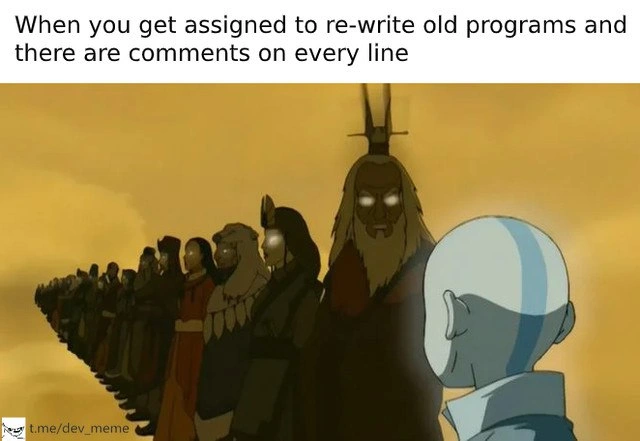
A meme based on a scene from the animated series 'Avatar: The Last Airbender'. The image has a caption at the top that reads, 'When you get assigned to re-write old programs and there are comments on every line'. The scene depicts the character Aang, with his back to the viewer, looking at a long, ethereal line of his past incarnations (the Avatars), whose eyes are glowing. A small watermark for 't.me/dev_meme' is in the bottom left. The meme draws a powerful analogy between the developer and the Avatar. The endless line of past Avatars represents the numerous developers who have previously worked on the legacy codebase. The ubiquitous comments are the voices and decisions of these 'ancients,' which the current developer must now interpret, respect, or discard. For senior engineers, it captures the feeling of archaeological work required to understand an old system, where every comment is a clue from a different era of the codebase's history
Comments
7Comment deleted
Each comment is a ghost of a developer past, whispering conflicting requirements from a bygone era. Your job is to appease them all without angering the vengeful spirit who wrote the original build script in Perl
Activating the Avatar State is just reading 3 kLOC where every ancestor dutifully comments “// increment i” but not one explains why the billing loop runs twice on Tuesdays
The comments explaining what i++ does are from 2003, but the actual business logic was written by Avatar Roku who left the company during the dot-com bubble and nobody knows why we multiply by 0.97 before the database commit
Ah yes, the classic 'every line commented' legacy codebase - where you discover gems like '// increment i' above 'i++' and '// return true' above 'return true;'. It's the archaeological equivalent of finding a tomb where every brick has a sticky note explaining what a brick is. The real kicker? Half the comments contradict the actual code behavior because someone 'fixed' the logic but not the novel they wrote about it. At this point, you're not refactoring - you're performing literary criticism on someone's stream-of-consciousness debugging diary from 2003
A file with comments on every line is an eventually consistent event store of past maintainers; my rewrite is basically running Raft with ghosts
Comments on every line? Your past self's verbose apology tour for hacks that should've been refactored a decade ago
Legacy code with comments on every line isn’t documentation - it’s constitutional law; your rewrite is judicial review, and overturning one precedent summons the 2009 SOAP integration and a 3 a.m. rollback