When the Rust Compiler Tries to Be Helpful
Why is this Languages meme funny?
Level 1: Solving a Mystery
Imagine you’re doing a big puzzle, and every piece is supposed to fit together to show one picture. Now suppose one puzzle piece from a completely different puzzle got mixed in. When you try to put it together, the puzzle won’t look right because that one piece doesn’t match. Your friend (who is very smart but talks a lot) gives you a long note explaining which piece is wrong and why. The note has all the info you need, but it’s so detailed that you feel like you need to become a detective to understand it. You cover a wall with the puzzle picture, pin the strange piece to it, and draw red lines between the note and the puzzle pieces, trying to figure it all out. It’s a crazy scene for what turned out to be a simple problem: one piece didn’t belong.
In this meme, the computer is the friend giving a detailed explanation (that’s the Rust compiler error message), and the mismatched puzzle piece is like the one branch of code that returned the wrong type. The programmer is acting out the detective scene – just like a person on a crime show with a conspiracy board – to decode that explanation. It’s funny because usually fixing a coding mistake isn’t literally like solving a crime, but sometimes it feels that way! The joke is that the programmer turned a straightforward issue (one part of the code didn’t match the others) into a dramatic mystery investigation. In the end, they’ll find the “culprit” (the place in the code that returned the wrong thing), fix it, and the puzzle (program) will finally make sense.
Level 2: Match Arm Mismatch
Let’s break down what’s happening in this meme in plain terms. Rust is a programming language that cares a lot about types being correct. When you write a Rust program, the compiler (the program that checks your code and turns it into something the computer can run) will stop and show an error if something doesn’t make sense type-wise. One common rule in Rust is that in a match (which is Rust’s powerful version of a switch/case or an if-else chain), all arms of the match must produce the same type of value. Think of a match like a machine with multiple input channels (each arm is a channel): no matter which channel your data goes through, the machine should output the same kind of thing at the end. You can’t have one channel output an apple and another output nothing at all, because then the machine wouldn’t know what type of thing it’s ultimately giving you.
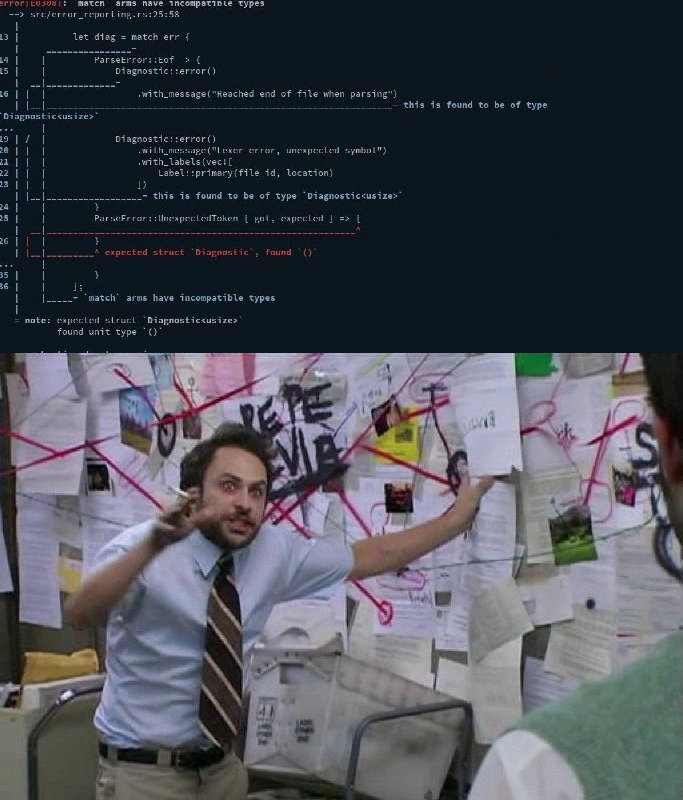
In the top half of the meme, the dark terminal screenshot shows a Rust compiler error complaining that the match arms have incompatible types. The text expected struct 'Diagnostic', found '()' is a huge hint. Here, Diagnostic<usize> is a specific type (probably some error-report object with an integer inside) and () (pronounced “unit”) is a special type in Rust that means “nothing” or “no value.” The compiler is basically saying: “I was expecting a Diagnostic from this match, but one of the arms gave me () instead!” This usually happens if one of the match arms ended without returning the Diagnostic value. For example:
enum ErrorType { Eof, UnexpectedToken }
fn make_diagnostic(err: ErrorType) -> Diagnostic<usize> {
match err {
ErrorType::Eof => {
// This arm returns a Diagnostic<usize> value:
Diagnostic::error().with_message("Reached end of file")
}
ErrorType::UnexpectedToken => {
// This arm mistakenly has a semicolon, so it returns nothing ():
Diagnostic::error().with_message("Unexpected token");
}
// ↑ Because of the semicolon, the second arm's value is `()`, not a Diagnostic.
}
}
In the code above, the first arm returns a Diagnostic<usize> (by calling Diagnostic::error().with_message("...")), but the second arm has a stray semicolon at the end. In Rust, ending an expression with ; turns it into a statement that yields (). That means the second arm doesn’t return the Diagnostic like the first arm; it returns the unit type (). This is exactly a match arms mismatch – one arm gives a real value, the other gives nothing. The Rust compiler catches this and throws the error E0308 to tell you “hey, these two need to match up.”
Now, the funny part: the bottom image of the meme (the guy with the wall of papers and red strings) is a popular reference showing someone acting like a detective who’s gone a bit crazy with a conspiracy board. Papers everywhere, red threads linking clues, frantic explaining – it’s the international symbol for “I’m trying to figure out something insanely complicated.” The joke here is that deciphering Rust’s error message made the developer feel like a conspiracy detective. The error message provides all the information, but it’s quite verbose (lots of lines, notes, and details). If you’re new to Rust, reading an error like “expected struct Diagnostic<usize>, found unit type ()” might not immediately click. You have to connect the dots: find which match arm gave a Diagnostic and which one gave (). The developer in the meme is visualizing this process as if they literally printed out the error text and code, pinned them to a wall, and drew red lines between the related parts to solve the mystery. It humorously exaggerates the debugging process.
In reality, Rust’s long error messages are there to help you. They’re telling you exactly what went wrong and where. But to a less experienced programmer, it can feel overwhelming – almost like reading a riddle. Terms like CompilerErrors, ErrorMessages, and strict rules of the Language can be daunting. This meme is poking fun at that feeling. It’s saying: “Rust told me exactly what’s wrong, but I still ended up staring at it like a mad detective until I finally understood!” Many of us have been there: you stare at the screen, read the error, scroll up and down the code, maybe add some println!s or ask a colleague, and eventually have that “Aha!” moment when you realize, for example, “Oh! This arm returns nothing because of that semicolon!” The moment of solving it feels almost as satisfying as cracking a case. And after you fix it (like removing the extra semicolon or making sure every branch returns a Diagnostic), the code compiles and it’s like the mystery is resolved.
So, in simple terms: the top of the meme shows a Rust error complaining about a type mismatch in a match, and the bottom shows a developer acting like a detective trying to make sense of it all. It’s a light-hearted take on Debugging and LanguageQuirks – highlighting that learning Rust’s strict type system can be a bit of a wild ride, but also a fun challenge once you get used to reading the clues.
Level 3: The Unmatched Type Conspiracy
This meme strikes a chord with experienced Rustaceans because it captures that “Wait, what does this error even mean?” moment. The top half is a real Rust compiler message complaining about mismatched types in a match expression. In Rust (a language notorious for both its safety and its sometimes verbose compiler errors), all arms of a match must return the same type. Here, the error error[E0308]: match arms have incompatible types is basically the compiler’s way of saying, “One of these things is not like the other.” One branch of the match returns a Diagnostic struct, while another branch returns nothing at all (() – the unit type), and Rust isn’t going to let that slide. Seasoned developers have seen this before: it often happens when you accidentally put a semicolon at the end of one branch or forget to provide a return value in one of the arms. It’s a classic Language Quirk in Rust that can lead to big DebuggingFrustration for newcomers.
The humor is amplified by the bottom image: the frantic detective (Charlie from It’s Always Sunny in Philadelphia) furiously connecting pins and strings on a conspiracy board. Every experienced dev has had a moment like this, combing through compiler output like it’s a set of cryptic clues. The Rust compiler actually gives pretty detailed clues! In the screenshot, it annotates the code, indicating “this is found to be of type Diagnostic<usize>” next to one branch, and then in the error note it says it expected that type but found () in another branch. A grizzled coder will chuckle because they remember their own debugging troubleshooting sessions at 2 AM, practically turning into conspiracy theorists: “Why is this type not lining up? Where is this unit type coming from?!” It can feel like you’re mapping out a murder mystery where the killer was a missing return value all along.
The unspoken joke here is that Rust’s compiler errors, while extremely informative, often look overwhelming at first glance. There’s even an infamous saying in Rust communities: “The compiler is your friend (but sometimes a very talkative friend).” The developer in the meme is treating the error message like a puzzle to be solved, pinning each piece of information on the wall. Let’s break down the “clues” that our conspiracy-board detective (the developer) is working with from the error:
- Clue 1: The main error line
match arms have incompatible typesimmediately tells us the match arms don’t agree on the result type. In Rust, that’s a big no-no. - Clue 2: The compiler provides a note: expected struct
Diagnostic<usize>, found(). This explicitly points out the type mismatch: one arm yielded aDiagnostic<usize>(some error-reporting structure, probably with a numeric ID type), but another arm yielded(), the equivalent of “no value.” - Clue 3: The error output even highlights the code. In the snippet, one arm calls
Diagnostic::error().with_message("...")and the compiler comments “this is found to be of typeDiagnostic<usize>” next to it. Another arm likely ends with a stray semicolon or lacks a return, resulting in the unit type. The detective-dev is essentially drawing red strings from those compiler notes to the corresponding lines of code to pinpoint the mistake.
For a senior developer, the scenario is hilariously familiar. It pokes fun at how we sometimes overthink a compile error. In reality, the fix might be simple (maybe remove a semicolon or return a similar Diagnostic in the other branch), but in the moment, faced with a screen full of CompilerErrors, you feel like you’re decrypting the Zodiac cipher. The meme brilliantly combines strict_type_system_humor with the classic over-analysis trope. It’s saying: Rust’s compiler gives you all the evidence, but you might still end up feeling like a conspiracy theorist trying to connect it all. And honestly, any dev who’s wrestled with a tough bug or error message can relate — sometimes debugging feels less like programming and more like detective work with a dash of madness. At least in this case, the language is on our side: Rust caught the bug at compile time, even if deciphering that message made the dev look like a madman for a minute.
Level 4: The Unification Puzzle
In Rust’s type system, every match expression must resolve to a single, well-defined type through a process of type inference. Under the hood, the compiler is performing a kind of constraint solving: each match arm provides a type, and the compiler attempts to unify these types into one overall result type. If one arm yields a Diagnostic<usize> while another arm yields () (the unit type meaning "no value"), the constraints conflict. In formal terms, the compiler has a type equation it cannot satisfy – it's like solving for X in X = Diagnostic<usize> and also X = () simultaneously. There is no possible X that equals both a complex Diagnostic struct and the empty () type, so the unification fails and we get an error.
Rust’s design follows a rich tradition of strong static typing similar to ML or Haskell, where all branches of a conditional expression must produce the same type. This originates from the theory of sum types and exhaustive pattern matching: a match is an expression that yields a value. In languages with Hindley-Milner style inference, the compiler would assign a type variable to the whole match expression and unify it with each arm’s type. Here, one arm unified the match’s type variable with Diagnostic<usize>, but another arm unified it with the unit type. The Rust compiler (rustc) deduced the generic parameter <usize> for Diagnostic from context (perhaps Diagnostic is parameterized by an ID type), adding another layer of specificity to the constraint. When the compiler reports expected struct Diagnostic<usize>, found unit type (), it is essentially telling us that it deduced the match should produce a Diagnostic<usize> but encountered an arm producing (), which is a type mismatch with no automatic conversion or common supertype to reconcile them (Rust has no implicit coercion from () to anything else).
It’s interesting to note how verbose error messages like Rust’s are a reflection of these underlying algorithms at work. They often include notes and labeled spans in the code (as seen in the meme’s screenshot) to show exactly where each type comes from. This verbosity arises from the compiler trying to construct a mini proof or explanation: it’s effectively saying “I inferred this arm is of type Diagnostic<usize> and that arm is of type (); since Diagnostic<usize> ≠ (), I cannot reconcile the types.” In theoretical CS terms, () is the unit type (a type with exactly one possible value, analogous to a singleton set), and Diagnostic<usize> is a richer algebraic data type. The compiler’s type system (a form of formal verification light at compile-time) rejects the program because the type constraints can’t all be true at once. It’s a bit like a logical proof failing: one branch’s type assertion contradicts another’s. The humor here is that an unwary developer might feel they need a PhD in type theory – or a crazy conspiracy diagram – to follow the compiler’s logical deduction, when in fact the compiler is doing exactly what it should to uphold Rust’s guarantee that if it compiles, it’s probably correct.
Description
A two-panel meme. The top panel contains a screenshot of a code editor with a dark theme, displaying a verbose Rust compiler error. The error message, 'error[E0308]: match arms have incompatible types', is shown with detailed ASCII art pointing out that different branches of a 'match' statement are returning different types: one returns an 'expected struct `Diagnostic`' while another returns a 'unit type ()'. The bottom panel features the famous 'Pepe Silvia' conspiracy board meme from 'It's Always Sunny in Philadelphia,' where Charlie Kelly frantically explains his convoluted theories in front of a wall covered in notes and connected by red string. This meme humorously equates the experience of deciphering a detailed, yet overwhelming, Rust compiler error with the feeling of descending into a mad conspiracy. For senior developers, it's a relatable take on the Rust experience: the compiler is an incredibly powerful and helpful tool that prevents bugs, but its exhaustive explanations can sometimes feel like a complex puzzle that pushes one's sanity to the limit
Comments
7Comment deleted
The Rust compiler gives you so much information to fix your bug that you start to feel like you're not debugging code, you're just a few red strings away from discovering who really wrote the initial commit
rustc builds a full red-string detective board to explain E0308, only to reveal the culprit was a lone semicolon that converted your Diagnostic into ()
After 15 years in the industry, you realize the real conspiracy isn't who Pepe Silvia is - it's why your perfectly typed struct suddenly thinks it's incompatible with itself after passing through three layers of generic abstractions and a macro expansion
When the Rust compiler gives you a type mismatch error, you don't just fix the bug - you embark on a full forensic investigation through your entire codebase, connecting lifetime annotations with red string until you realize the real error was the `Option<T>` you unwrapped along the way. Senior engineers know: Rust doesn't have bugs, it has 'opportunities for architectural enlightenment' that require a PhD in type theory and the investigative skills of a detective to resolve
E0308 is Hindley - Milner asking your match arms to unify; a single semicolon argues for returning (), and rustc takes its side every time
Rust: “expected Diagnostic<'_>, found ()” - the moment you break out the red string to trace how a single semicolon erased a match arm’s return and confused type unification
TypeScript template literals: Trading runtime bugs for compiler errors that demand a type theory exorcism