
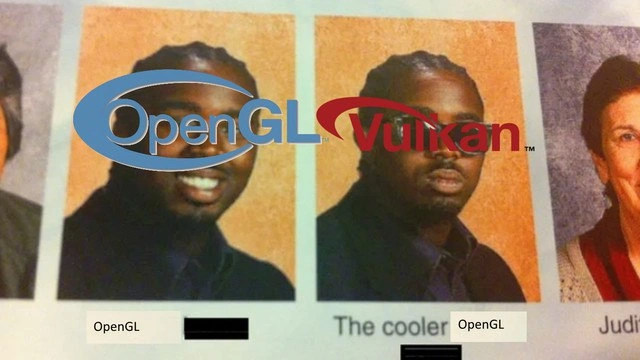
OpenGL meets its 'cooler' successor Vulkan in classic yearbook meme format
Description
The image uses the well-known two-panel yearbook layout from the “The cooler Daniel” meme. Both panels show the same bust portrait against a mottled orange background; the faces have been blurred. Under the left photo a white label reads “OpenGL,” while the right-hand label says “The cooler OpenGL.” A semi-transparent composite of the blue official OpenGL logo and the red stylized “V” from the Vulkan logo is overlaid across both portraits, visually hinting that Vulkan is being presented as the cooler version of OpenGL. For graphics programmers, the joke riffs on the long-running debate in the Khronos ecosystem that Vulkan’s lower-level, high-performance design is the modern, more impressive successor to the older OpenGL rendering pipeline
Comments
10Comment deleted
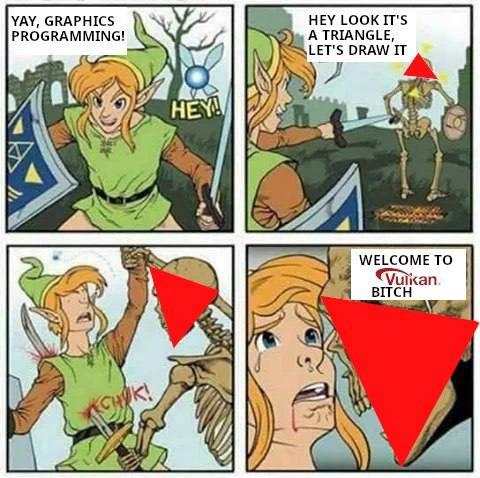
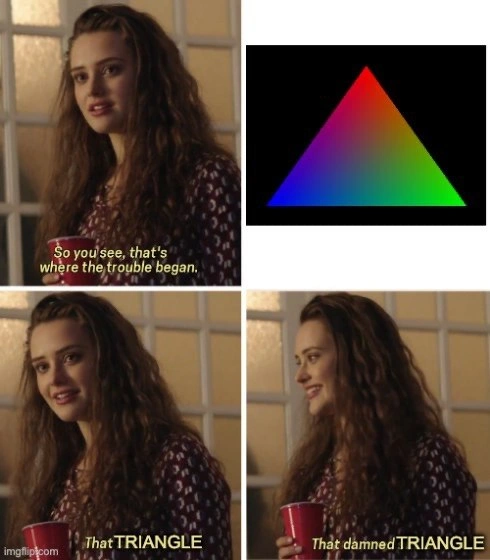
OpenGL: glBegin(GL_TRIANGLES); Vulkan, a.k.a. “cooler OpenGL”: first instantiate 12 descriptor sets, chain 5 pNext structs, schedule two pipeline barriers, then maybe - just maybe - you can draw a triangle
After 15 years of OpenGL's 'helpful' implicit synchronization and mysterious driver behavior, Vulkan arrives demanding you manually manage 47 different queue families and write 1000 lines of boilerplate just to clear the screen - and somehow we're all convinced this is progress because at least now we know exactly whose fault the race condition is
Ah yes, the eternal graphics programmer's dilemma: stick with OpenGL's friendly state machine that holds your hand through every draw call, or embrace Vulkan's 'here's 1000 lines of boilerplate to draw a triangle' philosophy. Sure, Vulkan gives you explicit control over synchronization, memory management, and command buffers - but at what cost? Your sanity, mostly. It's the API equivalent of switching from an automatic to a manual transmission: yes, you get better performance and control, but now you're responsible for not stalling at every intersection. And let's be honest, half the industry is still using OpenGL because rewriting that rendering engine would require explaining to management why we need six months to achieve the exact same visual output, just 'faster.'
OpenGL: the driver plays guess-the-state; Vulkan: you are the driver, the scheduler, and the blame in the postmortem - enjoy the consistent frame times
The cooler OpenGL? Vulkan: same triangle, but now you’re the driver - descriptor sets, PSOs, fences, and a VK_ERROR_DEVICE_LOST from the pipeline barrier you forgot
Vulkan: OpenGL after ditching the state machine for explicit sync - more control, fewer 'why did that render wrong?' moments
this Comment deleted
😳👍 Comment deleted
Vulkan > OpenGL > DirectX Comment deleted
Кек Comment deleted