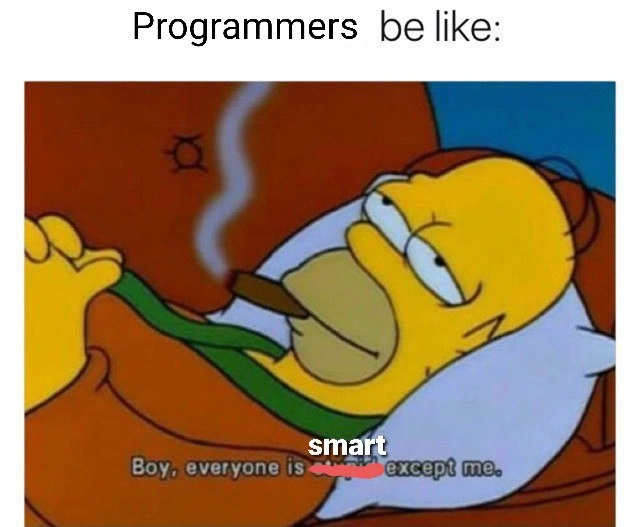
Programmers and impostor syndrome: convinced everyone else is smart except themselves
Why is this MentalHealth meme funny?
Level 1: The Odd One Out
Imagine you’re in a classroom and it seems like all the other kids understand the lesson, but you’re completely confused. You’d probably start to feel like you’re the only one who doesn’t “get it,” right? You might think, “Wow, everyone else is so smart except me.” That’s basically what this meme is about, but in a programming world. It’s a funny picture showing a cartoon character (Homer Simpson) looking proud and saying that line, except it’s changed to say everyone is smart and he’s not. The reason it’s funny is that a lot of people (not just kids in class, but grown-up programmers) feel this way sometimes. It’s like being on a soccer team where you’re sure every other player is a star, and you’re the only one who doesn’t know how to kick the ball properly. In reality, probably some of those other kids or players also feel unsure about themselves, but on the outside they all seem confident. So the meme is joking about that feeling – feeling like the odd one out who thinks they’re not as good as everybody else. It makes us laugh a bit, and also go “aww, I’ve felt like that too,” because it’s a very human feeling.
Level 2: Everyone Seems Smart
Now let’s break down the meme in simpler terms for a less experienced developer or someone new to these concepts. The core idea here is impostor syndrome – a term used to describe the feeling that you’re not as competent as others believe you are, and that you’re going to be exposed as a “fraud” who doesn’t actually know what they’re doing. In the context of programming, it means a developer (often a junior, but really it can be anyone) believes all the other programmers are so much smarter or more skilled, while they themselves think they just got by on luck or trickery. The meme literally states that feeling: “Boy, everyone is smart except me.” That’s exactly what runs through a developer’s mind when they have impostor syndrome. They look around and assume every other developer is brilliant, knows everything from algorithms to the latest framework, and here they are struggling with something basic.
The image is a frame from The Simpsons, a famous animated TV show known for its humor. In this frame, Homer Simpson is lying back, smoking a cigar with a very self-satisfied grin. Originally, Homer was saying “everyone is stupid except me,” implying he arrogantly thought he’s the only smart one around. But the meme creator modified it by scribbling out the word “stupid” and replacing it with “smart.” So Homer’s caption now reads “everyone is smart except me.” This twist turns Homer’s cocky joke into a statement of self-doubt. It’s a quick visual gag: the red scribble and white overlay text look obviously edited, which is part of the meme’s charm – it’s like a quick hack to repurpose the scene. The contrast between Homer’s smug face and the insecure message is intentionally silly. Homer looks proud and relaxed, yet the words express insecurity. That mismatch is humorous and emphasizes how absurd the negative self-talk can be. It’s as if even Homer (who is usually bumbling) is confidently lounging, while the programmer (in Homer’s shoes) paradoxically feels like the only dumb person in a world of geniuses.
So why do programmers often feel this way? A few reasons. First, technology is a huge field – no one knows everything, but when you’re new, you might not see that. For example, a junior developer might struggle to debug a simple app while hearing that a teammate just implemented a fancy machine learning pipeline or contributed to an open-source project. That junior starts thinking, “Wow, they’re doing all that and I can barely get my code to run. They must be super smart, and I’m... not.” What the junior doesn’t realize is that perhaps the teammate who did the machine learning pipeline might be completely lost when it comes to something the junior knows, like a new front-end library. But people don’t usually broadcast what they don’t know or the struggles they had. You mostly see the outcomes: the cool project got finished, the code looks clean in the repository, the answers on Stack Overflow are well-written and upvoted. You don’t see the hours of confusion, the bugs, the Google searches behind it.
Stack Overflow, by the way, is a Q&A website virtually every programmer uses to find solutions and examples. It’s so common that even senior engineers copy code from it or search how to do things (yes, even how to exit Vim or use a particular library!). But a junior dev might think, “Real programmers know this off the top of their head. I had to look it up – I must be an impostor.” In reality, relying on resources is a normal part of the developer experience (DX). The tag DeveloperExperience_DX often refers to making developers’ lives easier (through good tools, documentation, etc.), but here we can also think of it as the overall experience of being a developer, which includes these emotional challenges. A healthy developer experience would mean acknowledging it’s okay to ask questions and not know everything immediately. Impostor syndrome can be seen as a mental health aspect of that experience – it’s about one’s confidence and anxiety in the workplace or coding community. It’s why mental health is referenced; feeling like a fraud can affect a developer’s stress levels and enjoyment of their work.
Let’s decode some tags and elements:
- ImposterSyndrome (often spelled impostor with an ‘o’, but both spellings are used): This is the star of the show. It’s the persistent feeling that you don’t belong or aren’t good enough, despite evidence to the contrary. You might have completed projects or even gotten praise, but you write it off as luck or think others could have done it better.
- DeveloperSelfDeprecation: This refers to developers joking about themselves in a negative way (self-deprecating humor). The meme itself is an example: a programmer calling themselves the only non-smart person is a form of joking at one’s own expense. It’s very common in developer humor to poke fun at one’s own abilities – like saying “I’m a terrible coder” while actually being decent. It’s a way to bond with others (since many feel the same) and also to stay humble.
- RelatableDeveloperExperience and DeveloperHumor: These tags mean this meme is something many developers can relate to, and it’s using humor about the developer life. Pretty much any programmer who sees “everyone is smart except me” will likely chuckle and think, “Oh man, I’ve felt exactly that.” It’s relatable because it captures an emotional experience nearly universal in tech.
- Programmer_insecurity and DeveloperPsychology: These underline that the content is about the insecurity programmers feel. Developer psychology is a broad idea covering how programmers think and feel. Impostor syndrome is a big psychological pattern in the field.
- Simpsons_reference and homer_simpson_meme_frame: This just notes that the meme is borrowing from The Simpsons. The Simpsons is a treasure trove for memes because it has so many memorable scenes. In tech circles, using a Simpsons reference adds a dash of pop culture that many in the audience grew up with or at least recognize. Homer Simpson, lying back with that smug face, is a funny choice because usually you’d think of a super confident character saying “everyone is stupid except me.” Replacing it to show a lack of confidence makes it ironic and amusing.
- Self_doubt_humor: This tag captures exactly the style of joke: it’s humor coming from self-doubt. Instead of bragging, the joke is “I’m the one who doesn’t get it.” It’s like the opposite of bragging, and that contrast often makes people laugh in a that’s so true kind of way.
Consider a real-life junior developer scenario: Imagine it’s your first month on the job. You’re tasked with adding a small feature to the team’s project. You write some code, but you’re not sure if it’s the best way. Meanwhile, during the team meeting, another developer talks about a complex performance issue they solved or a new library they introduced to improve the system. Another colleague mentions they just finished a certification in cloud architecture. All this jargon and achievement makes you feel about two inches tall. You’re sitting there thinking, “I’m struggling with this tiny feature, and everyone else is doing rocket science. I’m definitely the weak link here.” That feeling is exactly “everyone is smart except me.” But what you don’t see: maybe the person who solved the performance issue struggled for days and asked for help from a senior. The one with the certification probably spent months studying and failed the first attempt. They might not broadcast those struggles, but they happened. No one is an expert in everything, and every expert was once a beginner.
In tech, it’s also common that each person has their niche. The front-end wizard might feel stupid when database indexing is discussed. The database guru might feel lost when people talk about machine learning. So each of them might, in certain conversations, quietly think, “Wow, everyone here is smart except me.” If they all admitted it, they’d realize it’s just that each one has strengths in different areas. That’s why teamwork in development is a thing – you combine different skill sets. But when we forget that, we unfairly measure ourselves against a composite image of “the perfect developer” (who doesn’t exist).
The meme’s popularity in developer circles also hints that talking about impostor syndrome has become more open. In the past, a junior engineer might have been afraid to admit they feel clueless, worrying it would make them look weak. Nowadays, it’s frequently discussed at tech conferences, blogs, and even within teams, because so many realized “Hey, I feel this way too!” Knowing that even the person you idolize has bouts of self-doubt can be hugely relieving. Some companies address it in onboarding, basically telling newcomers that impostor syndrome is normal and they shouldn’t let it discourage them. That’s part of improving developer experience – not just giving better tools but also fostering an environment where people aren’t terrified of being “found out.”
The mental health angle is important: constantly feeling like you’re not good enough can lead to stress, burnout, and anxiety. It’s hard to write good code when you’re second-guessing every line, thinking “a real programmer would do it better.” So memes like this, while humorous, also shine light on the need for empathy in tech teams. If everyone realizes others feel the same insecurity, it helps create a supportive culture where you can admit not knowing something without shame. It’s a gentle reminder not to put others on a pedestal and put yourself down. As the meme jokingly suggests, if you think everyone around you is a genius except you, odds are they’re quietly thinking something similar about someone else (maybe even about you regarding something you know well!).
Level 3: Comparison Overflow
At the highest level, this meme exposes a paradoxical quirk of software engineering culture: the prevalence of impostor syndrome among developers. In a field brimming with genius-level problem solving and rapid innovation, it’s ironic how many seasoned programmers privately feel like frauds. The image cleverly repurposes a classic Simpsons scene – Homer’s original smug line “Boy, everyone is stupid except me” is revised to “everyone is smart except me,” encapsulating the exact thought loop of a self-doubting coder. The humor bites because it flips a confident pronouncement into a statement of deep insecurity, highlighting how out of place even a capable programmer can feel.
In practice, this manifests whenever developers compare themselves to peers or online experts. One might fix a gnarly bug at 3 AM and still wake up convinced it was just luck or a one-off fluke. Meanwhile, a colleague effortlessly references some esoteric O(n log n) algorithm optimization or knows the minutiae of Kubernetes YAML by heart, and suddenly you feel like you’re the only one Googling basic syntax. This phenomenon is so common it’s practically an inside joke: everyone in the team secretly thinks they’re the least qualified, and thus by logical absurdity, everyone is wrong. Yet the feeling persists, creating a kind of mental “comparison overflow” – an overload of self-critique triggered by over-comparing oneself to an often idealized image of others. Much like a buffer overflow in C where extra data wreaks havoc, constantly stacking yourself against seemingly “genius” coworkers or open-source rockstars will overflow your confidence buffer, leading to errors in self-assessment.
From a senior developer’s perspective, the meme hits home because even veteran engineers with years of experience aren’t immune. In fact, gaining experience often illuminates just how vast the field is, which paradoxically increases the sense that one’s own knowledge is a drop in the ocean. There’s a well-known cognitive pattern at play here closely related to the Dunning-Kruger effect: truly skilled folks are keenly aware of what they don’t know, while less skilled people might overestimate themselves. So the more you learn, the more you realize you aren’t the smartest in every domain – fueling that impostor feeling. A senior dev might be an expert in, say, database query optimization, but drop them into a frontend React hooks discussion or a machine learning model review and they’ll suddenly feel like the dumbest person in the Zoom call. The industry’s fast pace means there’s always some new framework, some 10x engineer on Twitter posting unbelievable code, or some brilliant answer on Stack Overflow that makes the rest of us think, “Wow, I’d never have thought of that; am I even qualified to do this job?”
This shared “I’m not worthy” illusion thrives in tech due to certain systemic factors. Developer culture often idolizes “rockstar” programmers and savants who seemingly crank out flawless code in one sitting. Company job postings ask for "expert in everything" and tech conference speakers dazzle with cutting-edge techniques. Surrounded by the success stories, a normal developer ends up feeling like an impostor by comparison. Ironically, each of those “rockstars” likely has moments of doubt too. But in daily work culture, people rarely admit confusion openly – stand-ups are full of confident updates, code reviews come back with insightful comments, and knowledge-sharing sessions can feel like intellectual show-and-tell. It creates an optical illusion of competence: everyone else radiates confidence and knowledge, while your own uncertainties are hidden inside your head. Cue the internal monologue: “They all have it together. I’m the only one Googling every other line of code.”
Humorously, tech memes like this serve as a form of group therapy. The sight of Homer Simpson smugly declaring the exact opposite of what a self-doubting programmer feels is absurd, yet instantly relatable. The crudely edited subtitle (scribbling out “stupid” and overlaying “smart” in bold white) mirrors how blatant and common this thought is – it’s not subtle at all. It’s a visual way of saying “flip Homer’s attitude 180°, and you get me, the typical programmer, silently convinced of my own inadequacy.” The warm Simpsons color palette (orange, yellow, blue) contrasting with the stark white text highlights how jarringly out-of-place that feeling can be: warm, everyday life on the surface, burning self-doubt underneath.
For the grizzled senior engineers, there’s a dark comedy in this: we’ve all onboarded a new technology and felt like we’ve regressed to newbie status. Picture a staff engineer who can design a distributed system in her sleep, now forced to pair-program in an unfamiliar language. Suddenly she’s thinking, “Everyone here picks this up so fast… what’s wrong with me?” But of course, everyone else is thinking the same in some context or another. The meme elicits a wry chuckle because it’s both ridiculous and true: in a room of brilliant developers, each one might secretly believe they’re the imposter. It’s a whispered secret of the trade. As a result, the phrase “everyone is smart except me” has become a kind of tongue-in-cheek mantra in developer communities, often met with knowing nods and replies like “Story of my life, dude.” This self-deprecating humor is a coping mechanism, a way to bond and acknowledge the unseen reality that feeling inadequate is practically a rite of passage in the developer experience.
Description
Meme layout: A white banner at the top says in black text, “Programmers be like:”. Below it is a frame from The Simpsons showing Homer Simpson reclining on a pillow, eyes half-open, puffing a cigar with a smug grin. A faint grey smoke trail rises from the cigar. At the very bottom of the frame is a subtitle that originally read, “Boy, everyone is stupid except me,” but the word “stupid” is scribbled over in red and replaced by a bold white overlay that reads “smart,” so the full visible caption is “Boy, everyone is smart except me.” The scene’s warm orange, yellow, and blue palette contrasts with the stark white text overlay. Technically, the meme pokes fun at developers’ pervasive impostor syndrome - despite writing complex code they still feel intellectually outclassed by peers - highlighting common emotional dynamics in engineering culture and the psychological side of developer experience

Comments
6Comment deleted
My impostor syndrome peaks when the intern asks why we picked event sourcing and I quietly Google my own 2015 conference talk to find the answer
The same developer who can debug a race condition in a distributed system at 3am will spend 20 minutes googling how to center a div, then question if they're really cut out for this industry
Every senior engineer at 3 AM reviewing a junior's elegant solution to a problem they've been overthinking for three days: 'Boy, everyone is smart except me.' The real imposter syndrome is realizing that the 10x developer you've been intimidated by also Googles 'how to exit vim' every six months
My ego runs eventual consistency - between “I’m the only adult in prod” and “everyone else is smarter”; replication lag spikes right after code review
Impostor syndrome - our most reliable service: five nines uptime, scales with headcount, and zero observability
Imposter syndrome: the one tech debt that accrues O(n) interest, where n is years wrestling monoliths into microservices