Skip to content
DevMeme
5642 of 7435
A 'Circle' in the Triangle Factory: A Metaphor for Software Abstraction
DesignPatterns Architecture Post #6192, on Aug 25, 2024 in TG

A 'Circle' in the Triangle Factory: A Metaphor for Software Abstraction

Why is this DesignPatterns Architecture meme funny?

Level 1: Looks Round, Built Flat

Imagine you have a box of triangular tiles, and you want to make a big round picture (like a circle) on the floor. How would you do it? You’d probably place those little triangles in a circle-like pattern. From far away, it might look like one big round shape, but when you get closer, you notice it’s actually made of many tiny triangle pieces. This is exactly how a computer draws a “sphere” or any round object in a video game!

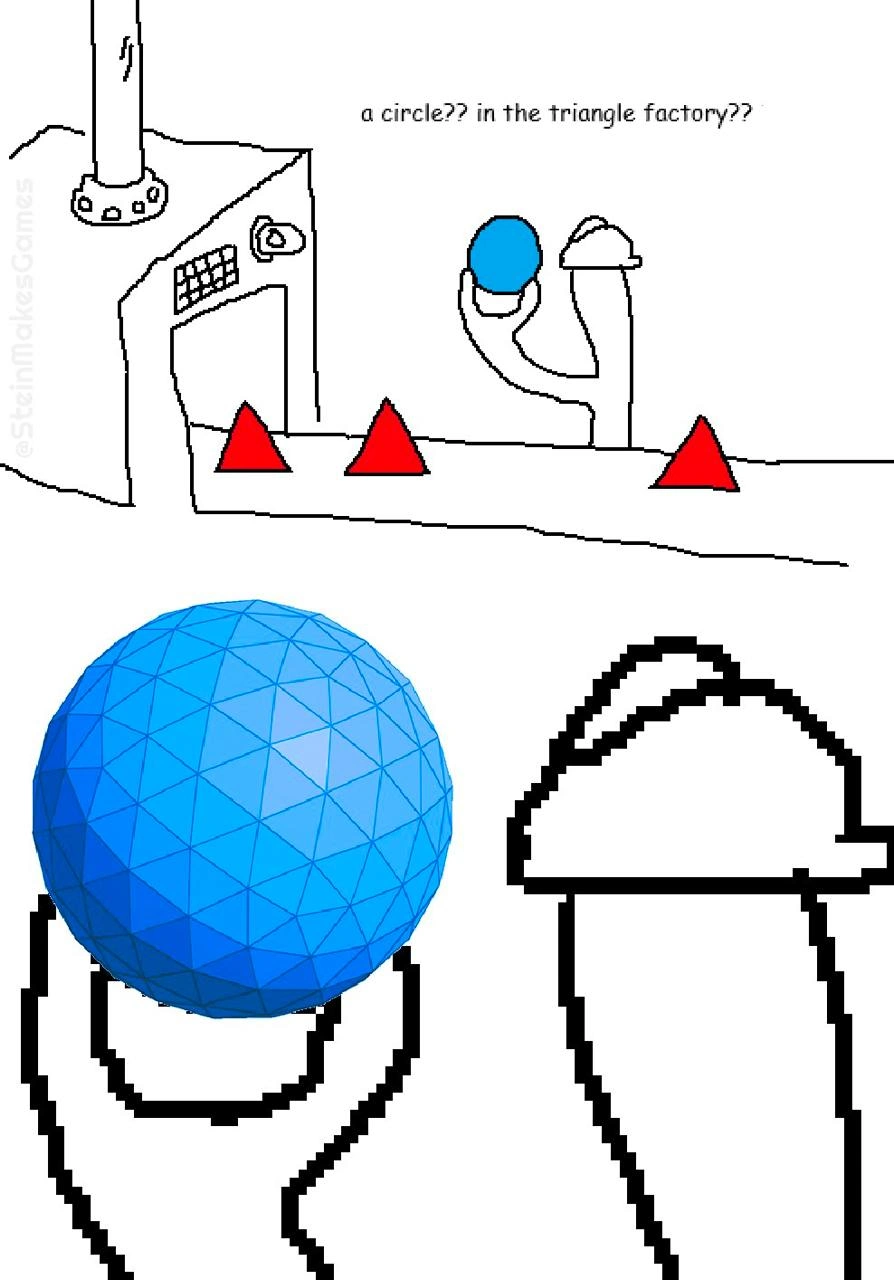
In the meme’s story, we have a pretend factory that makes only triangles (silly, right?). Now, suddenly, a blue ball (a circle-ish thing) appears on the factory line, and the factory workers are surprised – “Hey, who put a circle in our triangle factory?” 😮 But the funny reveal is that the blue ball is not a real smooth ball at all; it’s constructed from the factory’s triangles stuck together. It looks round, but it’s built out of flat pieces. It’s like if you made a snowman out of lots of little flat snowflakes pressed together – from a distance it’s a round snowman, but up close you see all the flat snowflake shapes.

The reason this is funny to developers is kind of like an inside joke: they all know that computers cheat a little when drawing round things. Instead of drawing a perfect curve (which is hard for a computer to do with pixels), the computer makes lots of small flat shapes (like pieces of a mosaic or LEGO™ bricks) to fake a curve. So in this cartoon, the factory only makes triangles (the little pieces), and naturally even the “circle” on the conveyor belt is actually just another one of their triangle products — just arranged in a round form. In simple terms, any round thing you see in a game is really made of tiny flat bits. The meme makes us laugh because it shows that idea in a goofy, literal way: a confused factory worker thinking something’s wrong, then realizing nothing’s wrong at all. The “circle” was just their triangles playing dress-up as a round object!

Level 2: Low-Poly Life

In game development and 3D graphics, round things aren’t actually perfectly round – they’re made of flat pieces. This comic highlights that with a bit of humor. The blue ball (which looks like a circle or sphere) is actually composed of many small triangles. In 3D modeling terms, we call that a triangle mesh: imagine a soccer ball, but instead of patches of leather, you have triangles fitted together to form the shape. Each triangle is perfectly flat, but when you join enough of them at slight angles, you get an object that approximates a smooth curve. This particular blue sphere is “low-poly,” meaning it’s made of a relatively low number of polygons (polygons here are basically triangles, since that’s the primary shape used). Low-poly spheres have a chunky, faceted look – you can see each individual flat face. If we increased the number of triangles (making a high-poly sphere), the faces would be so small that the sphere would look smooth to our eyes. But of course, more triangles means more work for the computer to draw, which is why there’s always a trade-off in GameDevelopment called the polygon_budget (i.e. how many triangles you can spend on an object).

Now, what’s with the “triangle factory” setup in the meme? It’s a funny way to visualize the graphics pipeline inside a computer. You can think of the graphics pipeline as a factory assembly line whose raw materials are vertices (points in 3D space) and whose products are triangles that get turned into pixels on your screen. In many frameworks (from older ones like basic OpenGL to higher-level ones like Three.js), when you create any shape – be it a car, a character, or a sphere – you actually define it by listing its corner points and how those points connect into triangles. The GPU (Graphics Processing Unit) then takes each triangle through a series of steps (vertex shading, shape assembly, fragment shading, etc.) to draw it. So, this meme jokingly pretends there’s a real factory with conveyor belts where triangles are the only allowed output. The text “a circle?? in the triangle factory??” is the cartoon factory’s reaction to seeing something circular where only triangles are expected. It’s as if the computer’s rendering process itself said “Hey, I only deal in triangles – who snuck a circle in here?”

But of course, the twist is that the “circle” isn’t violating any rules; it’s actually made of triangles. In the bottom panel, we see the worker holding up the blue object proudly, and if you look closely, the surface of that ball is covered in little triangular facets. This is exactly how a 3D engine would handle a sphere shape. For example, if you use ThreeJS3DGraphics (a popular 3D library for the web) and create a sphere (new THREE.SphereGeometry if you were coding it), under the hood it generates a bunch of vertices and triangles that form a ball. If you inspected the SphereGeometry, you’d find arrays of coordinates and indices defining triangles. Likewise, in game engines or GraphicsProgramming generally, everything from the simplest coin to the planets in a space game is built from triangles connected together.

Some key terms here: low_poly_sphere just means a sphere made of few polygons (hence visibly faceted). A vertex_shader_pipeline is part of the rendering process that moves those vertex points around (for instance, to apply 3D rotations or camera perspective) before the triangles are drawn. All of it reinforces the same idea: what looks round and smooth in a final image is often composed of many small flat pieces behind the scenes. The humor in the meme comes from recognizing this truth. If you’re new to graphics or GameDevelopment, it’s a little “aha!” moment – so that’s how computers draw circles and curves! They fake it with lots of tiny straight lines or flat shapes. Once you learn this, you’ll never look at a video game the same way again: you might find yourself spotting the slight flatness on curved surfaces or realizing why older games had very blocky-looking characters (they didn’t have the budget for more triangles!).

Another wink in the meme is the idea of a “factory pattern.” In programming, a factory_pattern is a design that produces objects. Here it’s played for laughs as if we literally have a factory producing triangles. It’s gone_wrong in a comedic sense because a “circle” showed up where only triangles should be. But as we revealed, that circle is no intruder at all. For a junior dev or a student, the lesson underneath the joke is: nearly all 3D shapes are made from triangles. No matter if it’s a car model in Unity or a character in Minecraft, zoom in close (or switch to a wireframe view) and you’ll see those triangles. And when something looks perfectly round, it’s just that the triangles are really small or numerous. This is one of those foundational concepts in graphics programming that, once you know it, makes the whole field click into place – and that’s precisely why seeing it depicted as a goofy factory comic is both funny and enlightening.

Level 3: Triangles in Disguise

To an experienced game developer, this meme is an immediately recognizable joke about how 3D objects are constructed. The top panel sets up a playful rendering_irony: a factory that seemingly produces only triangles spots a “circle” on the conveyor belt and is shocked – “a circle?? in the triangle factory??”. But the punchline (in the bottom panel) is that the blue sphere the worker is holding is still made of triangles! The “circle” turned out to be just triangles in disguise all along. It’s poking fun at the fact that in game development, even the round objects are secretly faceted under the hood. In other words, the triangle_mesh has struck again.

For seasoned devs, this raises a knowing smile because we’ve all seen the wireframe view of a supposedly smooth model: it’s a spiderweb of countless triangles. That shiny blue sphere is a classic low-poly sphere, meaning it’s a sphere made with relatively few polygons (triangles). You can literally count the triangular facets on its surface. Every graphics programmer or 3D artist has encountered this when modeling or optimizing assets. Need a perfect curve? Sorry, you get a many-sided polygon. The more sides (triangles) you add, the smoother it looks – but you’re always trading off performance. This is where the term polygon_budget comes in: in real-time GameDevelopment, you often have an upper limit on how many triangles you can afford for a single object or scene. Use too many and your frame rate tanks; use too few and your “circle” looks like a chunky stop sign. Finding that balance is both art and engineering.

The humor also touches on how newbies perceive shapes vs how engines really work. A newcomer might innocently ask, “Why not just draw a perfect circle/sphere?” The grizzled engine coder chuckles because there is no perfect circle in rasterized graphics. It’s reminiscent of the classic developer trope “There is no spoon” – here it’s “There is no circle, only triangles.” 😆 The meme’s faux confusion (“a circle?? in the triangle factory??”) mimics that first moment of surprise when you learn that your GPU is basically a giant triangle assembler. The vertex_shader_pipeline is effectively an assembly line – a literal factory – stamping out triangles and only triangles. So the comic exaggerates: imagine a strict factory where triangles are the only allowed output. If a circular object shows up, it triggers an unexpected_shape_error in the factory’s “QA department”. In reality, of course, that disc or sphere just means a bunch of triangles arranged cleverly in a roughly round form. The second panel confirms it: the worker holds up the object and it’s revealed as a faceted, hard-edged sphere. Crisis averted – it was one of theirs after all! The “circle” was just an inside joke, a rogue product that looked different but was made of the same old parts.

This resonates with graphics programmers because it satirizes a universal truth of rendering: what you see is not what the data truly is. Even high-end game engines (Unreal, Unity) and APIs like ThreeJS3DGraphics or OpenGL treat every model as a collection of triangles. If you’ve ever switched your 3D modeling software or game editor to wireframe mode, you likely had this exact reaction: “Wait, my smooth character model is just thousands of little triangles connected together!” The meme playfully anthropomorphizes that idea – the factory workers are the engine’s vertex processing stages, and they’re bewildered by anything that isn’t a triangle… until they notice it actually is. It’s a case of a factory_pattern_gone_wrong in a comedic sense: instead of the code design Factory Pattern that produces objects, we have a literal cartoon factory producing geometric shapes. And in this “design”, the spec is strict: only triangles allowed!

For the veteran dev, there’s also a hint of nostalgia. We remember older games where low polygon counts meant you could see the triangles on round objects (think of the spherical items in Nintendo 64 or PS1 games – very faceted!). Back then, your sphere might literally be an icosahedron (20-sided polyhedron) painted to look round. Nowadays we hide triangles better with smoothing algorithms and higher budgets, but they’re still there. So this meme is basically a cheeky reminder: no matter how advanced the engine, we’re still living in a world of triangles. It’s a shared secret among graphics folks – one that’s equal parts absurd and genius – and that’s why the meme’s scenario is so relatable and funny.

Level 4: Triangles All The Way Down

In the deepest depths of ComputerGraphics, everything boils down to triangles. A 3D graphics pipeline (as used in engines like OpenGL or Three.js) fundamentally only understands simple flat surfaces – and the simplest polygon that can form a surface is a triangle. Why triangles? Because any three points in space define a plane. This means a triangle mesh (an object made of many tiny triangles) is a perfect way to approximate complex curved shapes with lots of flat facets. The vertex shader pipeline in GPUs is built on this assumption: it takes in lists of triangle vertices, transforms them (applying 3D rotations, perspective, etc.), and then rasterizes the triangles into pixels.

Under the hood, the GPU uses linear algebra and interpolation to fill in each triangle's interior with pixels. It uses concepts like barycentric coordinates – a fancy term for saying “take the values at the triangle’s three corners and smoothly blend them across the surface”. Triangles make this blending beautifully simple, because any point inside a triangle can be described as a weighted mix of the three corner vertices. Textures, lighting, and other effects are all calculated per triangle, with the GPU essentially solving equations on tiny three-cornered patches. A four-cornered shape (quadrilateral) might seem simpler, but if its points aren’t perfectly flat on one plane, it actually warps – so GPUs just break every quad into two triangles anyway. In fact, triangulation (breaking shapes into triangles) is a fundamental operation in computational geometry: any 2D polygon or 3D surface can be subdivided into many triangles without losing the shape.

Historically, this triangle obsession came from hardware and math constraints. Early 3D hardware in the 90s was optimized for drawing millions of triangles rapidly, using algorithms like Bresenham’s line drawing and scanline rasterization tailored to tri edges. Even today, dedicated silicon on your graphics card (rasterizers, vertex processors) are designed to chew through triangle lists with incredible speed. Graphics programmers know that if you feed the GPU something other than triangles, it will tessellate it into triangles internally. Even high-level curved surfaces (like NURBS or Bezier patches used in modeling software) get diced up into micro-triangles for rendering. It’s triangles all the way down: the low_poly_sphere in the meme’s second panel is a perfect example – it’s basically an icosahedron-like sphere refined into many small flat pieces. The more triangles you use, the closer those flat facets approximate a true mathematical sphere. In the limit (with infinitely many infinitesimally small triangles), you’d have a perfect circle or sphere. Of course, infinite triangles aren’t practical (GPUs would explode 😉), so developers choose a finite number – a polygon_budget – balancing visual smoothness against rendering cost. The bottom line is that the “circle” in any real-time 3D scene is an illusion, conjured by dozens or thousands of tiny triangles cooperating in disguise. This fundamental truth is baked into every game engine and GraphicsProgramming library: the hardware is a triangle factory, so everything – everything – it produces is ultimately made of triangles, no matter how round it looks.

Description

A two-panel, minimalist comic illustrating a concept in engineering and computer graphics. The top panel, a simple line drawing, depicts a factory with a conveyor belt carrying red triangles. A worker in a hard hat holds up a blue sphere, exclaiming, 'a circle?? in the triangle factory??'. A watermark on the left reads '@SteinMakesGames'. The bottom panel zooms in dramatically with a pixelated art style, showing a close-up of the worker's hand holding the blue sphere. In this view, it's revealed that the sphere is not a true circle but a complex geodesic dome, a 3D model constructed entirely from a mesh of small blue triangles. The joke is a clever visual pun on abstraction versus implementation. From a distance or at a high level of abstraction, the object is perceived as a sphere ('circle'). However, at the low-level, implementation view, it's composed entirely of triangles, the factory's legitimate product. This is a powerful metaphor for software development, where stakeholders or users see a simple feature (the sphere), but engineers understand it's built from countless fundamental components (the triangles of code, APIs, and infrastructure). It particularly resonates with fields like computer graphics, where all curved surfaces are approximated by polygon meshes

Comments

17
Anonymous ★ Top Pick Product Owner: 'We need a simple circle.' Devs: *deliver a high-poly sphere*. QA's bug ticket: 'Found a triangle.'
  1. Anonymous ★ Top Pick

    Product Owner: 'We need a simple circle.' Devs: *deliver a high-poly sphere*. QA's bug ticket: 'Found a triangle.'

  2. Anonymous

    GPU mantra: when product demands perfect circles, hand them an icosphere and keep the wireframe toggle away - abstraction is just triangles with better PR

  3. Anonymous

    After 20 years in graphics programming, you realize the real circle was the triangles we tessellated along the way - and that one PM who still insists we can 'just render perfect circles' without understanding why the GPU laughs in triangle strips

  4. Anonymous

    When your factory pattern is so rigid it can't handle a circle, but then you realize the 'circle' is actually just a highly tessellated mesh of triangles anyway - a perfect metaphor for how we overthink type systems while the runtime just sees it all as bytes. Classic case of premature abstraction meeting the reality that everything's triangles under the hood, whether you're rendering graphics or trying to fit business logic into your overly prescriptive architecture

  5. Anonymous

    PM asks for a perfect circle; the GPU replies 'GL_TRIANGLES', and the senior dev quietly bumps tessellation until nobody can tell at 60 FPS

  6. Anonymous

    That 'circle'? Just a vertex buffer full of tris fooling the naked eye - until you crank up the LOD and bill the extra draw calls

  7. Anonymous

    Product asked for “native circles”; we shipped an icosphere because the rasterizer only eats triangles

  8. @mon_faleymon 1y

    Sry it's not a dev meme but it's my favorite from this series

  9. @ZgGPuo8dZef58K6hxxGVj3Z2 1y

    What is this meme format can somebody explain?

    1. @trainzman 1y

      Originally: two different points of view

      1. @ZgGPuo8dZef58K6hxxGVj3Z2 1y

        Ahhh okay thx

    2. @Algoinde 1y

      original

      1. dev_meme 1y

        It rocks since then! Prepared a small story for tomorrow’s morning made out of those memes (even though they are gonna be offtopic)

  10. @SomeWhereIBelong 1y

    3d graphics moment

  11. @moosschan 1y

    Did.. did the guy just broke the third wall?

  12. @AlexAparnev 1y

    Who put Rafaello at Toblerone assembly line?

  13. @azizhakberdiev 1y

    guess we are rasterizing now

Use J and K for navigation