
Modern Infrastructure: It's Backdoors All the Way Down
Description
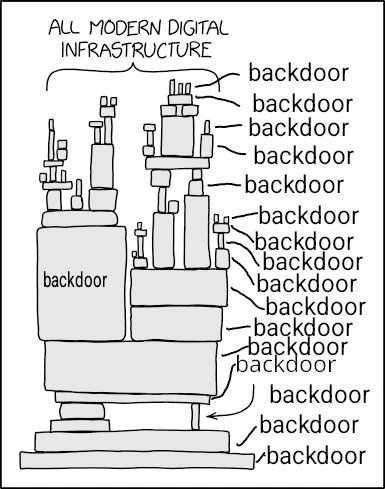
This is a single-panel cartoon, drawn in a simple black-and-white line-art style reminiscent of the webcomic XKCD. The drawing depicts a large, complex, and precarious-looking stack of various blocks and components. A large bracket at the top labels this entire structure 'ALL MODERN DIGITAL INFRASTRUCTURE'. The humor and commentary come from the labels applied throughout the stack. Numerous lines point to various components, from large foundational blocks to the smallest pieces at the very top, and nearly all of them are labeled 'backdoor'. The image serves as a cynical but accurate metaphor for the state of modern technology. It suggests that the complex systems we rely on - including hardware, firmware, operating systems, and software libraries - are fundamentally insecure and riddled with vulnerabilities, whether intentional or accidental. For experienced engineers, this cartoon is a powerful visual representation of supply chain security risks, the challenge of auditing dependencies, and the uncomfortable truth that our entire digital world is built on layers of potentially compromised components



Comments
11Comment deleted
The architecture review was a success. We confirmed every component has a clearly labeled, well-documented backdoor, which we're now calling the 'Express Lane API for Unscheduled Audits'
SBOMs these days read less like bill of materials and more like a list of known accomplices - our microservices aren’t loosely coupled, they’re jointly indicted
After 20 years in the industry, you realize the real architectural pattern isn't microservices or monoliths - it's the Universal Backdoor Pattern where every layer of abstraction adds exactly one new undocumented administrative interface, and your threat model is just a list of vendors you're contractually obligated to trust
This architectural diagram perfectly captures the modern approach to security: defense in depth, where 'depth' refers to how many layers deep the backdoors go. It's like we took 'assume breach' and made it a design principle - why wait for attackers to find vulnerabilities when you can build them in at every abstraction layer? The real innovation here is achieving O(n) backdoors where n is the number of components, proving that scalability isn't just for legitimate features
Leadership asked for “defense in depth”; procurement delivered “backdoor in depth” - transitively signed all the way down to the firmware
After CVE‑2024‑3094 our architecture doc basically became this picture; we added Sigstore, but the backdoor was already approved by the build pipeline
Zero-trust achieved: no front doors, just a symphony of backdoors for perfect blast radius scaling
Backdoor-driven development Comment deleted
chose the wrong door Comment deleted
Where's small explosives? Comment deleted
Where's the front door? Comment deleted