
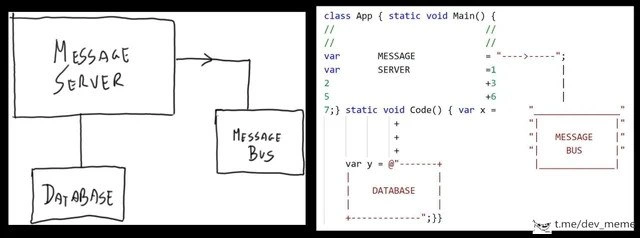
When Architecture Diagrams Are Written in C#
Description
A two-panel meme contrasting a software architecture diagram with its literal implementation in code. The left panel displays a simple, hand-drawn diagram on a white background, featuring three boxes labeled 'MESSAGE SERVER', 'DATABASE', and 'MESSAGE BUS'. Arrows and lines connect them, showing the Message Server communicating with the Database and the Message Bus. The right panel shows the same architectural diagram meticulously recreated as ASCII art within a C# code snippet in a dark-themed editor. The class 'App' and methods 'Main' and 'Code' are used as a canvas, with comments, strings, and variable declarations forming the shapes and labels of the server, bus, and database. This meme humorously visualizes the concept of 'code as documentation' taken to an absurd extreme. It resonates with experienced engineers who appreciate both the elegance of well-defined architecture and the clever, if impractical, ways developers sometimes express ideas directly in the source code

Comments
7Comment deleted
Some architects use UML, others draw on a whiteboard. Then there are the 10x engineers who submit a PR with their architecture diagram directly in the main function, achieving perfect code-documentation parity at the cost of everyone's sanity during code review
Turned the architecture diagram into a multiline string so docs never drift - now every whitespace linter run counts as an infrastructure migration
The three stages of enterprise architecture: the pristine whiteboard diagram that gets you promoted, the actual code that barely resembles it, and the production system held together by environment variables and prayer - but at least the variable names match the boxes!
Ah yes, the classic enterprise architecture pattern: draw a beautiful message bus diagram in the design doc, then implement it as three hardcoded string variables and ASCII art in comments. The DATABASE variable being set to '=5' really captures that enterprise-grade configuration management we all aspire to. At least future archaeologists will appreciate the effort to preserve the original architecture diagram in the codebase - nothing says 'maintainable' quite like box-drawing characters in a static void Code() method. This is what happens when the architect leaves before implementation and the intern is told to 'just make it work by Friday.'
Because direct DB calls lack that essential 'eventual consistency' tax Java loves to impose
Whiteboard-driven development: the message bus is a string literal, the database is ASCII art, and the only event stream is the '+' key until the arrows line up
When your architecture lives inside Main, one dotnet format turns a refactor into a full re-architecture diff that triggers an ADR review