
Forced Shipping Cadence via Intentional Memory Leak
Description
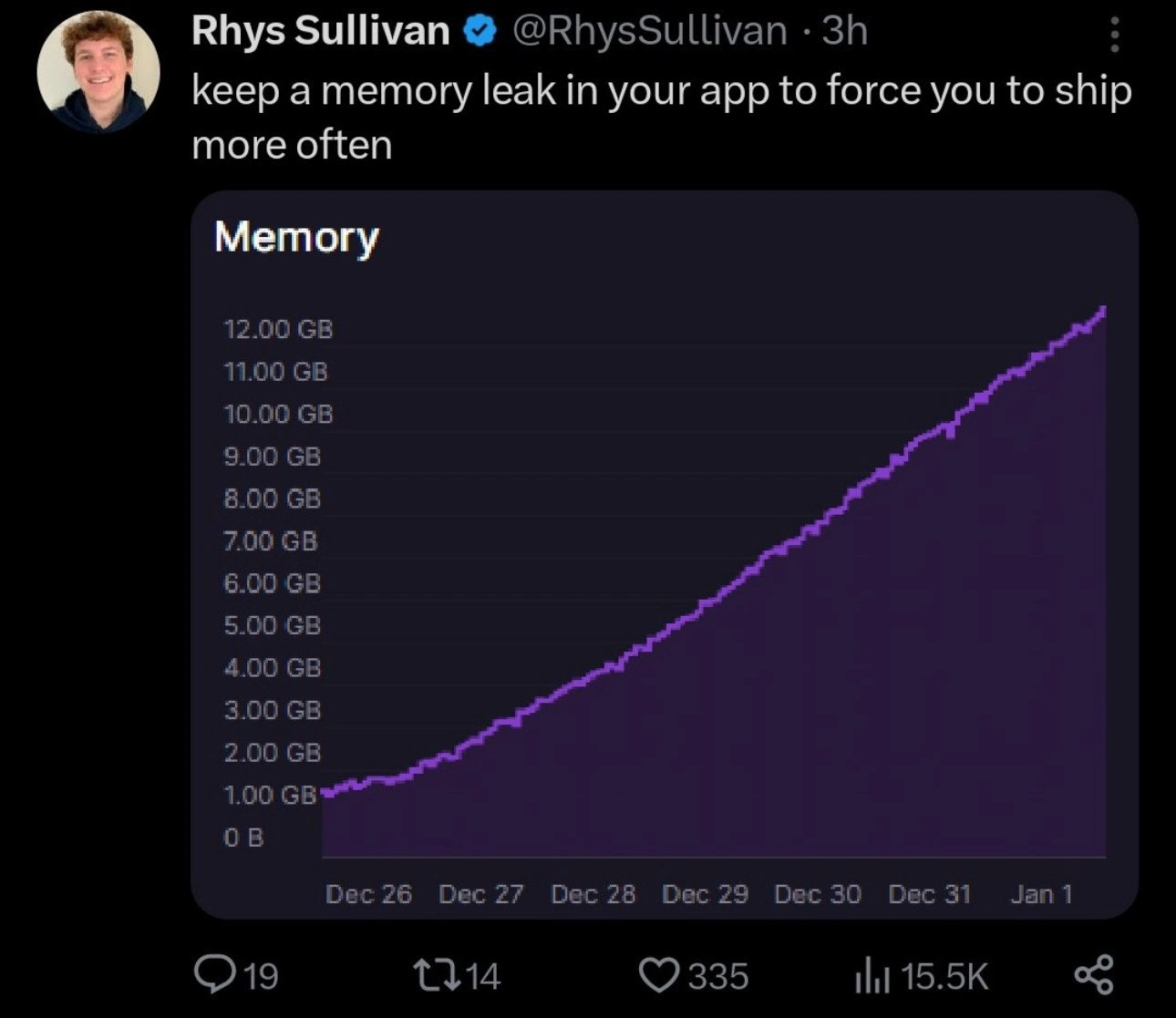
Screenshot of a tweet from Rhys Sullivan. The text of the tweet humorously suggests, "keep a memory leak in your app to force you to ship more often." Below the text is a dark-mode graph titled "Memory," which clearly visualizes this concept. The y-axis ranges from 0 B to 12.00 GB, and the x-axis shows dates from Dec 26 to Jan 1. A jagged purple line plots a relentless, steady increase in memory consumption over the week, starting around 1 GB and climbing past 12 GB, a textbook illustration of a memory leak. The humor is derived from reframing a critical software bug as a bizarrely effective, albeit catastrophic, project management strategy. Forcing frequent deployments to reset the application's memory prevents an inevitable crash, satirizing the 'ship fast and break things' culture by taking it to its logical, absurd extreme. This resonates with senior engineers who have witnessed terrible workarounds being justified as quirky features
Comments
11Comment deleted
We don't have a memory leak; it's a 'stateful resource allocation feature' designed to enforce our aggressive CI/CD cycle. The server gets a reboot every time it runs out of RAM, which, coincidentally, is just after sprint review
Forget CI/CD - our stack runs on RAM-driven agile: once the leak tips the heap past 12 GB, Kubernetes kills the pod and the restart officially counts as a release
Nothing quite motivates a team to embrace continuous deployment like knowing the production servers have exactly 72 hours before the OOM killer becomes your most active contributor - it's like Scrum, but with actual consequences instead of story points
Ah yes, the 'OOMKiller-Driven Development' methodology - where your deployment cadence is directly proportional to how quickly you exhaust available RAM. It's like having a built-in SLA enforcer that doesn't care about your sprint planning. Bonus points if you've configured your orchestrator's memory limits just low enough that the pod gets evicted before the on-call engineer finishes their coffee. Who needs CI/CD pipelines when you have inevitable process termination as your release trigger?
Release cadence hack: leak a tiny reference cycle so the pod hits OOM on schedule; ArgoCD redeploys, DORA looks stellar, and the only up-and-to-the-right KPI is RSS
New CD strategy: tie deployment KPI to heap size - when prod hits double digits, the pipeline auto-releases; we call it error-budget-driven garbage collection
Engineers' secret to elite DORA deployment frequency: one intentional memory leak per sprint
*to shit Comment deleted
I had an aneurysm reading this Comment deleted
force you to shit more often Comment deleted
All because he used C Comment deleted