Skip to content
DevMeme
4698 of 7435
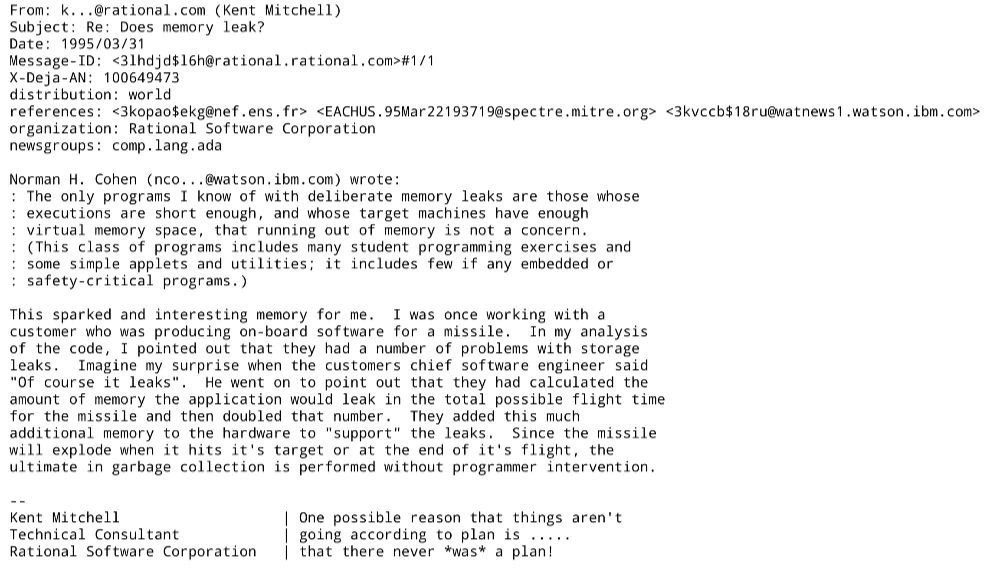
Missile dev casually budgets RAM for memory leaks - impact provides final garbage collection
EmbeddedSystems Post #5148, on Apr 22, 2023 in TG

Missile dev casually budgets RAM for memory leaks - impact provides final garbage collection

Why is this EmbeddedSystems meme funny?

Level 1: Cleanup on Impact

Imagine you’re playing in a playroom and you make a huge mess with toys everywhere. Normally, you’d have to clean up all your toys when you’re done, right? But suppose you know that at the end of the day the entire playroom is going to be demolished – like a big boom and the room is gone. If that’s really going to happen, you might decide, “Why bother putting toys back on the shelf? The explosion will take care of the mess!” It sounds silly (and a bit extreme!), but that’s basically what happened in this story. A missile had a computer inside that was leaving bits of “memory” around (like making a mess in a room). Instead of cleaning up those bits properly, the engineers just made sure the computer had plenty of extra space for the mess. They knew the missile would only fly for a short time and then blow up. When it blows up, all the messy bits of memory disappear anyway. So it’s like solving the cleanup problem by just letting the whole room get destroyed. It’s funny in a crazy way: normally we’re very careful to tidy things up in programs, but here the plan was “don’t worry about it, the big boom at the end will clean everything!”

Level 2: Budgeting for Leaks

Let’s break down what’s happening in simpler terms. The story is about a missile’s onboard program that had a memory leak. A memory leak means the program keeps using more and more memory without freeing it up, like a sink that’s left running without a drain. Normally, this is bad because a regular program (say a server or an app) might run for a long time – eventually it would run out of memory and crash. In EmbeddedSoftwareDevelopment, especially for something like a missile, you have a fixed amount of memory (RAM) and you usually try very hard to avoid leaks or any wasted space. But here the developers made an unusual choice: they didn’t fix the leak. Instead, they calculated how much memory could possibly leak during the missile’s maximum flight time. Let’s say the missile might fly for up to 120 seconds and the software leaks, for example, 4 KB of memory per second. Over 120 seconds that would be 480 KB leaked. They then doubled that to be safe (safety margin) – about 960 KB – and made sure the missile’s computer had that extra memory available. This way, even though the program leaks memory, it would not run out of RAM during its short lifespan. Why can they get away with this? Because the program doesn’t run indefinitely – the missile’s flight is short and at the end of it, the missile is going to explode (by design, either hitting the target or self-destructing). When it explodes, all the memory is naturally freed because the hardware is literally gone. Normally, good programs have some form of garbage collection (automatic memory cleanup) or at least proper memory management to reclaim unused memory. In languages like C or Ada (commonly used in the 1990s for missiles and other embedded systems), you had to manually free memory. If you didn’t, you got leaks. Here they jokingly call the missile’s explosion “the ultimate garbage collection.” In other words, instead of the code cleaning up its mess, reality does it – the impact (explosion) cleans the memory slate completely. It’s a tongue-in-cheek example of how engineers sometimes think very practically: if the gadget is one-use-only, you might not need elegant long-term solutions. This story was shared on an old-school internet forum (Usenet, specifically the comp.lang.ada newsgroup) in 1995, showing even back then developers had a sense of humor about odd engineering solutions. It’s both funny and educational: it teaches about memory leaks and resource planning in a memorable way. The tags like MemoryLeaks and MemoryManagement are spot on – it’s all about handling memory in a program. And it falls under DeveloperHumor because, let’s face it, using a missile’s destruction as your cleanup strategy is a pretty outrageous way to solve a programming problem. In summary, the missile’s developers basically said, “Yes, our program leaks memory, but it’s okay – we gave it enough extra memory to last, and once the mission is over, boom, problem solved.” Literally boom.

Level 3: Impact-Driven GC

In this classic 1995 Usenet anecdote, we see an embedded systems team taking a creative approach to memory management. Normally, a memory leak – where a program keeps grabbing memory (malloc) without giving it back (free) – is a serious bug. Left unchecked in a long-running system, leaks cause out-of-memory crashes or degraded performance. But here, on a missile’s onboard computer, the engineers deliberately allowed leaks, essentially turning the mission timeline into a makeshift garbage collector. The missile’s flight had a strict upper bound (minutes at most), so they calculated the total leaked bytes over that worst-case flight duration and simply added extra RAM to cover it. It’s a bold instance of trading software purity for hardware headroom: rather than refactoring code to plug leaks (which can be risky or time-consuming), they baked in the leaks as a known cost. This is gallows humor for veteran developers – the ultimate “works on my machine” solution when your machine is designed to self-destruct. The punchline is literally spelled out in the quoted text: when the missile completes its mission and blows up, it performs “the ultimate in garbage collection” by obliterating all leaked memory along with everything else. It’s an extreme case of time-bounded execution saving a project from its own bad habits. Seasoned engineers will smirk at how manual memory management in languages like Ada or C led to this scenario – if you can’t fix the leak, explode the leaky container. This highlights an unwritten rule in real-world software: sometimes pragmatism beats idealism. In safety-critical development you'd expect zero leaks and rigorous QA, yet here we have a calculated leak budget and a literal big bang at the end to clean it all up. The humor lands because it subverts everything we’re taught about good coding. It’s a developer horror story turned joke – solving a bug not by patching code, but by adjusting reality (more RAM, finite runtime) to make the bug irrelevant. The EmbeddedSystems community knows that on constrained hardware you often budget every byte; here they budgeted bytes destined to be “lost,” essentially treating memory like a one-time resource that gets taken out with the trash at program end. It’s software engineering meeting dark comedy: a memory leak that’s safety-critical on paper, yet harmless in practice because the hardware has an expiration time. Engineers with production experience chuckle (perhaps a bit nervously) because it’s a reminder that sometimes our Debugging_Troubleshooting “solutions” can be as destructive as the problems – though rarely this literally!

Description

Black-on-white mono-spaced screenshot of a 1995 Usenet post titled “Re: Does memory leak?” from Kent Mitchell at Rational Software Corporation. Full visible text: From: [email protected] (Kent Mitchell) Subject: Re: Does memory leak? Date: 1995/03/31 Message-ID: <[email protected]>#1/1 X-Deja-AN: 100649473 distribution: world references: <[email protected]> <[email protected]> <[email protected]> organization: Rational Software Corporation newsgroups: comp.lang.ada Norman H. Cohen ([email protected]) wrote: : The only programs I know of with deliberate memory leaks are those whose : executions are short enough, and whose target machines have enough : virtual memory space, that running out of memory is not a concern. : (This class of programs includes many student programming exercises and : some simple applets and utilities; it includes few if any embedded or : safety-critical programs.) This sparked an interesting memory for me. I was once working with a customer who was producing on-board software for a missile. In my analysis of the code, I pointed out that they had a number of problems with storage leaks. Imagine my surprise when the customer software engineer said "Of course it leaks". He went on to point out that they had calculated the amount of memory the application would leak in the total possible flight time for the missile and then doubled that number. They allocated this much additional memory to the hardware to "support" the leaks. Since the missile will explode when it hits its target or at the end of its flight, the ultimate in garbage collection is performed with no programmer intervention. -- Kent Mitchell Technical Consultant Rational Software Corporation | | One possible reason that things aren't | going according to plan is ..... | that there never *was* a plan! Visual layout resembles a plain-text email/newsreader window, with quoted lines prefixed by colons and a signature block separated by dashes. Technically, it lampoons memory management in safety-critical embedded systems: the team knowingly leaks memory, counting on the missile’s destruction for cleanup - an extreme time-bounded execution strategy that highlights embedded constraints and developer humor

Comments

17
Anonymous ★ Top Pick Forget reference counting - on the missile project we used time-to-impact semantics: if the heap outlives the airframe, it’s not a leak, it’s a feature
  1. Anonymous ★ Top Pick

    Forget reference counting - on the missile project we used time-to-impact semantics: if the heap outlives the airframe, it’s not a leak, it’s a feature

  2. Anonymous

    Ah yes, the good old days when we debated memory leaks on Usenet instead of Stack Overflow, and 'just restart the process' was considered a legitimate garbage collection strategy for missile guidance systems - what could possibly go wrong?

  3. Anonymous

    When your garbage collector is a kinetic energy event and your memory leak mitigation strategy is 'just add more RAM and hope the explosion happens before the OOM killer,' you've achieved a level of systems architecture that makes malloc() look like a solved problem. This is the embedded systems equivalent of 'it's not a bug, it's a feature' - except the feature is a fireball, and your uptime SLA is measured in Mach numbers

  4. Anonymous

    Memory leak in missile software? That's not a bug - it's a trajectory correction gone wrong

  5. Anonymous

    Design pattern: ballistic GC - budget the leak, add RAM, rely on a terminal destructor; works perfectly until Product extends mission time and your allocator becomes the incident

  6. Anonymous

    Favorite embedded SLO: "heap must last until impact." They fixed the leak by overprovisioning RAM and relying on hardware GC - aka detonation; the one time crash-only systems isn’t a metaphor

  7. @trainzman 3y

    That's like not caring for closing files/sockets in python bc the program is so short system will close them anyway

  8. @callofvoid0 3y

    the hell

  9. Zeno Bin Kanaan 3y

    Are the 'leaks' a necessary side-effect of whatever software this thing is running? Would it not be more efficient to reduce leakage and by extension the materials needed for fabrication? What am I missing?

    1. @dugeru42 3y

      by the time u fix the leak the war is over

    2. Deleted Account 3y

      Oh, a perfect time to advertise the Rust programming language

  10. @dugeru42 3y

    imagine integration testing :D

  11. @RiedleroD 3y

    I want this amount of pissoires

  12. @asm3r 3y

    Php

    1. @RiedleroD 3y

      ?

      1. @asm3r 3y

        Early versions has no garbage collector - "php designed to die" anyway. I.e. run script for every https request, than process exit.

        1. @RiedleroD 3y

          huh

Use J and K for navigation