Skip to content
DevMeme
5848 of 7435
In C++, You Are the Garbage Collector
Languages Post #6405, on Nov 20, 2024 in TG

In C++, You Are the Garbage Collector

Why is this Languages meme funny?

Level 1: Cleaning Your Room

Imagine you and your friend each have your own playroom. Your friend has a magic robot cleaner that, every night, automatically picks up all his toys and throws away any trash. He never worries about tidying up – the room just cleans itself because of that special helper. Now, in your playroom, there’s no magic robot. When you’re done playing, you have to clean up all your toys yourself and put everything back where it belongs. If you forget or ignore the mess, your room will stay cluttered with toys all over the floor. This meme is joking that in the world of programming, Java is like the friend with the robot cleaner (it has a built-in helper to clean memory), but C++ is like the kid without a robot. Someone in C++ land might say to a Java user, “My friend, in your case you are the cleaning crew.” In other words, there’s no automatic helper in C++ – if you don’t clean up the mess (memory), nobody will, and things can get messy fast. It’s funny because it’s a simple truth: one kid has a helper to do the chores, and the other kid has to be their own helper!

Level 2: Memory Housekeeping

Every program uses memory to store data as it runs. The big question is: who cleans up that memory when you’re done with it? This meme compares how two programming languages, Java and C++, handle this “clean-up” very differently, leading to a funny contrast.

  • In Java, you get a built-in helper called a garbage collector. This is like an automatic cleaning service for your program’s memory. Whenever you create objects (using new in Java), you don’t have to worry about later deleting them. The Java runtime has a background process that will find objects you’re no longer using and free up their memory. Java developers often never explicitly write code to release memory; they rely on the system to do it. So Java can confidently say, “Don’t worry about memory leaks, we handle it for you.” A memory leak in simple terms is when a program keeps wasting memory by holding onto data it no longer needs – Java’s garbage collector is designed to prevent that by cleaning up unused pieces automatically.

  • In C++, there is no automatic memory cleanup by default. If you allocate memory for something (for example, using new to create a new object), you are responsible for freeing that memory when you’re done (typically by calling delete on that object pointer, or using free() if it was allocated with malloc in C style). If you forget to free it, that memory stays occupied (a manual memory leak), and your application could run out of memory over time because the “trash piles up.” This approach is called manual memory management – the programmer has to explicitly manage the allocation and deallocation of memory. It’s sort of a DIY approach: powerful, but you have to remember to do it correctly. C++ gives you tools like smart pointers (std::unique_ptr, std::shared_ptr) and a principle called RAII that help automate some of this (for instance, a smart pointer will automatically delete an object for you when it is no longer needed), but it’s up to you to use those tools. There’s no general garbage-collecting program running for all objects like in Java.

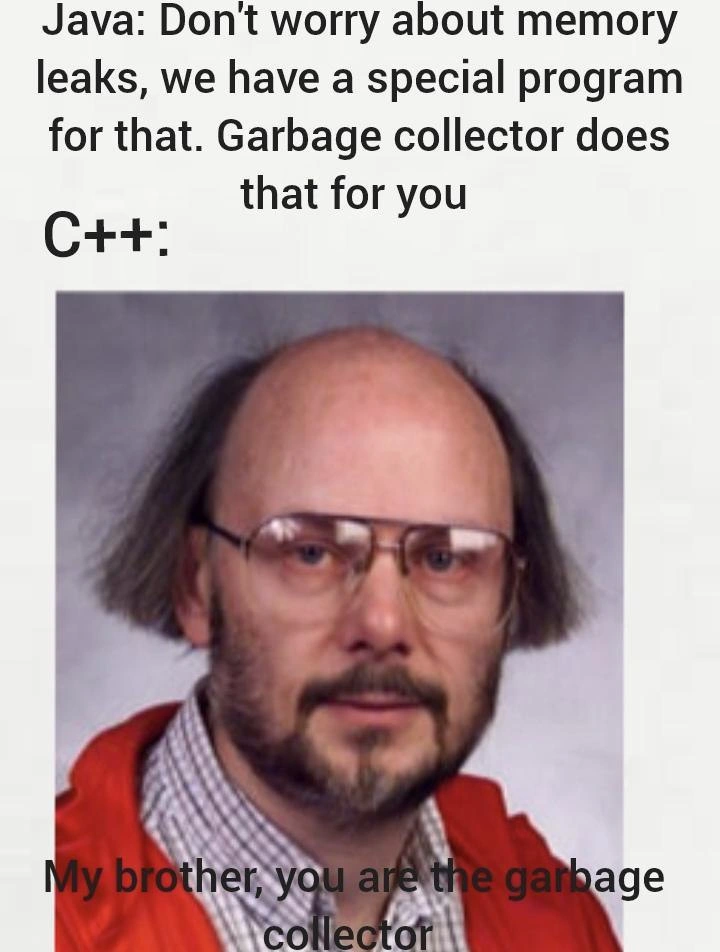
Now, the meme text at the top has Java saying: “Don’t worry about memory leaks, we have a special program for that. Garbage collector does that for you.” Java is basically boasting that it has this automatic garbage-removal feature so programmers can forget about cleaning memory. Underneath, it shows “C++:” and then a picture of a man with a crazed, wise look, and the caption: “My brother, you are the garbage collector.” This line is the punchline. It’s as if an experienced C++ programmer is telling the Java folks: “Buddy, in my world, I have to do the garbage collecting myself.” The phrasing “my brother” is just a humorous way to address the Java person, adding a bit of drama. The meaning is clear: in C++, the programmer plays the role of the garbage collector. There’s no separate program coming to the rescue; you write the code to clean up.

To put it simply, Java and C++ take different approaches to MemoryManagement:

// Java example:
Object obj = new Object();
// ... use obj ...
// No explicit free or delete here. The GC cleans up later when obj isn't needed.
// C++ example:
MyObject* obj = new MyObject();
// ... use obj ...
delete obj;  // You must explicitly free the memory. If you omit this, you've got a memory leak!

In the C++ snippet above, if you remove that delete obj; line, the memory used by obj would never be released back to the system during the program’s run – that’s a leak. In Java, you never explicitly write delete – the runtime environment figures out when obj is no longer used (no variables refer to it) and then a garbage_collector will automatically free it behind the scenes.

For a newer developer, this meme is pointing out why C++ is often considered “closer to the metal” (more low-level). You gain control over exactly when and where memory is allocated and freed, which can make programs very efficient, but you also gain the responsibility to not mess it up. It’s like the difference between an automatic car and a manual transmission: C++ is the stick shift that gives you more control but you have to remember every gear change (and stall if you get it wrong), while Java is the automatic where gear changes (memory free-ups) happen for you so you can focus on other things. The humor in the meme comes from that last line: “You are the garbage collector.” It’s a playful reminder (especially to those who know C++) that if there’s no automatic system, the duty of cleaning memory falls on the programmer’s shoulders. The guy in the photo represents a C++ developer who’s perhaps a bit frazzled from doing all this housekeeping himself, in contrast to the Java developer who sounds pretty carefree about it. Essentially, the meme is a lighthearted way to compare Java vs C++ and to warn, “If you code in C++, pack your own cleaning supplies!”

Level 3: The Cost of Control

In a Java program, a dedicated subsystem called the garbage collector (GC) automatically reclaims memory from objects that are no longer in use. Java developers often brag, "Don’t worry about memory leaks, GC does that for you," because they typically never call free() or delete explicitly. Meanwhile, in C++, there is no automatic garbage collector by default – if you allocate memory, you must manually release it. The meme highlights this contrast with humor: Java proudly says it has a “special program” for cleaning up memory, whereas C++ responds with “My brother, you are the garbage collector,” implying the C++ programmer themselves must perform this clean-up. It’s a playful way to say: in C++, the developer is the one taking out the trash (memory).

This joke resonates with experienced engineers because it pokes fun at a classic trade-off in programming language design. C++ provides low-level control and blazing performance, but with great power comes great responsibility. You have direct control over memory allocation, which is powerful, but you’re also responsible for every new having a matching delete. Forget to free memory and you’ve got a memory leak; free it twice or use it after freeing and you’ll summon the dreaded specter of undefined behavior (often manifesting as crashes or weird bugs). Seasoned C++ devs have war stories of production crashes caused by a single misplaced delete or a missing one. They’ve spent late-night debugging sessions with tools like Valgrind to hunt down leaks and dangling pointers because a pointer was freed too soon or not at all. The meme’s frizzy-haired, wild-eyed C++ developer archetype perfectly captures that “I’ve seen things you people wouldn’t believe” vibe which senior devs find hilariously relatable.

To avoid these hazards, modern C++ employs patterns like RAII (Resource Acquisition Is Initialization) and smart pointers to make manual memory management safer. RAII is a C++ idiom where you tie the life of a resource (memory, file handles, etc.) to an object’s scope: when the object goes out of scope, its destructor automatically frees the resource. In practice, instead of writing delete all over, a C++ dev might use a smart pointer like std::unique_ptr or std::shared_ptr which will delete the object for you when no one needs it anymore. This is a bit like having a mini garbage collector built into library classes – but crucially, the programmer must choose to use them. It’s not enforced by the language at runtime the way Java’s GC is. If a dev falls back to raw pointers and forgets a delete, the safety net is gone. Ownership semantics come into play here: every dynamically allocated chunk of memory should have an “owner” responsible for freeing it. In well-structured C++ code, you can often trace which object owns which resource. But without discipline, things can get messy fast. (Languages like Rust took this concept further – the compiler itself enforces a strict ownership model so that memory is freed exactly once and at the right time, providing memory safety without a runtime GC. In Rust, if you try to use memory wrong, your code just won’t compile. C++ gives you the rope to hang yourself, whereas Rust puts guardrails on that rope.)

The humor lands because Java vs C++ memory management is a long-running theme in programming culture. Java’s automatic garbage_collector simplifies a programmer’s life – you don’t manually track every allocation – but it comes with its own baggage (GC pauses, more memory overhead, etc.). C++, rooted in LowLevelProgramming traditions from C, opts for ManualMemoryManagement for performance and control, but then the memory housekeeping burden falls on the developer. The meme’s punchline, “you are the garbage collector,” voices a kind of weary pride: C++ devs chuckle because they live this reality. They know that if they don’t clean up, nobody will. It’s funny because it’s true – a truth learned through hard-earned experience. It also satirizes the Java perspective: while Java devs might tout “no memory leaks here!”, a C++ dev might smirk knowing that behind Java’s ease-of-use is a lot of complex GC machinery doing the clean-up, whereas in C++ you embody that machinery through careful coding.

In summary, the meme cleverly contrasts language design philosophies: Java’s motto of “relax, memory management is handled for you” versus C++’s reality of “there’s no free lunch – you allocate it, you deallocate it.” The image of the disheveled guy in the C++ section embodies the C++ developer who’s been up at 3 AM dealing with a memory leak in a 10-year-old codebase. It’s an exaggeration with a kernel of truth that senior devs find hilarious and painfully familiar. After all, nothing says “LowLevelProgramming” quite like doing your own garbage collection by hand. The meme manages to be both a tongue-in-cheek jab at Java’s hand-holding and a nod of respect to the C++ folks who, for better or worse, must be their own garbage collectors.

Description

A two-part meme comparing memory management in Java and C++. The top section has text that reads, 'Java: Don't worry about memory leaks, we have a special program for that. Garbage collector does that for you'. Below this, under the label 'C++:', is a portrait photo of a weary-looking, balding man with glasses, a checkered shirt, and a red jacket. The final punchline is at the bottom: 'My brother, you are the garbage collector'. The meme humorously contrasts Java's automated garbage collection with C++'s manual memory management. In C++, the developer bears the full responsibility for allocating and deallocating memory, a task that can be complex and error-prone. The image of the stressed individual represents the burden placed on the C++ programmer, who effectively must act as the 'garbage collector' themselves, a concept deeply familiar to any engineer who has worked with lower-level languages


Comments

18
Anonymous ★ Top Pick In Java, you pray the garbage collector is efficient. In C++, you pray the developer who wrote the memory allocation code wasn't having an off day
  1. Anonymous ★ Top Pick

    In Java, you pray the garbage collector is efficient. In C++, you pray the developer who wrote the memory allocation code wasn't having an off day

  2. Anonymous

    Java’s GC stops the world for 200 ms; C++’s “GC” stops the sprint for a two-week code review while five seniors argue over who actually owns the pointer

  3. Anonymous

    After 20 years of explaining RAII and smart pointers to junior devs, you realize the real garbage collection was the segfaults we debugged along the way

  4. Anonymous

    The eternal struggle: Java developers sleep soundly while the GC pauses their application at 3 AM, while C++ developers lie awake wondering if they remembered to delete that pointer from 2015. At least in C++ you control when your application freezes - it's called a segfault, and it's a feature, not a bug. The real garbage collector was the memory discipline we learned along the way

  5. Anonymous

    In Java you tune GC; in C++ you tune yourself - RAII, smart_ptrs, and Valgrind - because on that runtime, you are the collector

  6. Anonymous

    Java outsources janitorial work to GC; C++ hands you a broom called RAII - and Valgrind conducts your performance review when you forget std::unique_ptr

  7. Anonymous

    Java's GC: outsourcing memory cleanup so you can focus on stop-the-world pauses during Black Friday traffic spikes

  8. @as_suguri 1y

    you are the garbage

    1. @Johnny_bit 1y

      That's what the elites want you to think in order to keep you down! Remember - it's garbage-CAN not garbage-CANNOT.

  9. @Agent1378 1y

    My brother hand me those pointers!

  10. @TheFloofyFloof 1y

    Doesn't c++ actually have a garbage collector?

    1. @Araalith 1y

      It has destructor at least

      1. @Agent1378 1y

        If implemented by programmer, lol

        1. @AlexKart20129 1y

          The default destructor always exist, even if it wasn't implemented explicitly.

          1. @Agent1378 1y

            Yeah, but it only frees memory taken by the object itself, doesn't free any internal objects.

  11. @Araalith 1y

    Circular references say "Hello!"

  12. @AlexKart20129 1y

    There will be no memory leak if you don't use the 'new' operator.

  13. @TheRamenDutchman 1y

    Rust: Can't have a garbage collector if you don't have garbage to begin with!

Use J and K for navigation