
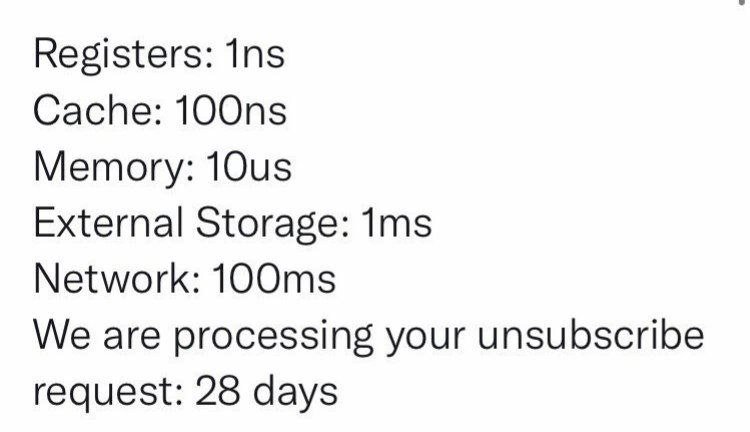
System Latency vs. Unsubscribe Request Latency
Description
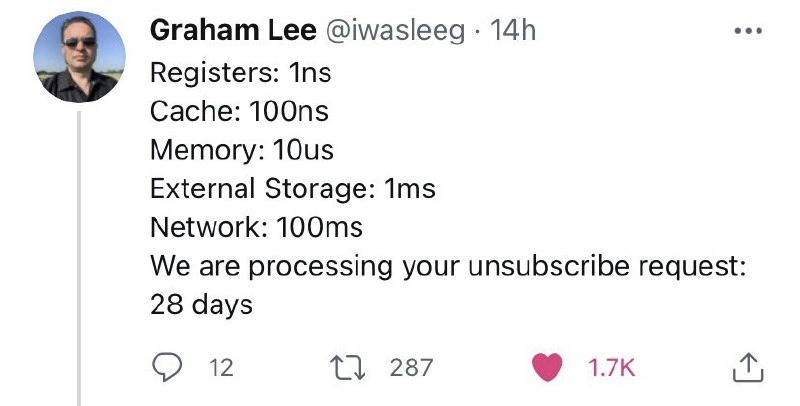
A simple text-based image on a white background with black font. It lists common computer latency numbers, starting from the fastest operations and progressing to slower ones. The text reads: 'Registers: 1ns', 'Cache: 100ns', 'Memory: 10us', 'External Storage: 1ms', 'Network: 100ms'. The list concludes with a humorous, non-technical, and disproportionately long timeframe: 'We are processing your unsubscribe request: 28 days'. The joke contrasts the microsecond and millisecond world of hardware and network performance, which engineers strive to optimize, with the intentionally slow and user-hostile business processes often implemented by marketing or product teams. This highlights the concept of 'dark patterns' in UX, where unsubscribing is made deliberately difficult or slow to reduce customer churn, a frustration universally understood by developers who know the actual technical task is trivial

Comments
12Comment deleted
It's not a technical delay; the unsubscribe request is simply deprioritized in the backlog and assigned to the 'User Retention' sprint, which, coincidentally, has a 28-day cycle
If DRAM took 28 days per fetch we’d file a P1 incident - marketing just calls it their ‘regulatory window’.
We can achieve nanosecond-level memory access and build distributed systems that span continents in milliseconds, but somehow that DELETE statement on the email_subscribers table needs a full lunar cycle to propagate through the 'complex systems' - which is definitely not just a SLEEP(2419200) wrapped in corporate policy
Ah yes, the classic memory hierarchy extended to include the slowest tier of all: the 'legal compliance' layer, operating at approximately 2.4 million milliseconds. Fascinating how we've optimized L1 cache down to single-digit nanoseconds, yet somehow 'UPDATE users SET subscribed=false WHERE email=?' still requires a 28-day SLA. Must be waiting for the data to propagate through their blockchain-based unsubscribe microservice architecture deployed across carrier pigeons
We nailed sub‑millisecond P99, but the unsubscribe path is a CRM → legal → ESP monthly cron - eventual consistency, measured in billing cycles
Registers hit 1ns; unsubscribe? That's the real test of distributed consensus across marketing, legal, and compliance pods
We tuned p99 from registers to WAN, yet the unsubscribe path is a human-in-the-loop Kafka->CSV->Legal pipeline scheduled by a monthly cron - eventual consistency measured in billing cycles
they're just hoping you will forget and then send another spam email with "oh sorry you didn't confirm your request on the last day so therefore we assumed you still want our newsletter slop" Comment deleted
Not exactly. Actually, working with such tool like that, I can tell the following. It might look easy to remove a single email from the broadcast, however, the emails are much likely going through the process of segmentation, that separates the audiences for receiving different newsletters. And such segmentation calculation cannot happen immediately after each unsubscription. But how are new emails coming there? I think they have another workflow for the first months of work, but then are added to a common database But the meme is funny anyway Comment deleted
but realistically, most companies do not need segmentation. that's just overcomplication for the sake of it. like using kubernetes for a userbase of 5½ people. might just be some legal procedure similar to EU handling "user rights" or something Comment deleted
EU handling user rights is as easy as setting up your cascades. Comment deleted
Repost Comment deleted