
Latency Hierarchy Unsubscribe Meme Explained
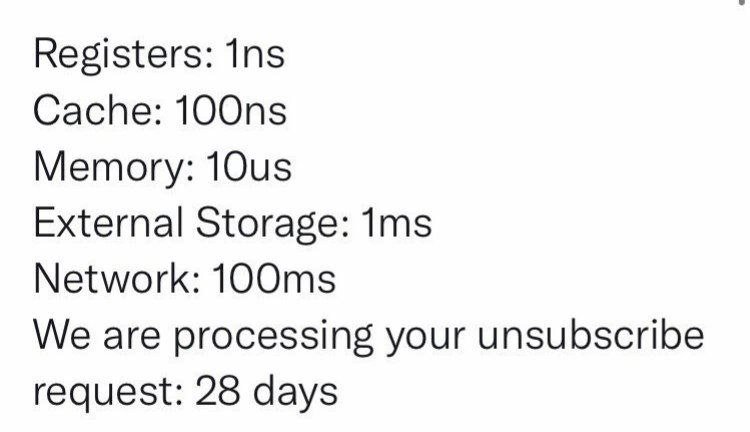
Classic computing latency numbers—registers, cache, RAM, disk, network—end with a 28-day unsubscribe SLA. The dive contrasts hardware physics with bureaucratic opt-out delays under GDPR and CAN-SPAM.
Level 1: Cheetah vs Snail
Imagine a race between a cheetah and a snail. 🐆🐌 The cheetah represents how fast computers can do things – like grabbing data in a flash. The snail represents how slow a company can be when you ask them to do a simple task like stopping those marketing emails. In the computer world, things happen in the blink of an eye (even faster, really!). But in the company world, you click “unsubscribe” and then… you wait, and wait... and wait. It’s as if you told someone, “Please stop sending me letters,” and they replied, “Okay, I will – but it might take a month.”
That contrast is what makes this funny. On one hand, your laptop or phone can fetch information from across the globe in a fraction of a second – zoom, the cheetah finishes the race instantly. On the other hand, a big organization takes 28 days (almost a whole month) to do something very simple like taking you off an email list – the snail is still inching along long after the cheetah is done. It’s a silly exaggeration that highlights a real feeling: computers are incredibly fast, yet sometimes companies or people are incredibly slow. We laugh because it’s true in a lot of our experiences. It’s like pressing a button to turn off a light and being told, “the light will actually go off next month.” That would be ridiculous, right? The meme is pointing out exactly that kind of ridiculous gap. In simple terms: machines zoom, people sloooow. And seeing those high-tech speedy numbers next to a “28 days” snail-pace number makes us chuckle at just how mismatched those worlds are.
Level 2: Real Time vs Business Days
Let’s break down the meme’s list of timings from a junior developer perspective. In computing, latency means how long it takes to get a response or complete an operation – essentially, a delay. Smaller time units mean faster responses. Here’s what each item in that list refers to in real life:
Registers (1ns): A register is a tiny storage location inside a CPU (the processor) where it keeps numbers it’s actively working with. Accessing a register is blazing fast – on the order of 1 nanosecond (ns), which is one billionth of a second. That’s like virtually zero delay for any normal scale of time. If an operation hits data already in a register, it’s as fast as the computer ever gets.
Cache (100ns): Cache is a special high-speed memory located very close to the CPU cores. Think of it like the CPU’s private notepad for frequently used data. When the CPU looks for data, it first checks this cache. A cache access might take ~100 nanoseconds, a bit slower than a register. Why slower? Because even though cache is fast, it isn’t inside the CPU arithmetic units – the data might be in an L1 or L2 cache a few millimeters away on the chip, and coordinating access takes a few more clock cycles. 100ns is still incredibly quick (0.0000001 seconds), but relative to a register, it’s about 100 times slower.
Memory (10µs): Here “memory” means main memory, i.e. RAM (Random Access Memory), where running programs keep their larger working data. Accessing RAM is around ~10 microseconds (µs) in this list. 1 microsecond is 1,000 nanoseconds, so 10µs is 10,000ns. That’s about 100x slower than the cache! The reason is that RAM chips sit on the motherboard, not on the CPU chip. The request has to travel through the memory bus, and the DRAM modules respond more slowly than on-chip cache. For perspective, 10 microseconds is 0.00001 seconds. Still tiny, but noticeable if you’re a processor doing millions of operations per second. When your code accesses something in main memory (like a large array not in cache), it hits this 10µs-ish penalty, which is why we use caches to avoid hitting RAM too often.
External Storage (1ms): This refers to long-term storage like an SSD (Solid State Drive) or hard drive. 1 millisecond (ms) is 0.001 seconds, which is 1,000 microseconds. That’s yet another ~100x jump from main memory. If your program needs to read some data from disk (say, opening a file or querying a large database on disk), it takes on the order of milliseconds. SSDs can often respond in a fraction of a millisecond for small reads, whereas old-school spinning hard disks might take several milliseconds (or more if the disk is busy moving the read head). Compared to RAM, disks are slow, but they’re designed for persistence and large capacity. One millisecond is still pretty quick to a person – it’s a thousandth of a second, you wouldn’t notice it in isolation – but in computing, a 1ms delay is huge when you’re doing millions of operations.
Network (100ms): This is about how long a round-trip across a network might take, for example requesting data from a server somewhere and getting a response. 100 milliseconds is 0.1 seconds, roughly the blink of an eye. If you’re calling an API over the internet or fetching a web page from a distant server, ~50-100ms latency is common (it can be lower on local networks, or higher if the server is far away or congested). At 100ms, we’ve transitioned from microseconds (computer internal speed) to a human-perceptible delay. For instance, a ~200ms delay is something you might feel as a slight lag. Network latency is higher because it involves physical distance (signals traveling through wires across cities or oceans) and numerous intermediate devices (routers, switches) that each introduce a bit of delay. Compared to that 1ns register, 100ms is 100 million times slower. In everyday terms, if a register access is like grabbing something from your pocket instantly, a 100ms network call is like walking down the street to get something – still quick, but you notice the trip.
Up to this point, everything listed is a technical latency – delays caused by computer architecture or physics. Developers learn these to design efficient software (e.g., why reading from memory repeatedly is slower than keeping data in cache). Now the meme throws a curveball:
- "We are processing your unsubscribe request: 28 days": This isn’t a hardware or software operation at all – it’s referring to the common message you see when you click an “unsubscribe” link at the bottom of marketing emails. Companies often say something like “Please allow X days for us to process your request.” In this joke, X is an enormous 28 days (four weeks!). That means if you decide you don’t want to receive a newsletter or promo emails anymore, the company is claiming it might take up to four weeks to stop sending them. 28 days is 2,419,200 seconds – astronomically larger than any computer latency. There’s no technical reason for this delay to be so long; it’s usually about company policy or legal allowances. In many jurisdictions, anti-spam and data privacy laws like CAN-SPAM (a US law governing marketing emails) or GDPR (European General Data Protection Regulation) give companies a grace period to comply with unsubscribe requests. For example, CAN-SPAM gives businesses up to 10 business days to remove you from a mailing list. Some companies, perhaps to be safe (or slow), interpret this generously, sometimes saying “allow 2 weeks” or in extreme cases up to 30 days. The meme highlights 28 days (essentially a month) as an exaggerated example of this process latency. It’s highlighting how absurd that sounds compared to the nanoseconds and milliseconds earlier. After all, unsubscribing someone from an email list is as simple as updating a database entry or toggling a flag in their user profile – something a computer can do in milliseconds or less. The humor (and frustration) comes from the fact that humans/organizations introduce a delay millions of times longer than any computer operation. It’s a tongue-in-cheek way to say: “Computers are fast, but companies can be slow to act.”
So, in summary, the meme first teaches us about the latency hierarchy in computer systems – from super-fast CPU registers to relatively slow networks. Then it contrasts it with an example of corporate latency: something simple taking ridiculously longer than it should. It’s categorized under Performance and DataPrivacy for good reason. “Performance” because of the tech latency references, and “Data Privacy” because it involves an individual’s request to control their personal data (opting out of emails). It’s also tagged with CorporateHumor and Marketing because it pokes fun at the marketing department/ corporate process dragging its feet. A junior dev encountering this meme learns not only some hardware speed trivia, but also a bit about how the real world works outside of code. Just because our systems can respond in a split second doesn’t always mean the user’s request gets honored that fast – sometimes policy, law, or business process adds an invisible wait. And the meme’s stark “28 days” punchline makes that point in a darkly comedic way.
Level 3: 28-Day Opt-Out Odyssey
Picture the classic “latency numbers every programmer should know” cheat-sheet hanging by a senior developer’s desk – that hierarchy from registers to network latencies listed in neatly ascending time scales. Now the meme cheekily appends a new worst tier to that list: the email unsubscribe. It looks like this:
Registers: 1ns
Cache: 100ns
Memory: 10µs
External Storage: 1ms
Network: 100ms
We are processing your unsubscribe request: 28 days
Why is this so amusing to those of us in tech? Because the first five lines are well-known facts of computer performance, drilled into us when we talk about LatencyOptimization. We strive to avoid expensive cache misses and round trips because we know even a few extra microseconds can hurt performance. The progression from nanoseconds to milliseconds is a familiar technical reality. Then comes that final line which vaults straight from milliseconds to 2.4 million seconds. It’s a jarring context switch from the world of hardware speed to the world of CorporateCulture and Marketing. It highlights an absurd truth: a modern computer can retrieve data from the other side of the planet in a fraction of a second, but getting off a company’s mailing list might take a month. The humor lands because every engineer who’s ever clicked an “unsubscribe” link has likely encountered a polite message along the lines of, “We have received your request. Please allow up to 30 days for it to take effect.” That phrase has become infamous. We know, logically, that unsubscribing should be a simple database update – a few milliseconds at most to flip a bit saying “don’t email this user.” So when a company claims it needs 28 whole days to do it, it reeks of either bureaucratic delay or a thinly veiled excuse to spam you a little longer.
This meme is essentially calling out that nonsense with a deadpan delivery. It’s tech humor meets corporate satire. The senior dev chuckle comes from the dramatic contrast: everything in the computer’s silicon world happens blindingly fast, measured in ns, µs, ms… and then there’s the snail’s pace of a marketing department honoring an opt-out, measured in days. It’s the ultimate latency anti-optimization. The phrase “28 days” might also nod to legal compliance wiggle room. Under laws like the GDPR in Europe (General Data Protection Regulation) or the US CAN-SPAM Act, companies must honor unsubscribe requests within a certain timeframe (CAN-SPAM gives up to 10 business days). Many of us suspect some companies intentionally use the maximum allowed window. It’s a MarketingVsReality situation: the marketing team might say, “We’ll remove you… eventually,” hoping to squeeze in another newsletter or promotion before you vanish from their lists. There’s an element of dark humor here for anyone who’s dealt with DataPrivacy compliance or corporate red tape. The developer in us knows there’s no technical need for such delay – it’s likely a business decision, or maybe an artifact of a clunky legacy system that only syncs mailing lists once a month. Either way, it’s an eye-rolling “feature.”
The meme resonates with experienced engineers because it’s a shared pain-point wrapped in irony. We’ve spent careers shaving off milliseconds in code or going the extra mile to reduce query latency. Then we encounter something like unsubscribe_process_delay = 28_days in real life and it’s just hilariously depressing. In a DevOps world where we automate everything, this feels like someone literally wrote:
def process_unsubscribe_request(email):
    time.sleep(28 * 24 * 3600)  # Wait 28 days (!)
    marketing_list.remove(email)  # Finally remove email from list
It’s as if the system architects said, “We’ll handle your request, just queue it for a month.” No wonder developers joke that perhaps the unsubscribe workflow is handled by a sloth running on an old mainframe in the basement, or by an intern who checks a spreadsheet once a moon cycle. The trauma is real: many of us have clicked “unsubscribe” only to keep receiving emails for weeks, doubting if the request even went through. The meme’s dry tone (“We are processing your request: 28 days”) perfectly mimics the canned corporate response, and we smirk because we’ve seen it verbatim. It’s both funny and infuriating in its accuracy.
On a serious note, veteran engineers also recognize the DataPrivacy angle. That 28-day figure might be poking fun at formal compliance periods – for example, GDPR often gives companies up to a month to respond to user data requests. So technically, they’re within their right to take their sweet time. But the spirit of those laws is to protect users, not to permit foot-dragging. In practice, a well-run system should process an opt-out immediately or at worst within a day. Taking a full month feels deliberately obtuse. It exemplifies the difference between best practice and what large organizations sometimes do when incentives aren’t aligned with user experience. The dev community jokes about it because we see the absurdity: it’s like discovering a performance bottleneck that is 1e9 times slower than everything else – not due to code, but company policy. In a world of high-frequency trading and real-time analytics, waiting 28 days for anything is comical.
Ultimately, this meme hits on a universal in tech circles: the friction between lightning-fast technology and slow-moving corporate processes. It’s a reminder that some problems aren’t technical at all – they’re human. As developers, we can optimize algorithms and systems all we want, but we also shrug and laugh (perhaps a bit cynically) at the things out of our control, like a marketing pipeline stuck in molasses. The next time someone cites nanosecond-level optimizations in a code review, don’t be surprised if a grizzled engineer quips, “Cool, but can it also speed up the unsubscribe process?” Cue laughter, mixed with a touch of resignation. This is tech humor at its finest: exposing the gap between system latency and office latency, and uniting us in saying, “Yeah… been there, suffered that.”
Level 4: Registers vs Regulations
At the nanosecond scale, computing operates near the limits of physics. A CPU’s register access (~1ns, one billionth of a second) is essentially instantaneous for software – it's data located right inside the processor. Step one level out to the L1/L2 cache (on-chip memory), and latency jumps to ~100ns. This 100x slowdown occurs simply because the signal travels a bit farther on the chip or waits a few more clock cycles – an unavoidable consequence of switching transistors and tiny distances. Go further out to main memory (RAM), and now we’re around 10µs (10,000ns): another huge 100x jump. Why so much slower? RAM sits on the motherboard, millimeters away from the CPU. The request has to traverse physical wires, and the memory cells aren’t as speedy as on-chip cache. These delays are still on the order of microseconds (millionths of a second) – incredibly fast for humans, but an eternity for a 3GHz processor that ticks 3 billion times per second.
Next, external storage (like an SSD or hard disk) might be ~1ms (1,000µs). That’s thousand times slower again. Even with no moving parts, an SSD’s controller and the SATA/PCIe interface add overhead. And a hard disk? Seek times can be 5–10ms or more (mechanical disk heads are downright glacial by CPU standards). By the time we hit network latency (say a database call over the network or an API request across the country) at ~100ms, we’ve left the realm of silicon and entered the realm of geography and light speed limits. A ~100ms round trip might mean your data packet traveled thousands of kilometers through fiber, routers, and switches. Speed of light in fiber is about 5 microseconds per km, so a 100ms latency could roughly correspond to 20,000 km traveled – literally half the globe and back. We’ve climbed about nine orders of magnitude in delay from that 1ns register. Yet all these delays—cache misses, memory fetches, disk IO, network hops—are still dictated by physical realities: distance, signal propagation, and hardware architecture. Each layer of the memory hierarchy trades speed for size and distance, and despite engineers’ best efforts (out-of-order execution, branch prediction, caches, etc.), these gaps persist because physics is non-negotiable.
Now enter the final line of the meme: “We are processing your unsubscribe request: 28 days.” Twenty-eight days – on the order of $10^6$ seconds – is 13 more orders of magnitude beyond a 100ms network call. In nanoseconds, that’s $2.4\times10^{15}$ ns (2.4 quadrillion ns). For perspective, if that 1ns register operation were scaled up to one second, then a 28-day wait would correspond to about 76 million years. This absurdly long “latency” isn’t due to physics or engineering limits at all – it’s imposed by humans and bureaucracy. There’s no semiconductor, network cable, or disk platter that mandates a month-long delay to flip an “unsubscribe” flag in a database. This is a different kind of latency introduced by regulations, corporate policy, or perhaps deliberate foot-dragging. Essentially, we’ve extended the latency hierarchy beyond the technical realm into the bureaucratic realm. It’s a collision of silicon speed with human speed. The meme’s punchline exposes how comically large that gap is. Even the slowest hardware operation (say, retrieving data from cold storage or a tape backup) would be seconds or hours, not weeks. But an email unsubscribe confirmation can ride out an entire compliance window. In engineering terms, it’s like an “artificial latency floor” set not by nature but by legal fine print and company process. The fundamental laws of computing – electrical signals, clock cycles, speed of light – have been utterly superseded by the laws of marketing and GDPR. In summary, the meme highlights a truth seasoned engineers find both funny and exasperating: beyond the realm of technical latency optimization lies a wilderness where human factors dominate, and no amount of CPU cache or fiber-optic speed can overcome a 28-day waiting policy.


It's not a technical delay; the unsubscribe request is simply deprioritized in the backlog and assigned to the 'User Retention' sprint, which, coincidentally, has a 28-day cycle
If DRAM took 28 days per fetch we’d file a P1 incident - marketing just calls it their ‘regulatory window’.
We can achieve nanosecond-level memory access and build distributed systems that span continents in milliseconds, but somehow that DELETE statement on the email_subscribers table needs a full lunar cycle to propagate through the 'complex systems' - which is definitely not just a SLEEP(2419200) wrapped in corporate policy
Ah yes, the classic memory hierarchy extended to include the slowest tier of all: the 'legal compliance' layer, operating at approximately 2.4 million milliseconds. Fascinating how we've optimized L1 cache down to single-digit nanoseconds, yet somehow 'UPDATE users SET subscribed=false WHERE email=?' still requires a 28-day SLA. Must be waiting for the data to propagate through their blockchain-based unsubscribe microservice architecture deployed across carrier pigeons
We nailed sub‑millisecond P99, but the unsubscribe path is a CRM → legal → ESP monthly cron - eventual consistency, measured in billing cycles
Registers hit 1ns; unsubscribe? That's the real test of distributed consensus across marketing, legal, and compliance pods
We tuned p99 from registers to WAN, yet the unsubscribe path is a human-in-the-loop Kafka->CSV->Legal pipeline scheduled by a monthly cron - eventual consistency measured in billing cycles
they're just hoping you will forget and then send another spam email with "oh sorry you didn't confirm your request on the last day so therefore we assumed you still want our newsletter slop"
Repost