
When You Finally Understand a Piece of Code
Description
A meme using the 'Galaxy Brain' meme format. The first panel shows a normal brain with the text 'Reading the documentation.' The second panel shows a slightly more evolved brain with the text 'Asking a senior developer for help.' The third panel shows a galaxy brain with the text 'Running the code and seeing what it does.' The final panel shows a super-galaxy brain with the text 'Deleting the code and seeing what breaks.' This meme is a humorous take on the different ways that developers try to understand a piece of code. It suggests that the most effective way to understand a piece of code is to actually interact with it, rather than just reading about it. The final panel is a bit of an exaggeration, but it captures the sentiment that sometimes the best way to learn is by doing (and breaking) things

Comments
7Comment deleted
I don't always test my code, but when I do, I do it in production
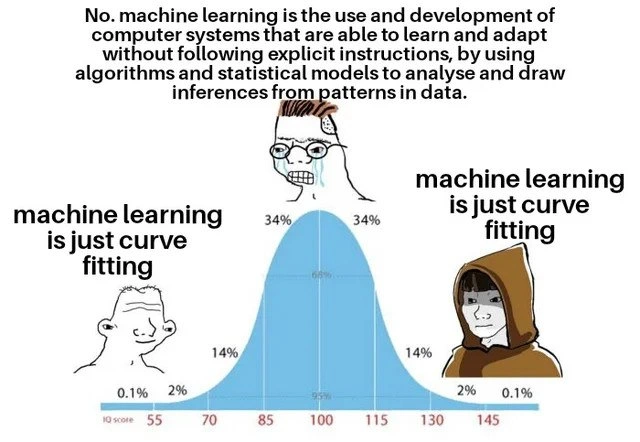
The interns and the distinguished engineers both call it curve fitting; everyone in the middle writes 80-page AI strategy decks so finance won’t notice it’s just y = mx + b running on a very expensive GPU
After 20 years in tech, I've learned that the real bell curve is how much budget you need to explain why your ML model is just a glorified linear regression with extra steps
After spending years optimizing hyperparameters, architecting complex ensemble models, and defending your PhD thesis on novel attention mechanisms, you eventually realize the junior data scientist who called it 'fancy curve fitting' on day one wasn't wrong - they just skipped the existential crisis phase where you angrily insist it's about 'learning representations' and 'minimizing empirical risk.' Welcome to the right side of the curve, where enlightenment tastes suspiciously like regression
ML is absolutely more than curve fitting - it’s curve fitting with distributed SGD, aggressive regularization, and a conference paper
Machine learning is just curve fitting - except the curve is a 175B-parameter nonconvex manifold fitted via distributed SGD on 128 A100s, and we call it “AI” so procurement stops asking why our regression needs a data center
ML: because why write explicit rules when you can overfit a Gaussian and blame the data?