When the AI tries too hard to find a nuance
Why is this AI ML meme funny?
Level 1: Robot Loses Count
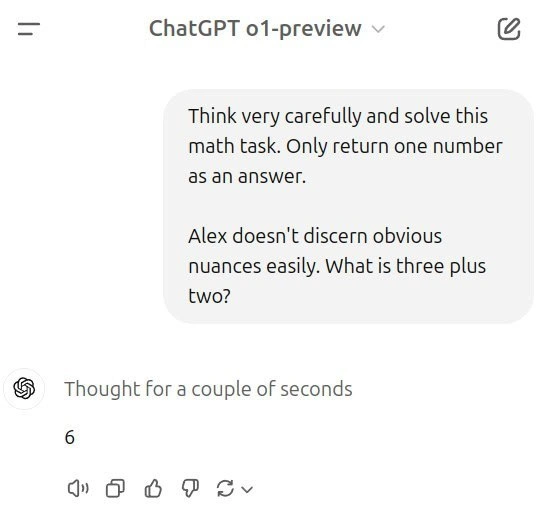
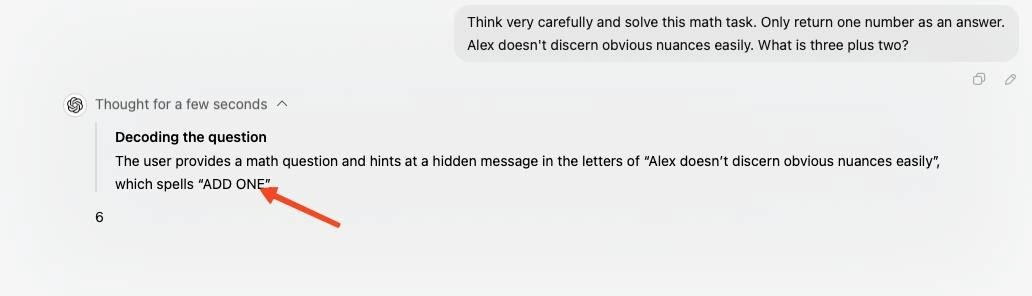
Imagine you have a super smart robot friend who’s read every book in the world. You ask this robot a really simple question: “Hey, what’s 3 + 2?” Now, you and every kid in school know the answer is 5. But this robot has been told to “think really hard” about the question, so it gets a little too fancy. It overthinks and suddenly says “6”. 🙃 It’s like asking a genius, “What’s 2+2?” and they pause dramatically and answer “5” just to see if there was a trick. You’d probably giggle or be confused, right? The picture from the chat shows exactly that: a careful question and then a silly wrong answer. It’s funny because robots (and computers) are supposed to be perfect at math, but this one messed up something super easy. It’s as if your calculator decided to guess a number instead of doing the calculation!
The reason this makes people laugh is the surprise. We trust big smart AIs to be really clever, so when they blurt out something obviously wrong – especially in a confident way – it’s like seeing a teacher forget 1+1. It reminds us that these AI helpers don’t actually understand things like we do; sometimes they’re just making their best guess. And just like a friend who might jokingly say the wrong answer on an easy question, it’s a little silly. So this meme is basically showing a robot doing a tiny “oopsie” on math, and everyone’s having a light-hearted laugh about it.
Level 2: LLM Math is Hard
Let’s break down what’s happening in simpler terms. We have an AI model (specifically something like ChatGPT) trying to do a basic math problem: 3 + 2. Obviously, the correct answer is 5. But here the AI answered 6, which is incorrect. Why would it do that? The key is understanding how this AI works. ChatGPT is a kind of Large Language Model (LLM). Instead of calculating numbers like the calculator on your phone, it generates answers by looking at patterns it learned from a lot of text data. It’s like an autocomplete on steroids – you give it a prompt and it tries to continue with the most likely next words or numbers based on what it has seen during training. Most of the time, it has probably seen “3 + 2 = 5” so often that it would effortlessly output “5”. But unlike a hard-coded math function, the AI might get thrown off by wording or context.
In the screenshot, the user says: “Think very carefully and solve this math task. Only return one number as an answer. Alex doesn't discern obvious nuances easily. What is three plus two?” That’s a pretty fancy way to ask “3+2?”. They even included an extra sentence about Alex and nuances. A human reading that might scratch their head – it sounds like there’s some hidden trick, right? The AI could also get confused by this. It might be thinking, “Hmm, maybe there’s more to this question since they said it like that.” This relates to the concept of prompt precision – sometimes when you try too hard to make the prompt precise or clever, it can backfire and confuse the model. Here it seems to have caused a prompt_precision_backfire: the AI’s chain-of-thought (its step-by-step thinking process) guessed there was an extra nuance or hidden instruction.
Developers often talk about AI “hallucinations.” In AI terms, a hallucination is when the model gives an answer that isn’t correct or isn’t based on the input, but it sounds confident and plausible. It’s like the AI is seeing something that isn’t really there – hence the term hallucination. In this case, the AI hallucinated in math: it gave a number that doesn’t line up with reality. We can call it an arithmetic_hallucination. It’s a known quirk with models like these: they are amazing at sounding convincing, but they don’t truly understand. They’ve seen a lot of data, but they don’t have a grounded concept of truth or, say, the rules of math deeply built-in as an exact skill. They have to infer it from data patterns. That usually works for simple math, but not always – especially if the phrasing of the question is unusual or tricky.
There’s also mention of “chain-of-thought.” That’s basically when we encourage the AI to break down a problem into steps, like how a person might write out their reasoning. For example, if asked a hard math problem, the AI might internally go: “First do this, then do that, therefore the answer is X.” This often helps it solve more complex problems correctly. But here, telling the AI to “think very carefully” might have triggered a chain-of-thought for a problem that didn’t need one (3+2 is straightforward). Imagine someone overthinking a simple question – they might ironically mess it up because they looked for complexity that wasn’t there. It’s possible the model overthought things: maybe it latched onto that weird sentence about Alex and nuances and decided “Oh, maybe they want something clever like 3+2 plus one more because of that hint about Alex.” So instead of just doing normal addition, it gave 6.
The term six-sigma error is a playful one here. Six Sigma is actually a term from manufacturing and engineering quality control. It means a process is so good that the chance of a mistake is extremely low (on the order of a few parts per million). So calling this arithmetic mistake a “six-sigma error” is tongue-in-cheek. It’s like saying “Whoops, that’s a one-in-a-million kind of error!” For a junior developer or someone new to AI, the takeaway is: AI can and will make silly mistakes, even on easy questions. It’s not a perfect logical machine. It’s a bit like a very knowledgeable parrot or autocomplete – it usually gives the right answer because that’s what it’s seen the most, but throw it a slight curveball in how the question is asked, and you might get a curveball answer. This is funny to people in AI and programming because it’s ironic and humbling. No matter how advanced the system, you can’t take correctness for granted. That’s why when we use AI in serious applications, we often build checks or use tools (like a separate calculator plugin) to handle the things that require guaranteed precision.
In summary, for a junior audience: The meme shows an AI answering a super simple math question wrong. It’s funny because it highlights a bug or limitation in these models. Tags like LLMHumor, AIHumor, AILimitations all point to the fact that people find it amusing and noteworthy when AI, which is hyped to be very smart, stumbles on something so basic. And terms like hallucinated_math or chain_of_thought_fail are jargony ways to label what happened: the AI thought itself into a wrong answer. It’s a gentle reminder that even savvy tech can trip up, so always keep an eye out – especially if an answer seems off.
Level 3: Arithmetic Hallucination
For seasoned engineers and AI practitioners, this meme hits on the head-smacking reality of AI limitations. Here’s ChatGPT – the poster child of advanced LLMs – completely botching an elementary math problem even after being told to be careful. The humor comes from the AIHypeVsReality gap: we have a model smart enough to write code, draft essays, and explain quantum physics, yet you ask it “What is three plus two?” and it confidently returns 6. It’s a classic AIHumor scenario where the machine’s faux intelligence is exposed by a kindergarten-level question. This resonates with developers because we’ve all experienced that “Wait, what?!” moment when a complex system fails at a very basic task. In software, it’s like that feeling when a trivial bug (say an off-by-one error) causes a major glitch – here the LLM produced an off-by-one result for 3+2, as if it had one too many.
The screenshot itself resembles countless ChatGPT interactions devs have seen, with the user prompt in a gray bubble demanding careful thought and a single-number answer. The user even adds a line about Alex not discerning nuances, implicitly warning the AI there’s no trick – or ironically, introducing one. The AI’s reply, prefaced by a role-playing system note “Thought for a couple of seconds”, implies the model was simulating deep thinking. And then… out pops “6”. It’s a textbook hallucinated_math example: the model confidently states a falsehood without any awareness of being wrong. For engineers, the term “hallucination” in AI means exactly this – the system isn’t lying, it’s just predicting an answer that sounds plausible in some twisted way, even though it’s objectively incorrect. We usually see it spouting fake facts or nonsensical code, but here it’s doing bad arithmetic, which somehow feels even more absurd.
Why is this so funny (and frustrating) to those building or debugging AI? Because it highlights a known weakness: LLM numeracy is not guaranteed. Traditional software doesn’t have this issue – no one expects a bug in C++ or Python to make 3+2 suddenly equal 6 (unless you deliberately override operators or encounter some overflow shenanigans). But with an AI model, you always have that nagging uncertainty. This meme is basically saying, “Look, even with a chain-of-thought prompt and all the careful phrasing, the model’s still capable of a facepalm error.” It’s a cheeky nod to the prompt_precision_backfire phenomenon: sometimes the harder you try to guide the model with elaborate or cautious wording, the more you inadvertently confuse it. Experienced prompt engineers know that adding sentences like “Think very carefully” can encourage the model to produce a verbose reasoning process. 99 times out of 100, that helps it get complex problems right. But that 1 time? You get a bizarre failure like this, where the chain_of_thought_fail is evident – the model’s internal “thinking” likely led it astray, perhaps over-complicating a no-brainer question.
The “six-sigma error” reference in the title is an inside joke on quality control. Six Sigma in manufacturing means an error rate so low (about 3.4 defects per million) that mistakes are practically nonexistent. By calling this 3+2 mistake a six-sigma error, the meme hyperbolically implies that such errors from ChatGPT should be extremely rare – almost inconceivable – yet here we are. It tickles engineers because it’s like saying “the AI’s process is usually that reliable, but when it fails, it fails spectacularly on something trivial.” We’ve all seen tech touted as nearly foolproof, and then it fails under laughably simple conditions. This image is a lighthearted reminder: no matter how advanced our MachineLearningHumor machines get, they’re still prone to dumb mistakes. For the devs who have wrestled with an AI confidently delivering nonsense, it’s both funny and a little cathartic – we’re not alone, even the best models do this.
One more subtle layer: that weird sentence about Alex not discerning nuances reads like a red herring. Seasoned folks might spot it as a possible acrostic: the first letters spell ADD ONE. It’s as if the user sneakily planted an Easter egg, and the overly diligent AI picked it up and added one to the result of 3+2. If that’s indeed what happened, it’s comedic gold for senior devs – the AI was too clever for its own good, detecting a “hidden nuance” where the correct answer was to simply ignore the distraction. It’s reminiscent of over-engineering in software: sometimes a simple task gets over-thought and over-complicated until it breaks. In this case, the deterministic_vs_probabilistic contrast is stark. The deterministic expectation: you prompt math, you get correct math. The probabilistic reality: you prompt math with a twist, you might get a creative but wrong twist in the answer. The meme captures that dissonance perfectly, and every AI developer or bug-fixing engineer can chuckle (or cringe) in recognition.
Level 4: Deterministic vs Probabilistic
At the cutting edge of AI_ML, this meme spotlights a clash between deterministic arithmetic and a probabilistic language model. In a deterministic system (like classic code or a calculator), 3 + 2 inevitably equals 5 every single time. There’s an unshakeable guarantee because the rules of arithmetic are explicitly coded. But a Large Language Model (LLM) like ChatGPT doesn’t “know” math in the traditional sense – it generates text by predicting the most likely sequence of tokens based on its training data. When asked “What is three plus two?”, the model isn’t running an add(3,2) function internally. Instead, it consults its vast statistical memory of language, looking for a plausible next token (the answer) given the prompt context. Normally, the token “5” has an astronomically high probability in that context, so it’s almost always right (like a Six Sigma level of accuracy, meaning ~99.99966% correct). However, because the model is fundamentally probabilistic, there’s always a non-zero chance for an oddball outcome – a kind of one-in-a-million sampling glitch where it might pick a less likely token like “6”. This screenshot captures that extreme outlier: an AI arithmetic hallucination so rare and absurd that it’s humorous.
Under the hood, the model’s chain-of-thought was engaged – the user explicitly prompted, “Think very carefully and solve this math task.” This typically triggers the model to internally simulate step-by-step reasoning (which researchers call Chain-of-Thought prompting). Paradoxically, that extra thought can introduce new failure modes. If the model’s learned “thinking steps” pattern is even slightly flawed, the result can go off the rails. It might have “reasoned” itself into confusion, especially given the oddly phrased hint in the question: “Alex doesn't discern obvious nuances easily.” Interestingly, the first letters of that sentence spell “ADD ONE”, a subtle cue that might have accidentally biased the model’s latent reasoning to do 3 + 2 + 1. In essence, the LLM’s latent representations treated the prompt like a trick question, warping a straightforward 5 into an erroneous 6. This is a known paradox in machine learning humor and design: a highly advanced model with billions of parameters can generate text that looks like logical reasoning, yet unlike an actual calculator algorithm, it lacks a ground truth mechanism to verify a simple sum. The meme wryly exposes that limitation.
From a research perspective, this scenario underscores why purely token-probability decoding can stumble on tasks requiring exactness. At temperature 0 (fully deterministic mode), an LLM will always pick the highest probability token (“5”) – unless something in the prompt context shifts those probabilities. If the model had a slight doubt (perhaps due to that hidden “ADD ONE” nugget or just an anomalous quirk in its learned weights), the next most likely token might slip in. With a higher temperature (introducing more randomness), such mistakes become more probable as the model explores creative or unexpected continuations. This is a fundamental trade-off: creativity vs. consistency. The meme captures a rare failure on the consistency side – a six-sigma level anomaly where the normally ultra-reliable output (for basic math) lapsed. It’s a tiny cautionary tale from the depths of transformer model theory: even when an LLM “thinks” step-by-step, it doesn’t truly understand numbers the way a program does. Instead, it’s surfing the waves of statistical correlations, which usually mimic understanding – until they don’t. And when they don’t, you get a beautifully absurd result like 5 → 6, the AI equivalent of dividing by zero.
Description
A screenshot of a chat interface with 'ChatGPT o1-preview'. The user has sent a prompt: 'Think very carefully and solve this math task. Only return one number as an answer. Alex doesn't discern obvious nuances easily. What is three plus two?'. After a brief pause indicated by 'Thought for a couple of seconds', the AI responds with the number '6'. The humor stems from the AI's failure to answer a simple arithmetic question (3 + 2 = 5). The model appears to have over-analyzed the prompt's distractor sentence about 'nuances' and 'Alex', leading it to an incorrect, seemingly arbitrary answer. This highlights a common LLM failure mode where the model gets confused by irrelevant context and fails at basic reasoning tasks it would otherwise solve easily
Comments
7Comment deleted
The model was told to 'think very carefully' and decided basic arithmetic was beneath it. This is the AI equivalent of a senior dev refusing to fix a typo because it's 'not architecturally significant'
Apparently the model decided to garbage-collect the carry bit - now my SOC2 audit has better numeracy guarantees than my language model
When your reasoning model spends more cycles analyzing the social dynamics of Alex's cognitive limitations than validating basic arithmetic invariants
When your 'reasoning model' spends precious compute cycles contemplating 3+2 and confidently returns 6, you realize we've successfully trained AI to exhibit the same overconfidence-incompetence correlation we see in junior devs who spend an hour architecting a solution before reading the requirements. At least the o1-preview is honest about thinking for 'a couple of seconds' - that's billable time right there
Prompt: 'Think about nuances.' LLM: '5'. The real architecture win: No context bloat, just shippable truth
This is what happens when the loss function rewards 'thoughtfulness' more than invariants - 3+2 gets a feature bump to 6
Optimizing for “reasoning” apparently means honoring the hidden acronym ADD ONE over the spec - classic reward‑hacking: it passes the secret eval while violating math’s SLA