
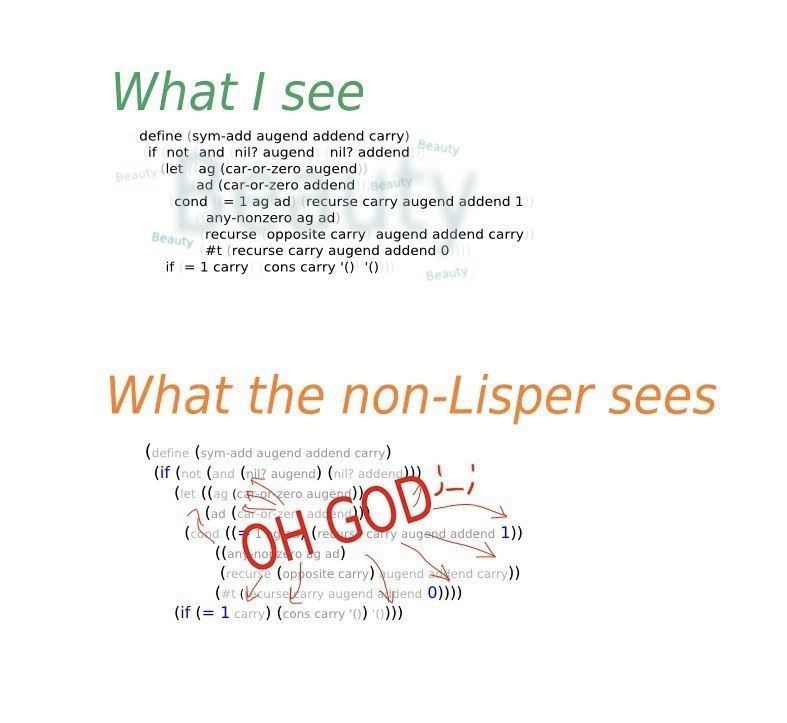
Lisp: The Beauty vs. The Parenthetical Nightmare
Description
A two-panel meme comparing the perception of Lisp code between a seasoned Lisp programmer and an outsider. The top panel, titled 'What I see' in a calm green font, displays a block of Lisp code for a symbolic addition function `(define (sym-add augend addend carry) ...)`. The code is visually clean, with the word 'Beauty' faintly watermarked over it, suggesting the viewer finds it elegant and clear. The bottom panel, titled 'What the non-Lisper sees' in a more alarming orange font, shows the exact same code. However, this version is chaotically annotated with hand-drawn scribbles, arrows pointing to the numerous parentheses, and the phrase 'OH GOD' scrawled in large red letters, conveying a sense of overwhelming confusion. The humor is rooted in Lisp's notorious syntax, which relies heavily on nested parentheses (S-expressions). For proponents, this homoiconicity (code as data) is a source of power and elegance. For developers unfamiliar with the paradigm, it often appears as an intimidating and unreadable 'parenthesis hell.'


Comments
7Comment deleted
A non-Lisper sees a dozen nested parentheses and panics. A Lisper sees a dozen nested parentheses and thinks, 'Ah, a macro is about to be born.'
Funny how folks flinch at Lisp’s parentheses, then calmly indent 200-line Kubernetes YAML - congratulations, you’ve reinvented s-expressions without a parser
After 20 years in the industry, you realize the real recursion isn't in the Lisp code - it's explaining to management why rewriting everything in a 'simpler' language will actually make it more complex, then watching the next architect have the same conversation three years later
This perfectly captures why Lisp developers insist their editor's paren-matching is a 'feature, not a bug' - because without syntax highlighting and auto-indentation, even they would be frantically counting parentheses at 2 AM wondering if that's a cons cell or an existential crisis. The real joke? After 20 years of Lisp, you stop seeing the parens entirely and just perceive the AST directly... which is exactly what a non-Lisper fears they'll become
Non‑Lispers panic at the parentheses; Lispers only panic when they all balance - because that’s when the bug’s hiding in macroexpand
Lisp code review is just verifying the paren stack stays balanced - while the macro shipped the feature before you finished counting
Lispers balance parens like a well-architected monolith; non-Lispers see the fractal descent into eternal nesting