
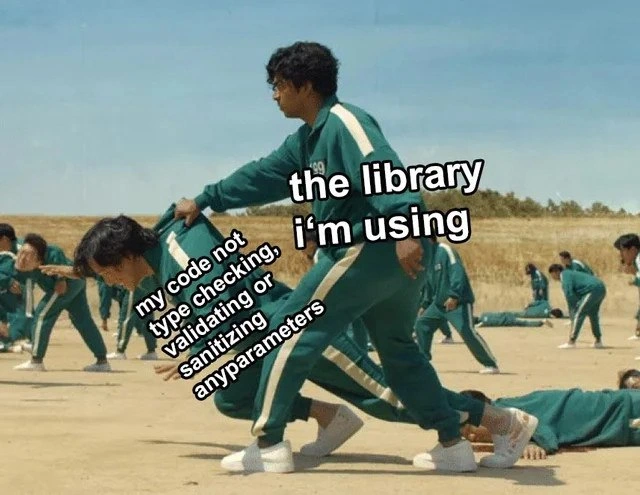
Third-party library heroically saves your unvalidated, unsanitized parameters from disaster
Description
Image is a still from the TV show Squid Game: participants in green tracksuits are stumbling in a dusty field. One standing contestant grabs another who is mid-collapse, preventing him from hitting the ground; background players are also frozen mid-motion. Bold white text over the rescuer says "the library i’m using". Diagonal white text on the falling player reads "my code not type checking, validating or sanitizing any parameters" (spacing preserved). The meme jokes that sloppy application code relies on a dependency to catch bad inputs, highlighting issues of code quality, missing input validation, and over-reliance on third-party libraries. It resonates with developers who trust external packages to handle edge cases their own code neglects
Comments
9Comment deleted
Nothing says “enterprise-grade” like a multimillion-TPS API whose entire input-validation layer is an open-source library maintained by one sleep-deprived grad student - our threat model is basically ✨npm install hope✨
After 15 years of watching libraries gracefully handle my team's creative interpretations of 'optional' parameters, I've learned that the real MVP isn't the developer who writes perfect code - it's the library author who anticipated we'd pass a Promise<string[]> where they expected a number and somehow made it work anyway
When your application code treats every function parameter like an untyped 'any' while the library you're calling expects a rigorously validated, sanitized, and type-checked input - suddenly those runtime exceptions aren't so mysterious. It's the classic case of 'garbage in, segfault out,' except the library is just enforcing the contract your code never bothered to read. Pro tip: if your error logs look like a crime scene, maybe start validating inputs before they reach production-grade dependencies that actually respect their own type signatures
Letting a third-party lib do all validation is the microservice equivalent of making the API gateway your QA team - fine until a minor release flips sanitize=false and you ship XSS-as-a-service
Manual validation across 50 endpoints: because consistent bugs beat dependency risks
Validation strategy: let the library throw - our trust boundary is a transitive dependency and SemVer‑fueled optimism
Hehe Comment deleted
Library? So powerful? Comment deleted
rubocop?) Comment deleted