JavaScript vs. C++ Libraries: A Tale of Two Extremes
Why is this Languages meme funny?
Level 1: Tiny Tools vs Giant Machines
Imagine two friends dealing with a very simple problem in completely over-the-top ways. One friend has a special little helper for every tiny task. Need to check if a number of candies is even? Instead of just counting them by hand, they grab a quirky gadget or call someone else to do it. They basically won’t lift a finger unless they have a mini tool for it. Now, the other friend is the opposite: if they need to do something simple – like make a little "beep" sound to get everyone’s attention – they won’t just use a whistle or tap a bell. Nope, they disappear into the garage and build a whole new machine from scratch that can beep. They’re hammering, wiring, and assembling a big contraption with speakers, all just to create one small "beep!" sound. It’s obviously unnecessary, and that’s why it’s funny. One friend makes even the easiest task depend on a tiny helper gadget, while the other friend tackles a simple task by inventing a huge, complicated device. Both approaches are so exaggerated and silly that you can’t help but shake your head and laugh. It’s like solving a one-piece puzzle by either buying a dozen instruction booklets (Friend A) or constructing a robot to put that one piece in place (Friend B) – two ridiculously extreme ways to handle something that should be simple!
Level 2: Simple Checks vs Complex Solutions
At this level, let's break down what’s going on in that tweet for a junior developer. First, some definitions:
- A library (or "package") is a bundle of code someone else wrote that you can reuse in your own project. Instead of writing a feature from scratch, you often can import a library to do it for you.
- JavaScript libraries are often shared via npm (Node Package Manager). npm is an online repository and a command-line tool that lets you easily download and manage packages for JavaScript/Node.js projects. You might have used
npm installto grab frameworks or tools. In the JavaScript world, it's common to have many small packages that each do one simple thing. - C++ libraries work a bit differently. C++ is a compiled language, and its libraries are usually distributed as compiled files or as source code that you integrate into your project. There isn't one single npm-like hub for all C++ libraries. C++ developers use various methods to get libraries (for example, installing via a system package manager, using tools like vcpkg/Conan, or just downloading source code). C++ libraries also tend to be larger in scope or solve more complex problems, partly because adding an external library in C++ can be non-trivial (you have to deal with compiler settings, linking, and platform compatibility).
Now, the tweet jokes about the "average" library in each of these ecosystems:
An "average JavaScript library" in this meme is something like
is-even,is-odd, oris-number. These are real examples of very trivial npm packages. For instance,is-evenis an actual npm package that tells you if a number is even. How might it do that? Likely by performingn % 2 === 0– essentially using the modulus operator to check if a number divides by 2 with no remainder. That's a one-line check that many beginners could write themselves in seconds. Yet, someone packaged it as a reusable library! Similarly,is-oddreturns true if a number is odd (probably just the inverse ofis-eveninside), andis-numberchecks if a value is of type Number (and not something weird likeNaNor a string). These are extremely simple functions. It's funny (and a little shocking) because it feels like overkill to have separate libraries for such basic tasks, but in the JavaScript world this actually happens. People publish these tiny utility packages, and other developers include them rather than writing the code from scratch, possibly to save time or ensure they handle edge cases correctly.To illustrate, using a trivial JS library might look like:
// JavaScript: using a tiny npm package for a simple task const isOdd = require('is-odd'); console.log( isOdd(3) ); // -> true, since 3 is oddUnder the hood,
is-oddmight itself be usingis-evenor extra type-checking, but as a user you just callisOdd(3)and get a boolean result.Now, an "average C++ library" according to the meme is something quite different: the example given is essentially a cross-platform beep library. This means a library (and command-line tool) to make the computer produce a "beep" sound — specifically to toot "tooot" as the description says. Why would that exist? Well, making a computer beep isn't straightforward in modern times. In the old days, you could do it with simple means (for example, sending a bell character
\ato the console could trigger a motherboard speaker beep). But by 2025, not all computers have a physical PC speaker for beeping, and many operating systems ignore or mute that old-school beep. So a determined C++ developer created a library to ensure a beep actually comes out of the speakers on any OS. Achieving that is a much more complex problem than checking if a number is even! The meme implies that in C++, the bar for what's considered an "average" library is set much higher — it might involve system-level programming or reinventing hardware functionality.To use a C++ library like this beep tool, you might do something like:
// C++: using a hypothetical library to make a sound #include "beep.h" int main() { beep::play("tooot"); // This might play a "tooot" sound through the speakers return 0; }In reality, the code inside
beep::play()would have to handle different platforms (Windows vs. Linux vs. macOS) to actually produce a tone. It might call the WindowsBeepfunction for one case, or use an audio API or device file on Unix systems. The key point is that this C++ library isn't just a one-liner; it's an entire project that tackles a tricky, low-level task (making a real sound) in a portable way.
So why is the tweet comparing these two? It's showing the huge difference in library granularity between the JavaScript and C++ ecosystems:
- In JavaScript, you might pull in dozens of super-small libraries for tiny tasks. This makes development quick and easy in many cases, but it has a downside: you can end up with a large web of dependencies. Your project could rely on hundreds of packages (because each small package might in turn depend on other small packages). Managing all those can become a headache, often jokingly referred to as dependency hell when things go wrong. A famous real incident highlighting this was when the
left-padpackage (just a few lines of code to pad a string with spaces) was unexpectedly removed from npm by its author; suddenly, tons of JavaScript projects broke because they indirectly depended on that tiny utility. Developers learned that having so many trivial dependencies can be risky. - In C++, developers are generally more conservative about adding dependencies. There's a culture of "if it's simple, implement it yourself" to avoid external dependency overhead. C++ also has a strong standard library for most basic needs (you don’t need an
is-evenlibrary because you can just use the%operator). When C++ devs do pull in a third-party library, it's usually for a bigger need – something complex that would be a lot of work to write from scratch, like a graphics engine, JSON parser, or (in this joking case) a multi-platform beep toolkit. So the tweet humorously calls the beep library "average" to contrast it with the much simpler scope of the JavaScript libraries. It’s like saying: in JS land, the average library is 5 lines of code, while in C++ land, the average library is a full-blown system utility.
One term used is cross-platform: this means the library works on multiple operating systems (Windows, Mac, Linux, etc.). The beep project prides itself on being cross-platform, which is a big deal in C++ because it means the author handled all the OS-specific details to make it run anywhere. In JavaScript, by contrast, many packages are inherently cross-platform (since Node.js runs the same on all platforms, a small logic check like is-even doesn’t change between OSes).
In simpler terms:
- The JavaScript approach is like having lots of little helpers for everything. Even very simple tasks (like checking if a number is odd) might be done by importing a small helper library. It’s very convenient, but it means you rely on many external pieces.
- The C++ approach is more about doing things yourself unless it’s really complex. Simple task? Just write the few lines of code in C++ to do it. Complex task that would be reinventing the wheel? Okay, maybe bring in a library – but that library might be a big, robust piece of software in its own right.
The meme is a playful language comparison that exaggerates to make a point. It highlights how different programming communities solve problems in almost opposite ways. For a junior developer, the takeaway is that what counts as a "typical library" in one language can be totally different in another:
- In JavaScript, you might laugh and say, "I can’t believe there’s a package just for that!"
- In C++, you might laugh and say, "I can’t believe someone went to the trouble to build this whole thing just to do that!"
Both scenarios are comically exaggerated here – and that contrast is exactly why developers found the tweet amusing.
Level 3: Micro Packages vs Mega Projects
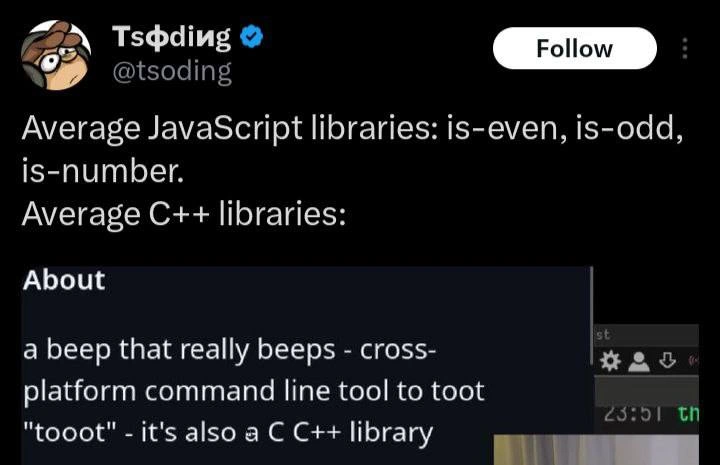
Tweet by @tsoding: "Average JavaScript libraries:
is-even,is-odd,is-number.
Average C++ libraries: a beep that really beeps – cross-platform command line tool to toot "tooot" – it's also a C C++ library."
This meme highlights a hilarious contrast between two language ecosystems: JavaScript with its plethora of ultra-granular npm packages, versus C++ with its ambitious, hardware-hugging libraries. Seasoned developers immediately recognize the satire here. On one side, the "average" JavaScript library is exemplified by trivial utilities like is-even or is-odd – tiny modules that do little more than check if a number is even or odd. On the other side, the "average" C++ library (tongue-in-cheek) is represented by something outrageously over-engineered: a cross-platform tool to make a PC beep (literally producing a sound "tooot") as a fully-fledged C/C++ library.
Why is this so funny? It pokes fun at language culture and package management extremes. In the Node.js world, developers often joke that there's an npm package for everything – even for one-liner functions. Need to know if a number is even? Sure, just npm install is-even. That package likely contains nothing more than:
module.exports = function isEven(n) {
return n % 2 === 0;
};
Yet, it's published and versioned as if it were a critical piece of infrastructure. In fact, there's a real is-odd package on npm with millions of downloads that literally uses is-even under the hood (along with a couple of other tiny dependencies) to determine oddness. These micro-packages are the epitome of dependency granularity: incredibly fine-grained pieces of code packaged independently. Experienced devs will recall the infamous left-pad incident, where an 11-line npm utility for padding strings was removed from the registry, breaking thousands of projects. That fiasco became a legendary example of dependency hell caused by relying on trivial external packages. The meme’s mention of is-number is another nod – dynamic JS often needs type-check helpers, so yes, there’s even an is-number library (ensuring a value is numeric and not NaN, etc.). In the JS ecosystem, it's normal (if slightly absurd) to pull in packages for such elementary tasks. This can lead to massive dependency trees where a simple project might depend on hundreds of packages (each doing tiny jobs). Every seasoned JavaScript engineer has done a double-take looking at the bloated node_modules folder and thought: "All that just to add two numbers?"
Now contrast that with the C++ world. C++ developers come from a culture where the standard library is robust and you typically write utility code yourself rather than grabbing a small library for it. It's rare to find a C++ library dedicated solely to checking if a number is even – you'd just use x % 2 == 0 in code. So what does an "average C++ library" look like? The joke suggests it's something wildly over-engineered by comparison: not content with simple tasks, a C++ project might be about controlling hardware or doing something low-level and esoteric, like toggling the PC speaker to produce a sound. The example given – "a beep that really beeps" – sounds like a fun side-project a C++ guru might publish: a command-line program (and library) to make your computer physically beep "tooot". It’s the kind of eccentric tool you stumble upon on GitHub and think, "Huh, someone really spent time on this?" Seasoned C++ devs chuckle because they've seen plenty of these one-off libraries that interface with hardware or OS quirks. Making a cross-platform beep is actually non-trivial: on Windows you might call the Beep(frequency, duration) API to control the speaker, while on Linux/macOS you might need to use \a (the BEL character) or interface with system sound drivers. Achieving a consistent "toot" across OSes in 2025 might indeed require digging into system APIs or even writing a tiny waveform to the sound device – definitely more involved than one line of code. So, a C++ developer might roll up their sleeves and reinvent the wheel – or in this case, reinvent the speaker. The meme exaggerates by calling this the average C++ library, implying that C++ libraries often aim at grand, system-level feats compared to JavaScript's bite-sized utilities.
The humor lands especially with those who have dabbled in both ecosystems. We’ve all seen the absurdity: JavaScript projects where node_modules contains dozens of ultra-focused packages (some so basic you feel a bit guilty for not just writing the function yourself), contrasted with C++ projects where someone’s proud of crafting a new libBeep that manipulates OS calls to make sound come out of the machine. It’s a classic case of “use what’s there” vs “do it yourself from scratch”. There's also an underlying commentary on how different communities approach reuse and complexity. In the JS world, the motto is often “don’t reinvent the wheel” – why write your own even-number check when a package exists (never mind that installing it might pull in three other packages and 500 lines of code to essentially do n % 2)? Meanwhile, the C++ ethos historically has been closer to “if you need it done right, do it yourself”. Thus, C++ devs might avoid trivial dependencies (the language didn’t even have a unified central package repository for most of its history) and instead create something custom, even if it seems over-the-top for the problem at hand.
Another aspect poked at here is dependency management versus self-reliance. JavaScript’s npm makes adding dependencies so frictionless that developers sometimes include packages for the tiniest things without a second thought. This can lead to version conflicts and maintenance headaches when one of those hundreds of dependencies updates or disappears (hello, npm audit and security warnings for an app that only prints "Hello World"). C++ developers, on the other hand, often face a higher barrier to adding a third-party library (Will it compile on all platforms? Will it bloat the binary? Is the license compatible?). So they often prefer to avoid pulling in ten libraries for ten small tasks — instead, they put on their hacker hat and implement it internally. The downside? They might end up reinventing something that already exists. How many times have C++ projects written their own logging framework or utility collection? Plenty. The beep example is delightfully absurd because it’s such a primitive feature; one would assume the OS or language already provides a beep. But here comes a determined C++ dev in 2025 saying, "Nope, I'll make my own beep tool!" It’s both overkill and kind of endearing in its geeky enthusiasm.
In summary, the meme gets tech folks laughing (and maybe groaning) because it satirizes the extremes of two worlds we know well:
- The JavaScript/npm ecosystem: a wonderland (or minefield) of tiny, single-purpose packages – so many that a simple question like "is this number even?" can become an exercise in sifting through dependencies. It’s a nod to how PackageManagement in JS can sometimes feel like assembling a thousand tiny LEGO pieces just to build a toy car.
- The C++ ecosystem: a realm where if something isn't readily available, a programmer might create an entire subsystem to achieve it. It's poking fun at how C++ libraries often end up as comprehensive (and complex) solutions – sometimes solving niche problems with a level of effort that seems comically disproportionate to the original need.
For veteran engineers, this contrast is painfully relatable and ridiculously funny. We’ve witnessed the chaos of trivial npm packages causing big issues, and we’ve also seen the grandeur (and silliness) of C++ coders going low-level for a small victory. The meme exaggerates reality just enough to make us laugh, because deep down we recognize the grain of truth: different programming cultures have wildly different ideas of what constitutes a "useful library," and seeing those differences side-by-side is pure developer humor.
Description
A screenshot of a tweet from the user Tsфdiиg (@tsoding) that contrasts the typical libraries of JavaScript and C++. The tweet first states, 'Average JavaScript libraries: is-even, is-odd, is-number.' This pokes fun at the npm ecosystem's tendency for hyper-specific, sometimes trivial, micro-packages. The tweet then says, 'Average C++ libraries:' and shows a screenshot of a project description that reads, 'a beep that really beeps - cross-platform command line tool to toot "tooot" - it's also a C C++ library'. This humorously highlights the C++ community's penchant for creating quirky, low-level, and oddly specific system utilities. The joke resonates with experienced developers by exaggerating the cultural stereotypes of these two prominent programming ecosystems

Comments
17Comment deleted
A JavaScript project's `node_modules` directory has a larger gravitational pull than some small moons, all to determine if a number is odd. Meanwhile, a C++ dev will spend three weeks writing a cross-platform audio driver just to avoid a system call. Both are solving problems, just on very different scales of abstraction and sanity
npm might give you is-even with 40 transient deps, but in C++ the build script first compiles an entire audio driver before emitting a single ‘tooot’.
The real irony is that the C++ 'beep' library probably has fewer transitive dependencies than checking if a number is even in JavaScript, yet somehow still manages to segfault when you pass it a Unicode toot
The JavaScript ecosystem has perfected the art of atomizing functionality to the point where we need three separate packages to determine if a number exists and what kind of mood it's in, while C++ developers are still writing novellas in their README just to explain that their library makes a computer go 'beep.' One ecosystem treats functions like microservices, the other treats documentation like a Tolstoy novel - and somehow both communities think the other is doing it wrong
npm gives you is-even and 80 transitive deps; C++ gives you one ‘beep’ lib and 80 CMake flags - either way production goes “toooot” at 03:00
JS needs is-even to avoid NaN parity debates; C++ beeps once and templates handle the rest at compile time
npm: nine micro-packages to decide if 2 is even; C++: one “beep” lib that vendors a CLI and half the audio stack - either way the SBOM is louder than the feature
But I need a library that boops Comment deleted
Not just beeps Comment deleted
is-beep, is-boop, is-toot Comment deleted
js: 🤡 c++: 💀 Comment deleted
high level is best🚫 low level is better✅ Comment deleted
application written in js: 🐢 application written in python: 🐌 application written in C++: 🐍🐯🐰🐴 Comment deleted
the correct command is /votekick (or /kickvote) btw, but the bot is down now Comment deleted
That's true on paper, in the real world things can be much different, especially with "vibe coders" play-pretend devs Comment deleted
hmmmmmmm. 🆗 Comment deleted
\a Comment deleted