
The Peril of Permanent Temporary Fixes in Legacy Code
Description
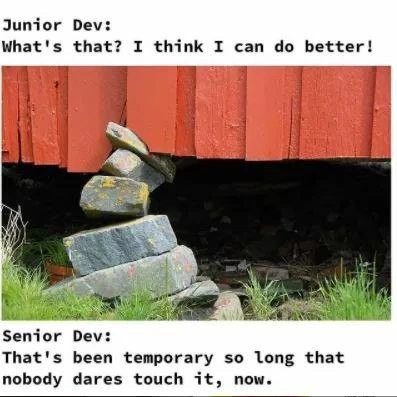
A two-panel meme contrasting the perspectives of a junior and senior developer. The top panel has text that reads, 'Junior Dev: What's that? I think I can do better!'. Below the text is an image of a red wooden building's foundation being propped up by a precarious and haphazard stack of large, weathered stones. The bottom panel contains the text, 'Senior Dev: That's been temporary so long that nobody dares touch it, now.' The meme humorously illustrates the concept of technical debt and the danger of 'temporary' solutions becoming permanent, critical fixtures in a system. For experienced developers, it's a relatable scenario where a junior's well-intentioned desire to refactor and improve code is met with a senior's hard-won wisdom about the risks of touching a fragile, undocumented, but mission-critical part of a legacy application
Comments
7Comment deleted
We call that 'Jenga Driven Development'. The source code comment just says 'DO NOT TOUCH', which also serves as its only unit test
That wobbly stone pillar is basically our TemporarySupportFactoryImpl - so load-bearing in the call graph that the architecture diagram just says “here be dragons,” and the incident playbook’s only step is “back away slowly.”
The only difference between a temporary workaround and permanent infrastructure is whether the original developer still works there to explain why touching it will bring down production, three microservices, and somehow the office coffee machine
Ah yes, the legendary 'temporary' fix from 2003 that's now load-bearing infrastructure. The junior dev sees a house of cards and thinks 'I can rebuild this properly in a weekend.' The senior dev knows that rock stack is actually holding up three microservices, two legacy APIs, and someone's quarterly bonus - and the original developer who understood why it's stacked that way left the company seven years ago. Touch it and you'll spend the next month in incident reviews explaining why you thought refactoring the authentication layer during Black Friday was a good idea
Junior sees tech debt; senior sees a load-bearing monolith that's survived three tech stacks and two layoffs
That hotfix outlived three release trains - so it got a CMDB entry, an SLA, and a recurring change freeze
Rule of thumb: if a “temporary” fix survives two quarters, it’s part of the architecture - this rock pile is our cron job with SLOs; touch it and prod relearns gravity