The Daily Drag to Stand-up When Code Needs to Ship
Why is this Meetings meme funny?
Level 1: Playtime Interrupted
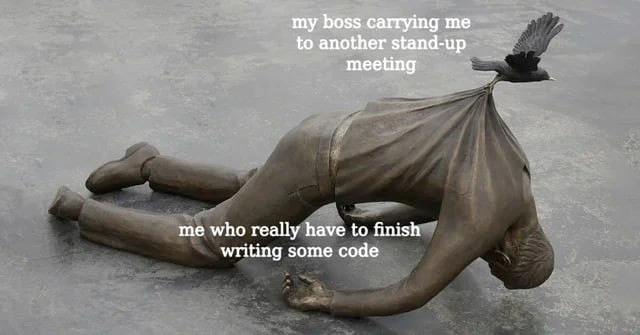
Imagine you’re playing your favorite game or building a super cool LEGO tower, and you’re totally into it. You’re concentrating really hard, and you’re almost done with something awesome. Now picture a grown-up suddenly coming in and saying, “Stop what you’re doing, it’s time to do this other thing right now,” and they literally pull you away from your toys. How would you feel? You’d probably be upset or annoyed because you were in the middle of something important (at least, important to you!). That’s exactly the feeling this funny picture is talking about. The person on the ground is like a kid (or anyone) who was busy with something they love — in this case writing computer code, which is like solving a big puzzle. The crow pulling on his jacket is like a boss or teacher dragging him to a meeting, which is like a mandatory group talk. He really didn’t want to go; he wanted to keep doing his fun, important thing. So the whole joke is: getting pulled away from what you love to do by someone in charge, right when you’re in the middle of it. It’s frustrating for the person being dragged, but from the outside, it looks a little silly and that’s why we can laugh at it.
Level 2: Meeting vs Coding Time
Let’s break down what’s going on in this meme in simpler terms. It’s about the conflict between coding time and meeting time in a developer’s day. On one side, we have “me who really have to finish writing some code” – this represents a programmer deep in their work, trying to get a task done. Programmers often talk about being “in the zone” or in a flow state, which means they are super focused on the code. When in flow, a developer might be solving a complex problem or writing a lot of code quickly, with full concentration. Time tends to fly in these moments because the person is fully immersed in the work. This is when DeveloperProductivity is at its highest – one uninterrupted hour in flow can accomplish more than three hours of constant starting and stopping.
On the other side, the meme shows the text “my boss carrying me to another stand-up meeting.” The stand-up meeting here is a specific kind of work meeting common in tech teams, especially those following Agile or Scrum methodologies. A stand-up (sometimes just called “daily stand-up” or “daily Scrum”) is usually a short meeting (~15 minutes) every day where each team member briefly shares what they did yesterday, what they plan to do today, and if they have any blockers (problems stopping their progress). It’s called a “stand-up” because traditionally everyone stands up during it – the idea is that if you’re standing, you’ll keep it brief and not turn it into a long discussion. This is one of the Agile ceremonies meant to keep the team synchronized and catch issues early.
Now, why would a boss have to “carry” someone to stand-up? That’s a humorous exaggeration of a common feeling among developers: when you’re in the middle of coding and someone says “Hey, stop that for a minute, it’s time for the stand-up,” it can feel very annoying or frustrating. The meme artist chose an image of a statue being dragged by a crow to dramatize that feeling. The boss is symbolized by the crow grabbing the person’s jacket, and the programmer is like the statue, flat on the ground, not wanting to move. It implies the developer is being forced or at least very reluctantly pulled away from their work to attend the meeting. It’s a funny image because of course in real life a boss doesn’t pick you up physically — but they might send repeated messages, poke their head into your office or cubicle, or insist you join the Zoom call, effectively forcing you to drop what you’re doing.
This highlights a well-known issue: context switching. In simple terms, context switching is when you change from doing one thing to another. For humans (and even for computers), switching contexts has a cost. Imagine you are writing an essay and someone interrupts you; when you return to the essay, you need to remember what you were going to say next. Similarly, when a developer stops coding to attend a meeting, they have to put a pin in their thought process. After the meeting, it takes some effort and time to resume the work and recall exactly where they left off. This is known as context_switching_cost. It’s like if you were reading a book and someone took the book away for 15 minutes – you’d have to spend a bit of time remembering what was happening in the story when you get the book back. With coding, the “story” is all in the programmer’s head (the state of the program, the plan for what to write next, potential solutions, etc.), and interruptions can make it harder to pick up where they left off. Studies in workplace psychology have noted that it can take a significant chunk of time (sometimes 15-30 minutes or more) to fully regain focus after an interruption. So even though a stand-up meeting itself might be only 15 minutes, the flow_state_interruption can have a much larger impact on the day’s productivity.
The categories and tags associated with this meme tell us more about the context:
- Meetings / MeetingHumor / MeetingOverload: The meme is definitely humor about meetings. “Meeting overload” is a term used when there are just too many meetings, eating up the time one could spend working. Many developers feel that they have too many meetings (from daily stand-ups to planning meetings, retrospectives, etc.), which cut into their actual coding time. This meme jokes about that overload by depicting the stand-up as yet another meeting you’re dragged into unwillingly.
- Agile / Scrum / AgileCeremonies: Agile is a way of managing software projects that values quick iterations and frequent communication. Scrum is a popular flavor of Agile that prescribes certain routines (ceremonies) like the daily stand-up, sprint planning, sprint review, and retrospectives. The stand-up is meant to help, but as with any process, it can become a bit of a checkbox exercise if not done thoughtfully. This meme is poking fun at the daily stand-up ceremony, implying it might be done in a drag-you-by-the-collar fashion rather than being genuinely helpful.
- DeveloperProductivity / DeveloperPainPoints / DeveloperFrustration: A “pain point” is something that causes problems or pain. Here the pain point for developers is constant interruptions or mandatory meetings that break their concentration. The frustration comes from wanting to be productive (finish writing code) but having to stop for a meeting, possibly one that happens every single day and sometimes feels pointless. If the developer in the meme “really has to finish writing some code,” they likely feel the stand-up is an obstacle at that moment, rather than a help. The humor is that his priority (finish the code) and the boss’s priority (attend the stand-up) are at odds.
It’s worth noting that stand-ups can be useful when done right — teams share information, and someone stuck on a problem might find help. But they’re supposed to be quick and not get in the way. The meme jokes that in reality, bosses might treat stand-ups as non-optional formalities, even when a developer is clearly busy. Many junior developers, when they first join a team, quickly learn this daily routine: every morning (or sometimes right after lunch), you stop what you’re doing and gather (or join a call) to do the stand-up. At first it might seem fine — it’s short, after all. But the more you get into coding complex stuff, the more you might feel that even this short interruption has a bigger cost than people realize. That’s exactly what this meme is pointing out. It’s a kind of inside joke among software folks: “Yep, been there, my code was on fire (in a good way) and then I had to drop everything for a meeting that I didn’t feel like attending.”
In summary, the meme uses a dramatic image to illustrate the everyday tug-of-war between focused coding time and required team meetings. For a newer developer or someone outside the field, it’s saying: Developers hate being interrupted when they’re coding, but bosses love their meetings. It’s a lighthearted take on a real workplace cultural issue — balancing the need for communication (meetings) with the need for concentration (coding). If you’ve ever been doing something important and had an adult or authority figure insist you stop and do something else (like a chore or another task), you can probably relate to the feeling. In the tech world, that scenario happens every day at stand-up o’clock!
Level 3: Stand-up Breakpoint
In the trenches of software development, nothing shatters a flow state quite like the abrupt, ritualistic stand-up meeting. The meme’s statue being dragged across the ground by a crow is a spot-on metaphor for a developer yanked out of deep focus. Picture a programmer blissfully lost in code — the world faded away, variables and functions flowing effortlessly from brain to keyboard. Suddenly, peck-peck! along comes the boss (that pesky crow) carrying them to another stand-up meeting by the scruff of the neck. The poor dev (represented by the collapsed bronze figure labeled “me who really have to finish writing some code”) is face-down, arms outstretched towards their work as they’re forced to attend yet another status circle. It’s darkly funny because we’ve all been that statue: one moment solving a complex bug, the next being dragged to recite what we did yesterday and what we’ll do today.
This is classic DeveloperHumor born from DeveloperFrustration. The image exaggerates how it feels inside when your MeetingCulture demands you drop everything for a daily check-in. The crow (boss) isn’t literally violent at the office, but it sure can feel like a forced_meetings ambush when you’re in “the zone.” Context_switching_cost in development is brutally real — akin to a CPU switching threads and having to reload caches. When a coder is in a flow_state, their mental “stack” is full of the task at hand: the architecture, the logic, the bug they’re tracing. A stand-up meeting hits like an interrupt signal, forcing a context save. Just as a computer incurs overhead saving registers and flushing pipelines on a context switch, a developer’s brain pays the price too. We might joke that a daily stand-up imposes a ~15-minute meeting plus a 30-minute reboot of your brain’s state after. That precious code you were writing doesn’t fit neatly into a 15-minute meeting slot — you’ll spend time afterward reloading all those details you were holding in your head. This flow state interruption has a ripple effect: by the time you’re fully back in the groove, you might have lost the insights or momentum you had.
From a senior engineer’s perspective, the humor cuts deep because it’s a well-known AgilePainPoints scenario. Agile Scrum methodology introduced the daily stand-up (a key AgileCeremonies practice) to improve team communication and quick identification of blockers. In theory, it’s a 15-minute rapid sync meant to replace longer, less frequent meetings and keep projects agile. In practice, however, it can become another routine that undermines actual work. The meme highlights this irony: nothing says “agile” like halting your productive coding every single day at the same time because the process checklist demands it. Experienced developers have seen how daily meetings, intended to boost DeveloperProductivity, sometimes backfire and turn into MeetingOverload. Maybe the stand-up runs over time, or it devolves into micromanagement with the boss interrogating everyone for status. The result? The team’s morning energy gets siphoned away, and the coding_vs_meetings battle tips in favor of meetings. The veteran coder in me can’t help but chuckle sarcastically here: we replaced weekly status meetings (Waterfall era) with daily status meetings (Scrum era) and called that progress. Meetings went from a dreaded occasional disruption to a daily drag — a smaller dose but a higher frequency addiction. It’s a prime example of good intentions (more Agile communication) turning into a DeveloperPainPoint when taken to extremes or handled rigidly.
Why is the boss depicted as physically dragging the dev? Because often it’s management or a Scrum Master enforcing attendance and punctuality. If you’re deep in code and a bit late to stand-up, you might get that pointed Slack message: “Stand-up now — where are you?” Cue the feeling of a crow pecking at your back. The meme exaggerates it to a crow hauling a statue, capturing that sense of helpless inevitability. You have to attend, no matter how trivial your update or how critical the code on your screen. The developer’s posture — collapsed and reaching out — screams “I don’t wanna go!” It’s funny because it’s true: developers often joke that our main “blocker” to report in stand-up is, well, the stand-up itself. (How many times have we wanted to say: “Yesterday I was coding until this meeting stopped me. Today I’d like to continue coding after this meeting. No blockers except this meeting.”) It’s a shared trauma and thus comedic gold in tech circles.
Digging deeper, there’s also an implicit commentary on the MeetingCulture in many companies. Some organizations schedule so many meetings and AgileCeremonies that engineers struggle to get actual work done. The phrase “dragged from flow state to stand-up” is the perfect encapsulation of that problem. Meetings often operate on a manager’s schedule — chopped into neat half-hour or hour increments — whereas coding thrives on a maker’s schedule: contiguous blocks of uninterrupted time to solve problems. Paul Graham’s well-known essay on Maker’s Schedule, Manager’s Schedule outlined this conflict back in 2009. Managers (like bosses and project leads) live in meetings; jumping from one to another is normal for them. For makers (developers, writers, anyone who creates), a single meeting in the middle of the morning or afternoon can wreck the whole flow. Senior devs know this viscerally. We’ve strategized about how to partition our day: maybe do code in the early morning, then accept meetings in the later afternoon when focus wanes. But when the company mandates a 9:30 AM stand-up right when you’re freshest, it’s a context switch you can’t dodge. That’s why this meme hits home — it exaggerates the scenario (boss as crow, dev as lifeless ragdoll) to validate a very real frustration. It’s a bit of gallows humor for those of us who’ve been dragged out of the code cave one too many times.
On a systems level, the meme underlines the trade-off between communication and concentration. Sure, stand-ups can be valuable: the team quickly shares progress, people mention if they’re stuck, and the boss gets peace of mind that work is happening. But the DeveloperProductivity cost is often invisible to non-developers. It’s the context_switching_cost nobody talks about in sprint retrospectives. If you’re a seasoned developer, you’ve likely experienced that mental whiplash of stopping your IDE, opening your meeting app, mechanically going through the stand-up (“Yesterday I did X, Today I plan Y, No blockers”), then trying to dive back into code only to realize you lost the thread of what you were doing. The laughter this meme provokes is a knowing, slightly pained laugh. We laugh because we’ve lived it and it’s easier than crying over spilled productivity. As a battle-scarred coder, I can’t help but smirk: Agile promised us more adaptability and less bureaucracy, yet here I am being dragged to a bureaucratic daily check-in while my code waits forlorn on the screen. The crow might as well be squawking, “No committing code until you give your update!” It’s absurd — and that absurdity is exactly what the meme lampoons.
In summary, this meme combines MeetingHumor with a dash of dark truth. It strikes a chord with developers who value focus and deep work. The statue’s plight is hilariously tragic: a once-majestic coder turned bronze roadkill by meeting overload. It’s the daily meeting struggle distilled into one image. Every experienced dev reading it can basically feel that tug on their collar. And we share a collective, knowing chuckle – because even if we can’t escape the stand-up drag, at least we can meme about it.
Description
This meme features a photograph of a bronze sculpture depicting a person lying face-down on a stone-paved ground. A small bird has grasped the back of the person's shirt in its beak and is attempting to drag the seemingly inert body. White text is overlaid on the image, labeling the bird as 'my boss carrying me to another stand-up meeting' and the person on the ground as 'me who really have to finish writing some code.' The visual humorously exaggerates the feeling of being unwillingly pulled into yet another meeting, especially a recurring one like a daily stand-up, when deep in concentration and facing deadlines. For experienced engineers, this captures the perennial conflict between collaborative agile ceremonies and the need for uninterrupted 'flow state' to solve complex problems, where even a short context switch can derail hours of work
Comments
7Comment deleted
My calendar has become a denial-of-service attack on my IDE
Daily stand-ups are just stop-the-world GC pauses - management logs “15 ms” while every thread loses its L1 cache and forgets what it was allocating
After 15 years in this industry, I've realized the most complex distributed system isn't Kubernetes or microservices - it's trying to coordinate a team's deep work schedule around the gravitational pull of recurring meetings that could have been async updates in Slack
The daily standup: where 'I'm blocked' means 'I'm blocked by this meeting from actually unblocking myself.' Senior engineers know the real sprint velocity killer isn't technical debt - it's the recurring calendar invite that fragments your morning into 15-minute chunks too small to load your mental context into RAM
Boss calls it a 15-min stand-up; raven bills it as a full velocity drag on cycle time
Daily stand-up: a synchronous RPC to management that preempts your deep-work thread, invalidates caches, and returns 200 OK with body "still coding."
Our daily stand-up is basically stop-the-world GC - full pause, no memory reclaimed, and a 23-minute context-switch tax before anyone can compile a thought