
Java's Evolution: From Wild Lynx to Domestic Cat
Description
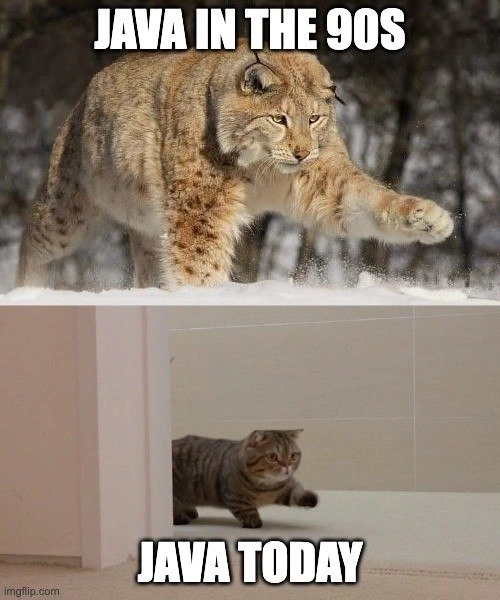
This is a two-panel comparison meme that contrasts the perception of the Java programming language over time. The top panel features a powerful, majestic lynx confidently striding through a snowy, wild landscape, with the white text 'JAVA IN THE 90S' overlaid. The bottom panel shows a small, timid-looking domestic tabby cat cautiously peeking around a corner inside a house, with the text 'JAVA TODAY' overlaid at the bottom. The meme humorously illustrates the shift in Java's reputation from a revolutionary, powerful, and versatile language in its early days (the wild lynx) to its modern perception as a more domesticated, safe, and perhaps less exciting language primarily used in corporate enterprise settings (the cautious house cat). For senior developers, this resonates with the experience of seeing a once-groundbreaking technology mature into a stable but often verbose and boilerplate-heavy tool, losing its 'cool' factor while still being a workhorse of the industry


Comments
21Comment deleted
Java used to be a wild lynx that could run anywhere. Now it's a domestic cat that can run anywhere, as long as 'anywhere' is a 16GB Docker container orchestrated by Kubernetes
Java in ’96: “Write once, run anywhere.” Java today: “Write once, bundle 800 MB of shaded JARs, ship a 2 GB container, tune ZGC, and pray the liveness probe doesn’t time out before Spring warms up.”
Just like that lynx, we all thought Java would leap elegantly into the future with its revolutionary JIT compilation and garbage collection. Twenty-eight years later, it's still trying to squeeze through the enterprise architect's AbstractSingletonProxyFactoryBean pattern while carrying the weight of every design pattern ever conceived and maintaining compatibility with code written when dial-up was cutting edge
The lynx promised to run anywhere; thirty years later it mostly runs in a bank's app server, on a JVM flag nobody dares remove
Java went from 'write once, run anywhere' revolutionary to 'AbstractSingletonProxyFactoryBean' - still running everywhere, just with more ceremony and a few extra layers of abstraction. The language that once threatened to make C++ obsolete now finds itself defending against Kotlin in its own runtime, proving that even apex predators eventually get comfortable on the couch
Java in the 90s leapt at applets; Java today tiptoes around the classpath hoping the classloader picks the right SLF4J binding
Java in the 90s pounced into browsers; today it crouches behind Spring Boot, Kubernetes, and a 2GB heap - still running the bank while pretending to be a “microservice”
90s Java: applet-slaying lynx. Today: kitten peeking from Spring's 50-layer config abyss, praying for Lombok
The picture is reversed. JAVA today is considered too bulky. Comment deleted
I think the features/posibilities are meant Comment deleted
I think that JVM was biggest success of java Comment deleted
but always 100% cpu usage on my computer,for example when it's required by vscode extension 😡 I hate java Comment deleted
Isn't vsc done in js/ts? Comment deleted
electron, to be precise. They allow plugins in other languages though afaik Comment deleted
Now you have languages like kotlin or scala that use it and have more features than plane java Comment deleted
плотная Comment deleted
what Comment deleted
it was an accident 😅 Comment deleted
If someone interested this here bellow is famous Korean cat LULU Comment deleted
I believe language server protocol implementations are generally implemented in the same language as the compiler (easier to reuse the parser that way) Comment deleted
I forget,maybe a backe-end extension for a kind of language,because several languages environment(nim,java,lua,tex,markdown,c,python,ruby,rust,haskell...) on my computer,and extentions for all of them are installed,after finding it I turn to spacevim and uninstall it completely. Comment deleted