
Haskell Developer's Guide to Variable Naming
Description
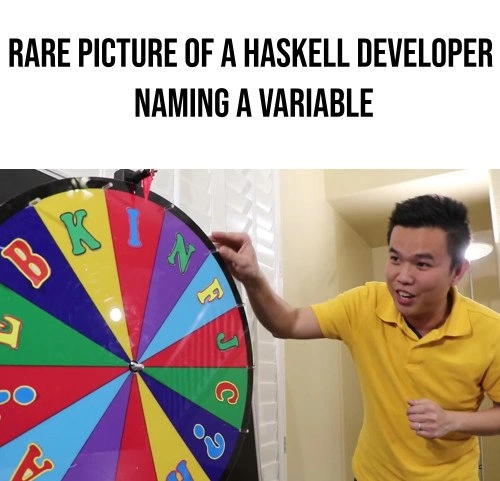
A two-part meme. The top section contains white background with black, capitalized text that reads, "RARE PICTURE OF A HASKELL DEVELOPER NAMING A VARIABLE". The bottom section is an image of an enthusiastic man in a yellow polo shirt spinning a colorful game show-style wheel filled with single capital letters like B, K, I, N, F, and J. The joke satirizes a common stereotype in the programming community that developers using functional languages like Haskell prefer to use terse, single-letter variable names (e.g., 'f', 'x', 'm') rather than more descriptive ones. This practice is often attributed to the mathematical roots of functional programming, where single letters are common placeholders. The meme humorously suggests that the choice of these single letters is as random as spinning a wheel, a concept that resonates with senior developers who have encountered or debated different variable naming conventions across various programming paradigms
Comments
8Comment deleted
In Haskell, a long variable name is anything that doesn't fit in a single cache line, including the type signature
Wheel of Fortune: Haskell edition - spin for a random consonant, alpha-rename whatever it shadows, and trust the type checker to divine your intent while future you greps hopelessly for “k” in a 12-layer monad stack
After 15 years of explaining to junior devs why 'xs' is perfectly clear in context and that 'f . g . h' is more elegant than 'processUserInputAndValidateAndTransform', you realize the real monad was the single-letter variables we accumulated along the way
The wheel is actually unnecessary - any experienced Haskell developer knows the answer is always 'f', 'x', or 'a'. Bonus points if you chain them into 'fmap f xs' where nobody, including your future self, will remember what 'f' transforms or what 'xs' contains. It's not obfuscation; it's 'embracing mathematical elegance' and 'letting the type system do the documentation.' Meanwhile, the rest of us are left reading code that looks like someone spilled alphabet soup on a keyboard, wondering if 'm >>= k' is profound wisdom or a cry for help
Haskell variable naming: where 'let k = spinWheel' finally makes type inference a game of chance
Wheel lands on “f”? Perfect - eta-reduce to point-free, let type inference erase the variable, and declare that naming was a side effect
Haskell naming algorithm: if x is taken, try xs; if that’s taken, spin the wheel, lowercase the result (constructors are uppercase), and let the type signature explain everything
I hope it won't be a question mark Comment deleted