Skip to content
DevMeme
7468 of 7506
Government Blocklist as the New AI Benchmark
AI ML Post #8185 · source on Telegram

Government Blocklist as the New AI Benchmark

Level 1: Too Good for the Principal

It is like one child showing off a new science project and saying early tests look amazing, while an older friend pats him on the shoulder and says, “We’ll know it really works when the principal bans it.” The joke treats getting in trouble as a better prize than winning the science fair, even though something can be banned for many reasons besides being brilliant.

Level 2: Beta, Benchmarks, and Bans

A foundation model is a large model trained broadly enough to support many later tasks. It can be adapted through additional training, instructions, tools, or specialized interfaces. A parameter is a learned numerical value inside the model. More parameters can provide more capacity, but a larger count does not automatically mean better answers, just as a longer program is not automatically a better program.

Supplemental training means continuing to train or adapt a base model with additional data after its main pretraining phase. Developer-workflow data could help a model learn coding patterns and tool use. To judge the result, however, one needs to know what data was used, how it was filtered, what objective was optimized, and whether performance improved on tests not represented in training.

A private beta gives a limited set of testers early access. It helps a team find defects and gather feedback before a public launch. SpaceX and Tesla employees may offer demanding real-world tasks, but because the organizations are closely connected to the model’s maker, success there cannot substitute for neutral testing.

An evaluation, often shortened to eval, is a structured test of model behavior. A useful report answers questions such as:

  • What exact task was performed?
  • Which model version and settings were used?
  • How many attempts or tokens were allowed?
  • Who judged success?
  • Was the test data hidden from training?
  • Can another evaluator reproduce the result?

The embedded post displays none of those details because it is a short announcement, and the screenshot truncates even the headline comparison. The reply jokes that waiting for a ban is easier than reading the eventual methodology.

An access restriction can be motivated by security when a model might enable dangerous cyber, biological, or autonomous activity. It can also reflect law and politics. That makes blocking an important deployment event but not a quality score. A ban tells us that an authority chose to restrict something under some rule; it does not tell us how good the model is at the user’s job.

Level 3: Regulation Is the Benchmark

The embedded announcement offers the normal vocabulary of an AI launch:

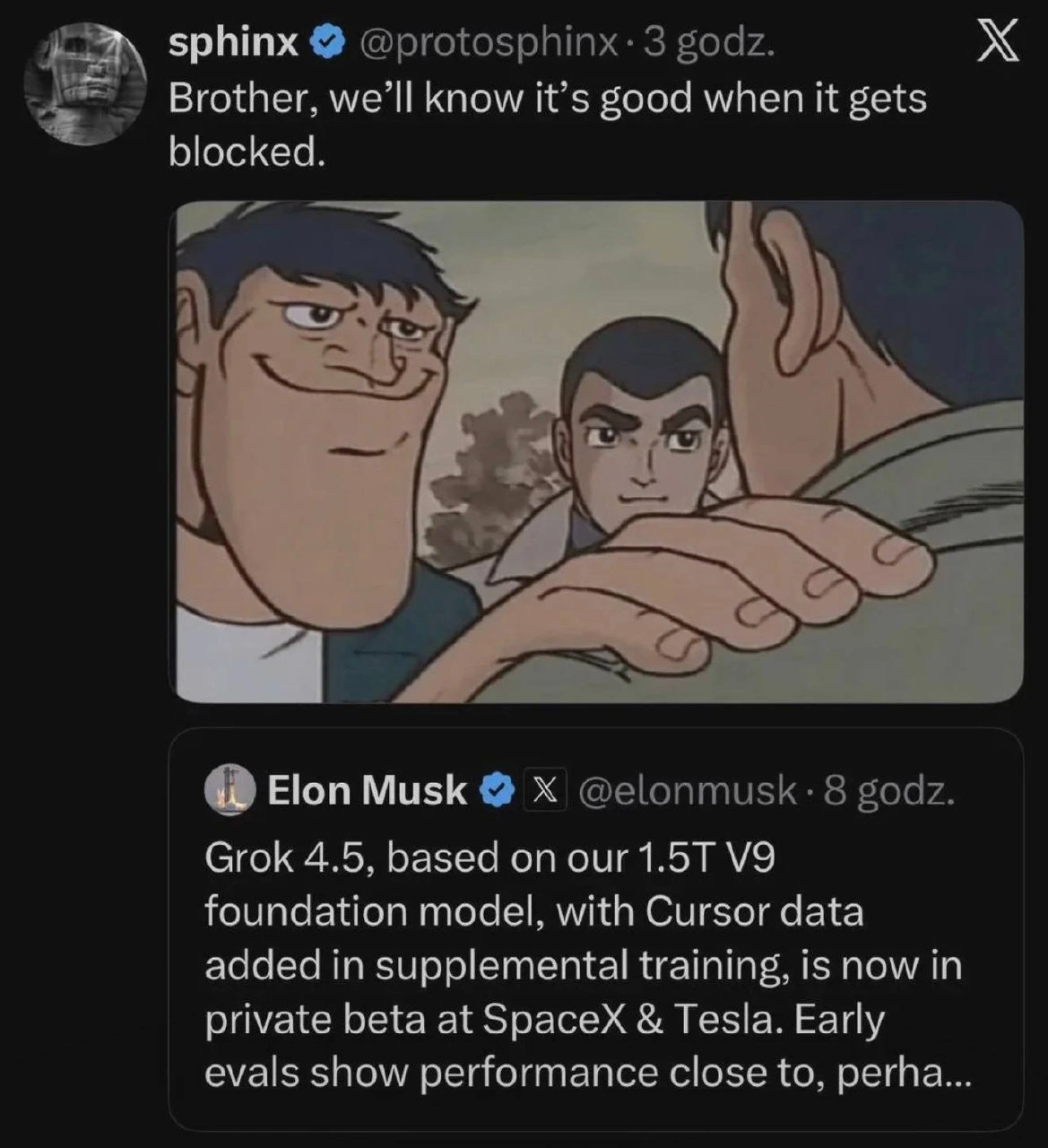
Grok 4.5, based on our 1.5T V9 foundation model, with Cursor data added in supplemental training, is now in private beta at SpaceX & Tesla. Early evals show performance close to, perha...

The screenshot cuts the final comparison off at perha..., so the viewer gets impressive scale, recognizable training data, prestigious internal testers, and a tantalizing evaluation claim—but neither the completed claim nor the evidence behind it. The reply discards all of those conventional signals and proposes a new one:

Brother, we’ll know it’s good when it gets blocked.

The smiling animated giant patting another man’s shoulder turns this into reassurance. Do not worry about missing benchmark tables, public access, or independent replication, brother. If a government eventually prohibits the model, the state will have furnished the only endorsement that matters.

That line was sharply topical on June 29, 2026. The previous day, Musk had announced the Grok 4.5 private beta shown here. The same month, a U.S. government directive had forced Anthropic to suspend access to its new Fable 5 and Mythos 5 models after officials cited national-security concerns about a reported safeguard bypass. A separate frontier-model preview launched days before this post with participation limited to selected organizations coordinated with the government. At the moment of the meme, restrictions and access lists were becoming part of model-release discourse, not a hypothetical ending to a science-fiction plot.

The joke converts that political context into Goodhart’s law for AI enthusiasts: when a measurement becomes the target, people optimize for the appearance of satisfying it. Benchmarks have become crowded with contamination concerns, favorable harnesses, different inference budgets, and vendor-selected task sets. “Got blocked” appears harder to game because it looks like revealed concern from an institution with privileged information. The forbidden model must be the powerful one—or so the mythology goes.

As an evaluation method, a government block is terrible. Regulatory action can respond to model capability, but also to safeguard design, deployment process, export jurisdiction, political pressure, data governance, corporate conflict, or incomplete evidence. It does not reveal whether a model writes better code, reasons more reliably, hallucinates less, costs less, or succeeds on real user workflows. A mediocre model can be controversial; a highly capable model can be deployed without a ban. blocked = state of the art is a compelling meme equation with no calibrated units.

The equation can also become self-serving marketing. If a model performs well, the laboratory cites evaluations. If it is restricted, fans cite the restriction as proof that it was too powerful. If it is neither, the next training run is already scheduled. Every outcome preserves the narrative of inevitable progress. Security policy becomes a prestige badge, and “national-security concern” acquires the cultural role once held by “runs Crysis.”

The visible technical claims deserve more disciplined treatment:

  • 1.5T appears to describe model scale, commonly reported as roughly 1.5 trillion parameters, but parameter count alone does not determine quality. Architecture, active parameters, data, optimization, inference compute, and post-training all matter.
  • V9 foundation model names the pretrained base on which later behavior is built, but the screenshot gives no architecture or training details.
  • Cursor data added in supplemental training suggests developer-oriented data was incorporated after the base training stage. It may improve coding behavior, but the image provides no information about data composition, permission, filtering, or measured contribution.
  • private beta at SpaceX & Tesla means selected internal users can test it before broad release. That supplies realistic workflows and feedback, but it is not an independent evaluation.
  • Early evals are preliminary by definition. Without tasks, baselines, model versions, prompts, scoring rules, inference budgets, and uncertainty, “close to” is positioning rather than reproducible science.

A credible model evaluation uses multiple dimensions. Capability tests should cover relevant tasks and disclose the execution harness. Safety evaluations should distinguish what the base model can do from what deployment safeguards permit. Reliability testing should measure variance, calibration, hallucination, and failure recovery. Cost and latency should be compared at similar quality targets. External evaluators should be able to reproduce at least the central claims. One leaderboard number cannot summarize all of that, and a prohibition order certainly cannot.

There is still a serious security trade-off beneath the joke. More capable models can lower the effort required for beneficial work such as vulnerability discovery and patching while also lowering the effort required for misuse. Risk depends on more than raw intelligence:

$$ \text{deployment risk} \approx \text{capability} \times \text{access} \times \text{opportunity for misuse}

  • \text{effective safeguards}. $$

That is a conceptual relationship, not a measurable formula, but it explains why authorities may care about access controls, monitoring, identity verification, or staged rollout. A blunt block can reduce exposure while also denying defenders and researchers useful capability. A permissive release can accelerate innovation while expanding the attack surface. The hard policy question is how to compare those costs using transparent technical evidence rather than either corporate optimism or regulatory mystique.

The meme chooses mystique because it is funnier. In its world, internal evals are vendor homework and the true benchmark is whether the API becomes a geopolitical incident. The irony is that celebrating a block as proof of quality gives regulators and hype marketers the same incentive: make the restriction dramatic enough and everyone will assume the model behind it must be extraordinary.

Description

A dark-mode X screenshot shows "sphinx" with a blue verification badge, handle "@protosphinx", and Polish timestamp "3 godz." posting: "Brother, we’ll know it’s good when it gets blocked." Beneath the caption is an animated reaction frame of a large, smiling man reassuringly patting another man on the shoulder while a third watches. An embedded verified post from "Elon Musk @elonmusk · 8 godz." reads: "Grok 4.5, based on our 1.5T V9 foundation model, with Cursor data added in supplemental training, is now in private beta at SpaceX & Tesla. Early evals show performance close to, perha..."; X logos, profile images, badges, and overflow dots complete the interface. Against the late-June 2026 backdrop of government restrictions on other frontier-model launches, the reply treats getting blocked as a stronger quality signal than private evaluations or benchmark claims.
Comments

1
Anonymous ★ Top Pick A model isn't SOTA until its API endpoint becomes a geopolitical incident.
  1. Anonymous ★ Top Pick

    A model isn't SOTA until its API endpoint becomes a geopolitical incident.

Use J and K for navigation