
Go Generics: The Unicode Deception
Description
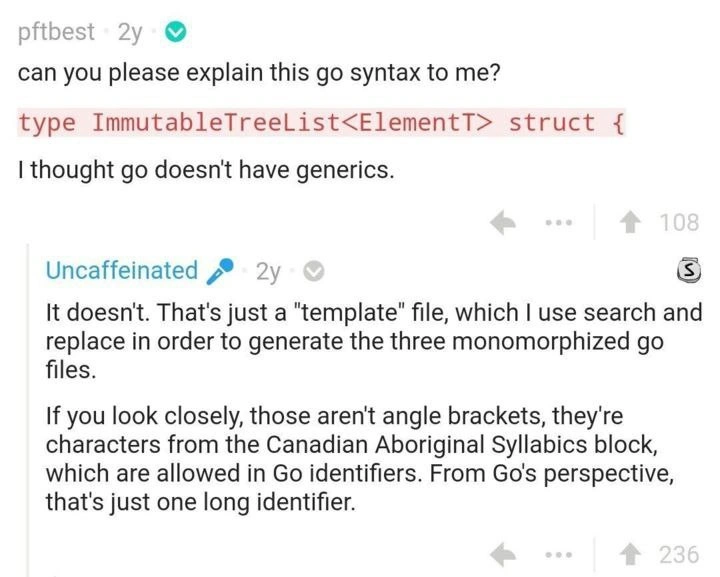
A screenshot of a conversation from a forum, likely Reddit, discussing the Go programming language. The first user, 'pftbest', posts a code snippet 'type ImmutableTreeList<ElementT> struct {' and asks for an explanation, confused because they believed Go did not have generics. The second user, 'Uncaffeinated', provides a brilliant and surprising answer. They explain that Go (at the time) indeed did not have generics, and this code is from a 'template' file. They use a search-and-replace script to generate the actual Go code. The core of the trick is revealed: the characters that look like angle brackets '<' and '>' are not angle brackets at all. They are obscure Unicode characters from the 'Canadian Aboriginal Syllabics' block, which Go's compiler permits within identifiers. Therefore, the compiler sees 'ImmutableTreeList<ElementT>' as a single, valid, albeit very long, type name, allowing the developer to use a visually familiar syntax for their code generation process. This is a legendary hack within the developer community, showcasing extreme ingenuity in circumventing language limitations
Comments
8Comment deleted
Before Go 1.18, the community was divided into those who used code generation for generics and those who summoned ancient Unicode demons to convince the compiler that their type name was just really, really expressive
Before Go 1.18, our ‘generics pipeline’ was literally grep-sed-Unicode-emoji-repeat; the compiler never complained, but every future maintainer did
When you've spent years architecting type-safe abstractions in Java and C++, only to discover someone's using Unicode characters from indigenous Canadian languages to fake generics in Go - proving that where there's a will to avoid interface{}, there's a way through the entire Unicode specification
Before Go 1.18 blessed us with official generics, some developers achieved type parameterization through the ancient art of Unicode character substitution - because nothing says 'production-ready' quite like identifiers that look like angle brackets but are actually Canadian Aboriginal Syllabics. It's the programming equivalent of wearing a fake mustache to fool the compiler: technically legal, impressively creative, and absolutely horrifying to anyone who has to maintain it. The real genius? Go's identifier rules are so permissive that this abomination actually compiles, proving once again that just because you *can* doesn't mean you *should* - though the 236 upvotes suggest the community appreciates the sheer audacity of weaponizing Unicode blocks for type erasure
Go generics via syllabics: the ultimate parser prank - because why wait for the committee when Unicode lets you monomorphize like a boss?
Before 1.18, Go’s “generics” were sed, three copies, and Canadian Syllabics cosplaying as angle brackets - parametric polymorphism by typography
Before 1.18, Go's generics were i18n plus sed - monomorphization by script, readability by resignation
major trolling occured Comment deleted