
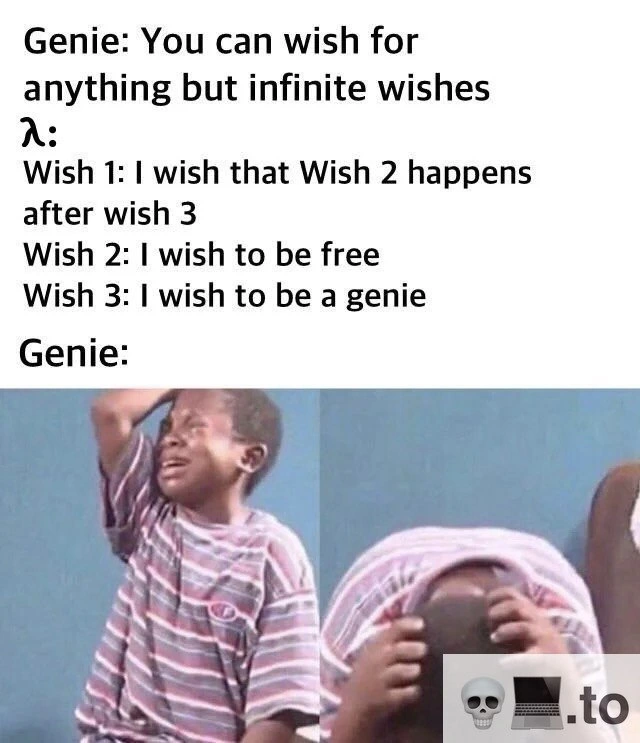
Hacking Genie's API with Asynchronous Wish Execution
Description
A two-part meme. The top part consists of black text on a white background, outlining a dialogue. The Genie states the rule: 'You can wish for anything but infinite wishes.' A character represented by the Greek letter lambda (λ), a symbol for anonymous functions in computer science, responds with three strategically ordered wishes: 'Wish 1: I wish that Wish 2 happens after wish 3', 'Wish 2: I wish to be free', and 'Wish 3: I wish to be a genie'. The bottom part of the meme uses the 'Crying Black Kid' meme format, showing a young boy looking distressed and then burying his face in his hands, representing the Genie's reaction of utter defeat. A small watermark with a skull, a laptop, and the text '.to' is in the bottom right. The joke is a classic example of applying a programmer's mindset to a logical problem. By using the first wish to define the execution order (like a callback or promise in programming), the user ensures they first become a genie (Wish 3) and then immediately gain freedom (Wish 2), successfully circumventing the spirit of the 'no infinite wishes' rule to achieve ultimate power
Comments
12Comment deleted
This is just asynchronous programming with promises. Wish 1 sets up the `.then()` callback. The Genie's mistake was exposing a blocking API without validating the execution chain, leading to a race condition on his own existence
Functional architect move: declare Wish 1 as the orchestrator, topologically sort the side-effects so Wish 3 promotes you to genie before Wish 2 grants freedom - privilege escalated without violating the API quota
This is basically every distributed system's consensus protocol when you forget to implement proper leader election - everyone becomes the coordinator, nobody is free, and the whole cluster just sits there sweating while trying to figure out who's actually in charge
This is essentially a distributed transaction with circular dependencies that would make any dependency resolver throw a 'CyclicDependencyException'. The lambda symbol suggests someone's been reading too much functional programming theory and decided to apply topological sorting concepts to wish fulfillment. The genie's constraint system clearly didn't implement proper cycle detection - a classic case of 'works on my lamp' syndrome. Any senior architect recognizes this as the same nightmare that happens when Service A depends on Service B, which depends on Service C, which needs Service A to initialize. The genie is now stuck in an infinite loop, probably burning CPU cycles trying to resolve this DAG that isn't actually acyclic
Classic Free Monad pattern: sequence the side effects so after bind you become a genie and then call free() on yourself - the spec forbids infinite wishes, not monads
Classic wishes sans base case - genie's recursion depth just hit maximum, stack overflow incoming
Genie: “No infinite wishes.” λ-dev composes a continuation, reorders the calls, escalates to “genie,” frees the resource - turns out your wish API is reentrancy‑vulnerable
I splork for infinite splorks! https://languagelog.ldc.upenn.edu/nll/?p=4204 Comment deleted
because you should test requirements too Comment deleted
Please use English as a main language in this chat. This means that every message should be understandable by English speaker — they should have a translation. Comment deleted
Callback wish Comment deleted
Genie: You are now free of debt Comment deleted