
MentalHealth Post #154 · source on Telegram
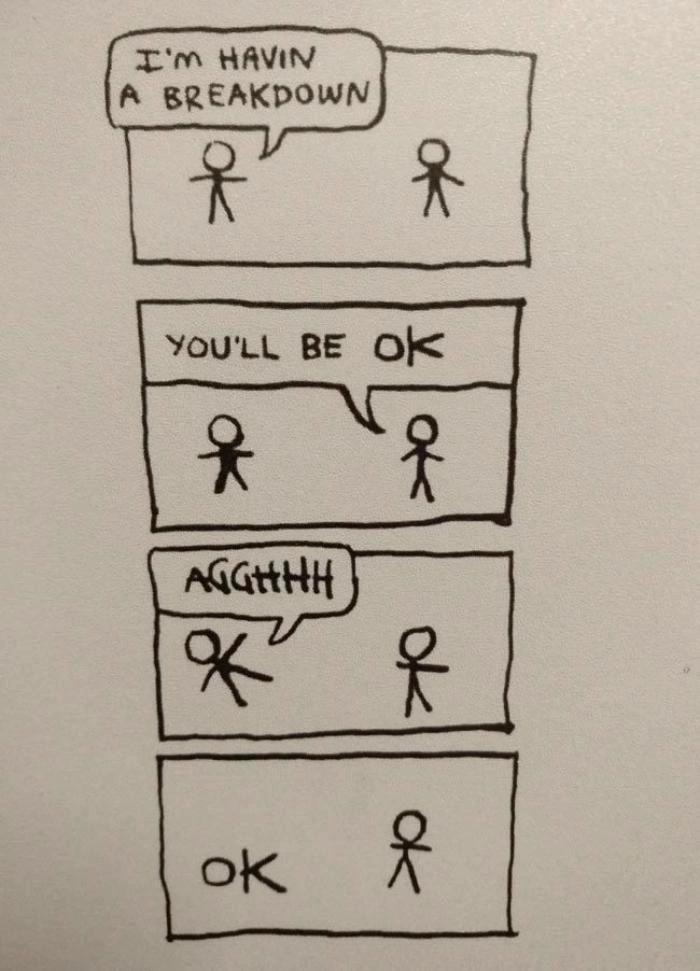
When a dev meltdown gets the classic "you’ll be OK" response
Description
Black-ink, four-panel stick-figure comic on a white background. Panel 1: two figures face each other; the left one says in a speech bubble, “I’M HAVIN A BREAKDOWN”. Panel 2: the right figure replies, “YOU’LL BE OK”. Panel 3: the left figure flails and screams, “AGGHHH”, while the right figure remains still. Panel 4: both stand calmly and the left figure now simply says, “OK”. The minimalist drawing humorously captures the abrupt emotional cycle many engineers experience when code, deadlines, or on-call incidents push them toward burnout and a teammate offers the most generic reassurance possible
More like this
More like this in MentalHealth →
Use J and K for navigation
Comments
7Comment deleted
Me: “I’m in a full-on CrashLoopBackOff.” Manager: “You’ll be ok.” Ah, the human version of setting restartPolicy: Always and calling it resilience
The four stages of debugging a race condition: denial, false hope, existential dread, and then realizing it was a missing volatile keyword the whole time
Classic incident lifecycle: catastrophic failure, brief screaming, then the health check returns OK and everyone moves on without a postmortem
This is the emotional equivalent of a production incident where someone says 'just restart the service' while the entire distributed system is cascading into failure. The reassurance 'you'll be OK' works about as well as telling a developer with 50 merge conflicts and a Friday 5pm deployment that 'it's probably fine.' By panel four, we've achieved what systems engineers call 'catastrophic failure' - where the original problem has escalated beyond recovery and now you're just documenting the postmortem. The real kicker? The person offering comfort is still standing there saying 'OK' like they've successfully resolved a P0 incident, while their colleague has essentially segfaulted out of existence
Classic prod firefight: alert storm -> 'recheck config' -> AGHHH (it's the cache again) -> rollout restart -> ok
Classic SEV‑1: dashboards insist on 200 OK while the on‑call screams; even the reassurance breaks down into the next frame - like our error budget
Prod: “I’m having a breakdown.” /health: “You’ll be 200 OK.” On-call screams while the status page stays green