Skip to content
DevMeme
5982 of 7435
Kubernetes Cluster: A DevOps Engineer's Alternative to Therapy
Containerization Post #6551, on Feb 25, 2025 in TG

Kubernetes Cluster: A DevOps Engineer's Alternative to Therapy

Why is this Containerization meme funny?

Level 1: Tech Over Talk

Imagine a student who is feeling really sad or stressed about something at school. Instead of asking a teacher or a counselor for help (which is like going to therapy in grown-up terms), the student decides to spend the whole week building an incredibly complicated LEGO city with moving parts. It sounds silly, right? They’re doing this huge, complex project – not because someone asked them to, but just to keep themselves busy. It makes them feel in control and distracts from being sad, but it doesn’t fix the sadness. This meme is like that, but with computers. It’s saying some people would rather do a big comfort project – like setting up a bunch of computers to work together (really hard to do!) – instead of doing the simple thing that might actually help, like talking about what’s bothering them. It’s funny because the swap is so extreme: it’s a joke that building a “mini computer farm” at home is their version of therapy. In real life, of course, talking to someone when you’re upset is important, but the joke teases those who avoid it by burying themselves in their hobbies. It’s poking fun at how we sometimes choose a familiar activity (even if it’s a lot of work) over something unfamiliar like asking for help – kind of like baking a 10-layer cake to avoid doing your homework. It’s an exaggerated, humorous way to show how people can prefer doing something elaborate over dealing with feelings.

Level 2: Home Lab Habit

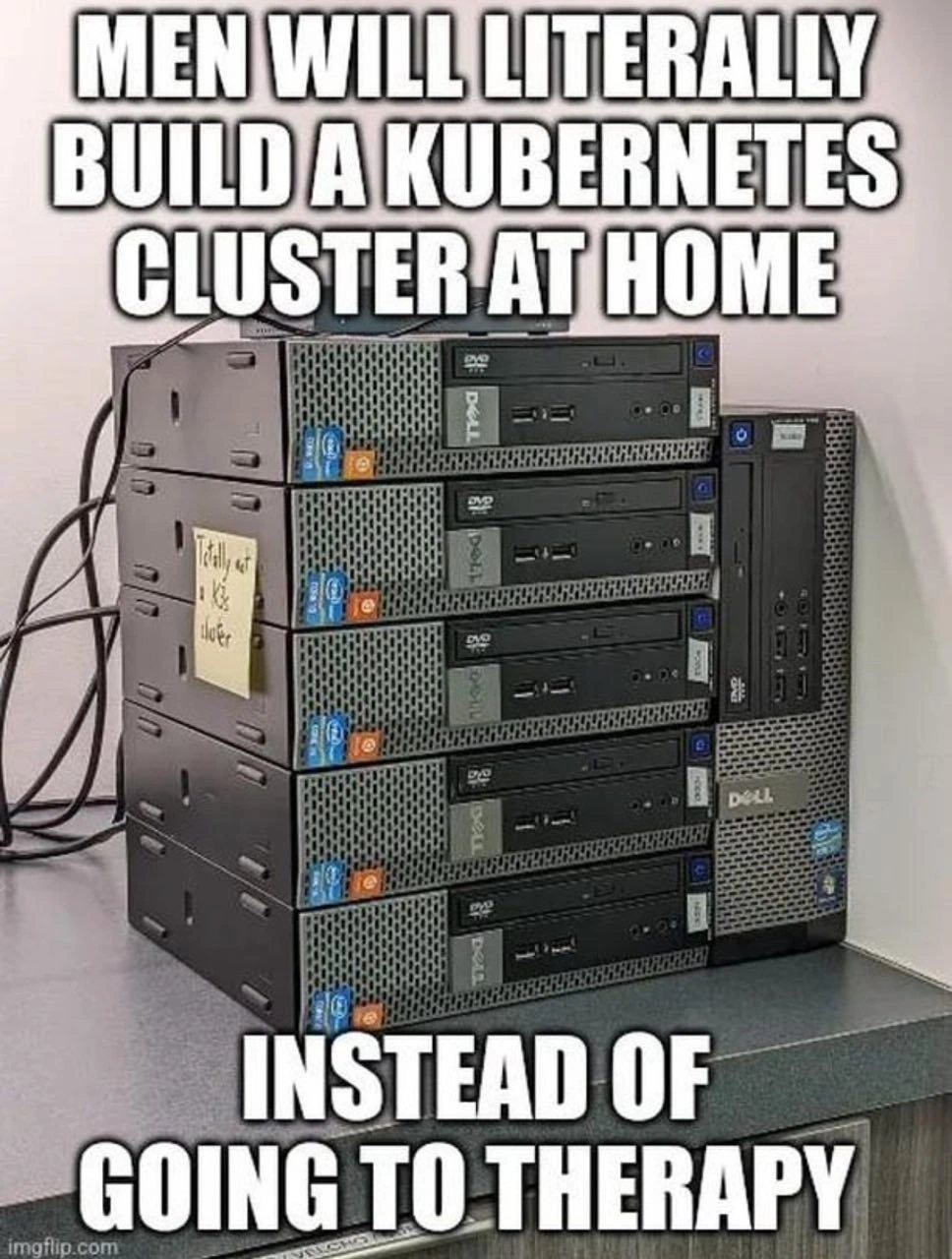
Now let’s break down the basics of what’s happening in this meme. First, Kubernetes: this is a platform (originally open-sourced by Google) for managing containers across a cluster of machines. A container is like a lightweight, portable mini-computer inside a computer, bundling an application with everything it needs to run. Think of it as a little box that holds an app, which can be shipped and run anywhere. Kubernetes (often abbreviated “K8s”) is in charge of automatically running lots of those boxes (containers) on a bunch of computers, starting or stopping them as needed, balancing load, handling failovers – basically orchestrating them. It’s what big companies use to run microservices and web apps reliably at scale. Now, a cluster just means a group of computers acting together as one system. In Kubernetes terms, you usually have a master/control node that makes decisions and worker nodes that do the actual work (running the containers). In the image, the person has five small Dell desktop machines networked together, effectively making a 5-node cluster. That’s essentially a tiny version of what a rack of servers in a data center would be – a home-made data center on a countertop! This is a classic home_lab setup: tech enthusiasts love to tinker by setting up servers or clusters at home to learn and have fun. It’s like the tech equivalent of building your own workshop.

The sticky note on the side saying “Totally not k3s cluster” is a humorous detail. K3s is a simplified, lightweight distribution of Kubernetes. The joke here is that the note is denying it’s a K3s cluster, but by drawing attention to it, it basically confirms that it actually is a K3s cluster. Why use K3s? Regular Kubernetes can be heavy – it normally runs a lot of components that might be overkill for a small setup. K3s is designed to run on minimal hardware (even a Raspberry Pi or these older PCs) with less memory and CPU usage. It often runs everything in one binary and can use a sqlite database or a single etcd for storing cluster data, making it easier to set up for one person. So what our meme’s subject has done is install K3s on all these little Dells, network them together, and voila – they have a personal Kubernetes cluster. The sticky note is basically a wink to those in the know: “Yes, I totally did this crazy thing at home.” In other words, it’s a self-aware joke about nerdiness.

Now, why mention therapy? The text of the meme says: “Men will literally build a Kubernetes cluster at home instead of going to therapy.” This is using a popular joke format on the internet. People often say “X will literally do Y instead of Z” to poke fun at someone doing something elaborate or silly to avoid something else. Here X = men (as a group, a stereotype that guys often avoid therapy), Y = build a Kubernetes cluster at home (a very time-consuming, technical project), and Z = go to therapy (seeking professional mental health help). The meme exaggerates to make a point: the person in the image is spending all this effort on a tech project presumably as a way to avoid or distract from dealing with personal issues or stress that might actually be better helped by talking to a therapist. It’s a tongue-in-cheek commentary on how some folks (especially in tech, and often males due to cultural reasons) might prefer to throw themselves into a DevOps hobby or any familiar work rather than address emotional well-being.

This falls into DeveloperHumor because it references something very specific (Kubernetes clusters, which most people in tech know are complex and often work-related) in a domestic, personal context. The image literally shows hardware one might find in a small office server room, but instead it’s in someone’s home, wired up casually next to a wall. That visual alone is humorous to developers: it screams “homelab nerd!” For a non-tech analogy: it’s as if someone assembled a mini space rocket in their garage as a weekend hobby. For techies, building a Kubernetes cluster at home is that kind of “wow, that’s intense for a hobby” project. It’s definitely not something the average person does for fun. The meme playfully jabs at the idea that this intense DevOps tinkering is being used as a coping method, hinting “maybe just talk to someone about your problems instead?”

So, in simpler terms: the meme is combining a joke about hardware and software (the home Kubernetes cluster – which covers the Containerization/DevOps side) with a joke about mental health (avoiding therapy). On one side, it’s educating those in the know that yes, people actually do set up self_hosted_cluster environments at home “just because.” On the other side, it’s making a cultural observation: sometimes, tackling a complicated but familiar task can feel easier than dealing with one’s feelings. The result is funny because it’s an absurd example highlighting that tendency. After all, booking a therapy session might take an hour of courage, whereas building a Kubernetes cluster could take days of work – but the latter is within this person’s comfort zone, and the former isn’t. It’s a relatable exaggeration for many in the engineering community.

Level 3: Containerized Coping

For seasoned developers and DevOps professionals, this meme elicits a knowing laugh and maybe a wince of self-recognition. It’s pointing out a common coping mechanism in tech circles: when life feels chaotic or stress runs high, some of us double down on an all-consuming side project. Why? Because tinkering with technology gives a sense of control and accomplishment. Here, building a Kubernetes cluster at home – essentially a private mini-cloud – is the chosen distraction. The text “MEN WILL LITERALLY BUILD A KUBERNETES CLUSTER AT HOME INSTEAD OF GOING TO THERAPY” riffs on a popular joke format (“men will literally do X instead of Y”). It satirically suggests that rather than seek professional MentalHealth help (which can be hard or stigmatized, especially among men), an engineer will bury himself in a super technical hobby project. It’s funny (and a bit dark) because setting up a Kubernetes cluster is not a trivial undertaking – yet to the person doing it, wrestling with complex YAML configs and hardware is somehow more comfortable than wrestling with their feelings. This is DeveloperHumor and EngineeringHumor at its finest: highlighting absurd behavior that contains a grain of truth about developer life.

Think of the realities behind this image: Five small Dell machines stacked up like a server rack, all buzzing away. These look like Dell OptiPlex mini-towers – cheap, plentiful second-hand PCs that homelab enthusiasts love. A senior DevOps engineer sees that and immediately recognizes the trope: the Home Lab. Many experienced tech folks have a home_lab setup of some kind – from a single Raspberry Pi running Docker, to a closet with blinking racks. There’s an entire subculture around self-hosted everything. Continuous integration servers for personal projects, network-attached storage for media, even personal Kubernetes clusters for learning or just for bragging rights – it’s a hobby as much as it is practice. So the sight of this “dell_optiplex_stack” screams home lab pride. The sticky note “Totally not k3s cluster” is a wry in-joke. K3s, as mentioned, is the lightweight Kubernetes. By saying “totally not,” they’re humorously admitting “yeah it is, I know I’m being extra nerdy about this.” It’s the kind of cheeky label you might put on your gear so your spouse or roommate doesn’t instantly roll their eyes – “Nope, definitely not turning the house into a data center, haha, move along.” This is HardwareHumor mixed with cloud-native geekery.

Why is this so relatable to senior devs and SREs? Because many of us have been there: maybe not specifically running Kubernetes at home, but channeling stress into tech tinkering. Production outage at work got you down? Build a new gaming PC. Overwhelmed by tasks? Spend Saturday automating your home lighting with a Python script and a Raspberry Pi cluster. It’s a form of procrastination that feels productive. There’s a shared understanding that tech work, with all its complexity, can ironically be more straightforward than emotions. Kubernetes has clear rules: deploy pod, check logs, fix error, get success. Feelings don’t come with a stack trace to debug. Going to therapy means confronting uncertainty and vulnerability, which can be intimidating. So instead, one might choose the comforting logic of a system they can control. As the meme jokingly implies, why open up to a stranger about your feelings when you can configure a perfect cluster with kubectl commands? Of course, this is hyperbole and irony – therapy can be hugely beneficial, and a cluster won’t actually solve emotional issues – that contrast is exactly what makes it funny and a tad poignant.

This meme also nods to the reality that in tech culture, over-engineering is a common joke. We often joke about solving trivial problems with ridiculously complex setups. (Why write a simple script when you can set up a full CI/CD pipeline with Kubernetes to do the same thing, right?) Here the “problem” is stress or emotional load, and the “ridiculously complex solution” is a full-blown Kubernetes cluster as a coping device. It’s essentially the DevOps equivalent of stress baking, except instead of pastries, you’re churning out configuration files and node setups. Many engineers find a strange calm in those repetitive, logical tasks – assembling hardware, cabling, installing Linux, initializing the cluster. It’s almost meditative, providing the illusion of control and structure when personal life feels messy. The meme captures this with a punchline format that everyone in the community recognizes. It resonates especially with those who have maybe delayed that therapy appointment while they “just finish this one project…” Spoiler: the project is never truly finished, just like the avoidance can become a loop.

In essence, the senior perspective sees this meme and laughs, perhaps a bit self-consciously. It underscores industry in-jokes: the prevalence of Kubernetes in every context (“let’s Kubernetes all the things!”), the enthusiastic but sometimes unnecessary use of cool tech at home, and the tendency of engineers to lean on their craft as a refuge. It’s both a celebration of the passion that drives personal projects and a gentle roast of the way we might use that passion to sidestep personal growth. Like any good DevOpsHumor, it’s funny because it’s true enough to sting a little. After all, the cluster might have health checks and load balancers to keep services running smoothly, while the engineer ignores their own load (of stress) and could use a bit of balancing in life. It’s a comedic mirror: Deploy all the containers you want, but you can’t just kubectl apply happiness.yaml to your life. 😅

# Pseudo-code for the coping mechanism humor
if engineer.feels_stressed():
    engineer.build("home_kubernetes_cluster")  # Deploys complex tech project as distraction
else:
    engineer.book("therapy_session")           # Actually seeks help (the thing being avoided)

Level 4: Orchestrating Overkill

At this highest level, the meme’s humor hides in plain sight of advanced container orchestration and distributed systems theory. The image depicts a DIY Kubernetes cluster built from repurposed Dell mini desktops – essentially a personal micro-datacenter. To an experienced eye, this isn’t just a random stack of PCs; it’s a full-blown Kubernetes cluster (albeit a homebrew one). Kubernetes is a complex container orchestration platform, originally born from Google’s internal Borg system, designed to manage application containers across many machines. Spinning up a cluster at home means this person is recreating cloud-grade infrastructure on a kitchen counter. They’ve likely installed a lightweight Kubernetes distribution (the sticky note jokes “Totally not k3s cluster” – which basically screams it is exactly a k3s_cluster). K3s is a slimmed-down Kubernetes, perfect for a home_lab because it trims the fat (less memory usage, simplified components) while still speaking native kubectl. It often uses an embedded datastore (like SQLite or an internal etcd with a single node) instead of a full HA etcd cluster, making it just light enough to run on older hardware. By labeling it “Totally not k3s,” they’re tongue-in-cheek acknowledging that yes, they set up a personal_cluster_build with K3s on those Dell boxes – a nerdy form of self-deprecating humor.

Under the hood, even a slim Kubernetes cluster embodies serious distributed systems concepts. There’s a control plane (the brain of Kubernetes) possibly running on one of these nodes, hosting the API server, scheduler, and controller manager. The other nodes act as worker nodes running the kubelet agent and container runtime (containerd or Docker). The cluster state is likely stored in etcd (even K3s can run an embedded etcd nowadays), which relies on the Raft consensus algorithm. That means this DIY cluster is tackling the same fundamental challenge of consensus and state replication that large-scale production clusters do – albeit with fewer nodes and reduced load. The scheduler inside Kubernetes is solving a bin-packing problem, placing container Pods onto those nodes based on resources and constraints. That’s a non-trivial, NP-hard problem in the general case, and here our hobbyist is effectively playing with that algorithm at home. It’s a bit like orchestrating a tiny orchestra: each Dell node plays a part in harmony, running pods and services with Kubernetes conducting. The fact that all this is happening on a home setup is both impressive and comical. It’s DevOps meets Hardware in a very literal sense – an SRE’s toy data center assembled from cast-off PCs.

From a theoretical perspective, building a cluster introduces all the distributed computing quirks professionals handle in production. Think networking: they have to wire these machines together (the dangling cables are visible) and possibly configure a local network with proper IP addressing, maybe even set up a home DNS or use Kubernetes’ internal DNS for service discovery. There’s also the concept of service load balancing and virtual IPs; a home cluster might use something like MetalLB to provide real IPs for services on a home LAN, or the user might stick to NodePorts and manually keep track of ports for each service. And consider storage: if they deploy any stateful apps, they have to decide how to handle storage across these nodes (NFS share? local volumes?). All these details mean the person has recreated a mini-production environment. Kubernetes is famed for features like self-healing (automatically restarting failed pods) and auto-scaling (adjusting workloads based on demand). Our home engineer now has those at their fingertips. There’s rich irony here: Kubernetes will automatically ensure an app stays running via health checks and restarts – a system self-care mechanism – yet the human running it might be neglecting their own system health (mental health) by avoiding therapy. The meme lands as hilariously over-engineered coping: it’s humor via hyperbole. Instead of applying a fix to the actual issue (emotional stress), the person applies their engineering know-how to a totally unrelated complex project. It’s like using a distributed consensus algorithm (etcd/Raft) to achieve consistency… in everything except one’s personal life. This top-level analysis sees the meme as a mashup of Containerization tech brilliance and the psychology of avoidance – a distributed system solving every problem except the human one.

Description

A popular meme format with the caption in a bold, white font at the top and bottom of the image. The top text reads: 'MEN WILL LITERALLY BUILD A KUBERNETES CLUSTER AT HOME'. The bottom text reads: 'INSTEAD OF GOING TO THERAPY'. The central image is a photograph of a stack of five identical, small form-factor Dell Optiplex desktop computers, with a sixth one standing vertically beside them. These are commonly used in home labs due to their low cost and availability. A yellow sticky note on one of the computers humorously says, 'Totally not a K8s cluster'. The joke satirizes the tendency within the tech community, particularly among men, to engage in complex, often frustrating, technical projects as a way to cope or avoid dealing with emotional or mental health issues. Building a Kubernetes (K8s) cluster is a notoriously difficult and time-consuming task, making the comparison to therapy particularly ironic and relatable for experienced engineers

Comments

30
Anonymous ★ Top Pick Some people process trauma with a therapist; I process it with a distributed etcd cluster. The failure domains are surprisingly similar, but only one of them triples my electricity bill
  1. Anonymous ★ Top Pick

    Some people process trauma with a therapist; I process it with a distributed etcd cluster. The failure domains are surprisingly similar, but only one of them triples my electricity bill

  2. Anonymous

    Why pay a therapist when a five-node k3s lab lets me watch etcd finally achieve the kind of consensus my feelings never could?

  3. Anonymous

    The real high availability we need is emotional availability, but instead we're achieving five nines uptime on a cluster that runs nothing but a single nginx pod serving 'Hello World' to absolutely no one at 3 AM

  4. Anonymous

    Building a five-node Kubernetes cluster from recycled Dell OptiPlex machines to run a single WordPress blog is the infrastructure engineer's equivalent of buying a sports car during a midlife crisis - except it's louder, costs more in electricity, and your spouse is even less impressed. The sticky note reading 'Totally not a cluster' is the technical equivalent of 'I can stop whenever I want,' which we all know means you're already pricing out enterprise-grade switches and planning the migration to a proper rack mount solution

  5. Anonymous

    Therapy? Nah, CAP theorem lets us partition our mental health for availability - consistency optional

  6. Anonymous

    Built a Kubernetes cluster at home so when life goes sideways I can cordon myself, drain the workload, and call the reboot a rolling update

  7. Anonymous

    Nothing says self-care like kubeadm init: a five-node etcd quorum drowning out intrusive thoughts while the power bill reminds you your SLOs are purely emotional

  8. @M_Ali_S_S 1y

    What's that?

  9. @walkersubterra 1y

    Well, building is some kind of therapy. Soooooo....

  10. @Le_o_R 1y

    True.

  11. @echedelle 1y

    I think I dont know any man doing that, only fems and enbyes

    1. @callofvoid0 1y

      maybe 'cause they don't need therapy?

      1. @RiedleroD 1y

        men absolutely need therapy

        1. @lilfluffyears 1y

          We all need therapy

    2. @pixelsex 1y

      i got a raspberry k8s cluster, can't find a use for it tho, any tips?

      1. @echedelle 1y

        VaultWarden, ffmpeg AV1 transcoding, nextcloud + signaling server

  12. @echedelle 1y

    Is k3s and not k8s :3

  13. @mrYakov 1y

    If your party doesn't look like this, don't invite me. (1060 rpi cluster btw)

    1. @Algoinde 1y

      so this is where the rpi shortage went

    2. @SamsonovAnton 1y

      All to be outperformed by a single dual-socket Xeon 6980P server.

      1. dev_meme 1y

        Well, this one is a beast

  14. @Eugene1319 1y

    Is it a good exercise to build something like that by yourself?

  15. @Kyngo 1y

    totally not a k3s cluster lmao

  16. @Diotost 1y

    To run a neural net therapist because real ones are too expensive?

    1. @mira_the_cat 1y

      it would need a good GPU, or better few GPUs

  17. @deerspangle 1y

    I've always thought a home k8s cluster is overkill. And then one of my home servers went down, and I can't recall which services were on that one vs the others, and can't easily swap services onto a different machine.. And suddenly I'm worryingly close to a home k8s cluster

    1. @SamsonovAnton 1y

      You'd better stop before You go and break your mind... 🎶

  18. @ZgGPuo8dZef58K6hxxGVj3Z2 1y

    Real

  19. @echedelle 1y

    I transcode by CPU

  20. @azizhakberdiev 1y

    yeah, just keep escaping reality

Use J and K for navigation