
The Unspeakable Horror of Your Own Legacy Code
Description
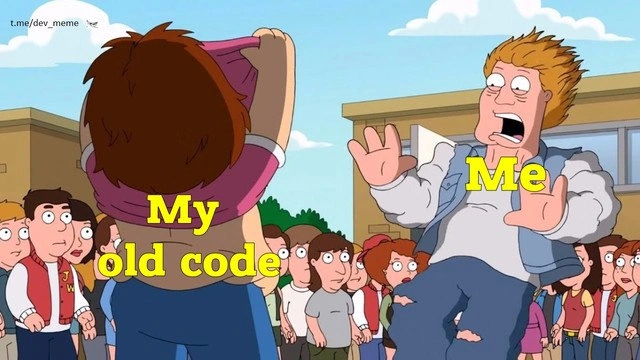
This meme uses a still from the animated TV show 'American Dad!'. In the foreground, a character with their back to the viewer, labeled 'My old code' in yellow text, is lifting up their pink shirt, exposing their back to a crowd. Another character, labeled 'Me', is recoiling in horror with a terrified expression, hands held up as if to ward off the sight. The background shows a crowd of onlookers with shocked and confused faces. There is a watermark for the Telegram channel t.me/dev_meme in the top left. The meme humorously captures the universal feeling among software developers of being embarrassed or horrified when revisiting code they wrote in the past. As a developer's skills and knowledge of best practices improve over time, their previous work can seem poorly structured, inefficient, or naive, leading to a strong sense of cringe and a desire to disown it
Comments
7Comment deleted
My old code has no unit tests, but it does have a 'Here be dragons' comment. I'm not sure which is scarier
Revisiting my 2009 repo is like catching past-me streaking through prod - globals flapping in the wind, a 2 000-line switch statement for modesty, and zero regard for thread safety
The only thing worse than inheriting someone else's undocumented legacy system is realizing the git blame points to [email protected] from 3 years ago, and the commit message just says 'fixed stuff'
Every senior engineer has that moment when they git blame their own code from three years ago and realize they've been the villain in their own origin story all along. The real technical debt was the confidence we had along the way - back when we thought nested ternaries and 500-line functions were 'elegant solutions' and comments were for the weak
Every time my old code shows up, I’m reminded that “temporary hack” is industry slang for “future platform with SLAs and 17 shadow cron jobs.”
Proof of temporal coupling: six months later the abstraction screams, tests are still 'TODO', and git blame calmly replies, 'also you.'
When your 2015 'temporary hack' surfaces as the load-bearing pillar of a multimillion-dollar monolith