
Security Post #4722 · source on Telegram
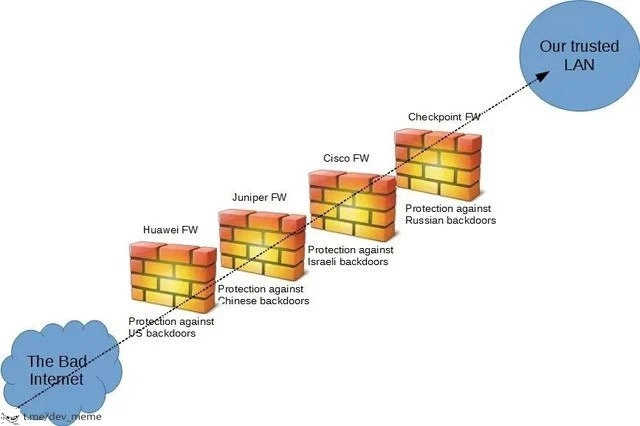
Defense In Depth, Geopolitics Edition
Description
A simple network diagram shows traffic flowing by a dotted arrow from a blue cloud labeled "The Bad Internet" through four brick firewall icons into a blue bubble labeled "Our trusted LAN." The firewalls are labeled "Huawei FW" with "Protection against US backdoors," "Juniper FW" with "Protection against Chinese backdoors," "Cisco FW" with "Protection against Israeli backdoors," and "Checkpoint FW" with "Protection against Russian backdoors." A small t.me/dev_meme watermark appears near the lower-left corner. The joke is a cynical defense-in-depth model where each security appliance is trusted mainly to defend against the geopolitical backdoors suspected in the previous vendor.
More like this
More like this in Security →


Use J and K for navigation
Comments
139Comment deleted
The threat model is solid until procurement asks which nation-state backdoor comes with the best enterprise discount.
And all of those firewall appliances built upon US / UK designed processors. 👌 Comment deleted
so network traffic will travel through CPU? Comment deleted
Unlike switches with ASICs, firewalls process traffic by software in a general-purpose CPU, with some offloading / acceleration possibility. Comment deleted
Well how? Will network traffic ever go below the kernel? CPU processes 0s and 1s, and doesn't do anything else. How will a CPU accelerate the network or provide firewall capabilities? If you're talking an HSM kinda thing or some chip with a compiler burned as firmware, it's different. Comment deleted
see uefi rootkit Comment deleted
see what? A rootkit injects some modules to the host, and again it works at the kernel level, not CPU level. A CPU is there to process 0s and 1s. A CPU is a large number of transistors to process 0 or 1 i.e. current flowing or not. Comment deleted
i mean it is possible to inject something sneaky by patching higher levels Comment deleted
It's totally possible and I have both created rootkits and mitigated them from systems, but it has nothing to do with the CPU doing that stuff. Comment deleted
Modern and complex CPUs like x86 and ARM are "computers in itselfs" that can do much more than simply running the supplied code — they may act as remote controllers. (Some of those functions may lie in an external chip, but still tightly coupled to the central processing unit.) Comment deleted
Well the point is not what an x86 or ARM based CPU can or cannot do. The point is how can they filter network traffic, without the use of kernel? Even meltdown and spectre can't do it without a process(part of a kernel) involved. Comment deleted
No, you got it all wrong. CPUs won't process the traffic as intended instead of firewall software — but they may react to the very same traffic in their very own way, thus creating a backdoor. Comment deleted
Nope a CPU won't do that unless you have some external chip involved to feed that data to it and take back the results or some chip which has some compiler burnt as firmware. Comment deleted
A CPU, in very pure terms is like a function, which you feed data to and receive the results. Now, if you wanna call an SoC a CPU, it's totally absurd. Comment deleted
Let's go step by step: Regular software may access the NIC ports. CPU / SB firmware may access the NIC ports — at least integrated ones, but also any other Intel-based controllers on PCI bus. What prevents the CPU / SB firmware to react to ingress network traffic or even inject self-crafted packets (frames) into the egress queue? Comment deleted
No software can do anything without it being on a persistent storage(disk, NAS, firmware) and then memory to finally feed off the CPU. Comment deleted
This "software" is called firmware and resides in a persistent memory inside the CPU, but also is loaded by BIOS and/or OS from an totally opaque file supplied by the CPU vendor. Comment deleted
I already wrote firmware in parentheses Comment deleted
Functions sometimes have a shared mutable state, bugs and vulnerabilities A hacked cpu might disable the firewall (because it has enough cache memory to detect patterns of known software or its parts, including an OS, and it can freely access and inspect all memory regions) and forward malformed packets to the other firewalls At the end of this chain, all firewalls will be compromised Comment deleted
Again, you didn't get the point and started to send random things. I didn't say a function can't be buggy. We write smart contracts carefully for precisely this reason. The point is a CPU alone cannot do it. Cache is empty when it's not being fed off by the RAM. RAM is empty when it's not being fed off by a persistent storage(disk, NAS, firmware). So cache can't store any pattern which later it can use as an exploit. No malware can do anything unless it has a process to work with. Even meltdown and spectre can't. So that's the point. There is nothing like a hacked CPU! There are exploits, rootkits, backdoors, etc. all of which work at OS, kernel and process(in general) level(at best, they can affect the fw). You can't program a CPU via a software to make it malicious for an OS. Comment deleted
Are we talking about impossibility or how hard it is? Your arguments are right in the second case, but not in the first tl;dr: you should prove that a cpu itself isn't already a SoC, and you can't because you can't trust the vendor in the context of backdoors >> you can't program a CPU via a software to make it malicious for an OS As a user, you can't. As the vendor, you can. The talk is about backdoors, about the second >> RAM is empty when it's not being fed No, it's not. In the context of this talk, we have at least firewall code and a network packet in the RAM and the cpu cache, so they aren't empty And you can't prove, the cpu doesn't already have a built-in malicious payload At some point, a network packet ends up in the cpu cache. And you can't prove there is no any algorithm inside that can disable firewall based on both a packet and software patterns If you're going to prove it's impossible at all (impossible, not too hard), you need to follow the formal logic and prove both: * a cpu doesn't know the patterns of executing software (os or firewall) * software doesn't allow a network packet to go through cpu cache in an unchanged or a known state (e.g. other hardware can compress or encrypt packets) And to prove both of this in general, you need to prove these for each potential combination of cpu, os and firewall. To prove this in the context of a particular combination, you need to reverse that cpu (and it's nearly impossible too) >> Even meltdown and spectre Because it's another type of vulnerability Comment deleted
you should prove that a cpu itself isn't already a SoC, and you can't because you can't trust the vendor in the context of backdoors A CPU(processor, the term used by a person, due to which the discussion originally started) is a combination of transistors put together and then fabricated. Modern ways of creating processors have tried to incorrectly stretch this definition to include NB(as AMD merged it some years ago and the rest followed suit), SB, other peripheral connects, unified memory and so on. But, the original definition of a CPU hasn't changed, it is a group of transistors put together in a certain way as to complete calculations on 0s and 1s and return the results. A CPU takes this data from a combination of registers, caches, memory and finally persistent storage and reverts back the processed data in the form of 0s and 1s in the same order as it received the unprocessed data. This is in part, analogous to the ROM misconception that many, including but not limited to, the mobile vendors have spread to stretch it to PROM, EPROM, EEPROM and so on to the point where a mobile disk is incorrectly referred to as ROM. This does not however, change the initial and pure definition of a ROM. In a similar way, it doesn't change the pure and original definition of a CPU which is plugged inside the motherboard. A CPU DOES NOT include SB or other parts of an SoC, that would be called a system, not a processor, at least until you are sticking to the currently accepted standards. All those exploits, backdoors and so on form a part of some persistent storage, without which the CPU can't be exploited or create a malicious version of itself. It can just receive malicious code and act on it, giving the results as a consequence. Now this result is the thing that can harm a system, and by system, I mean OS, kernel, disk etc. No exploit can change a CPU to behave in a different way than it was designed to at the 0s and 1s level. As the vendor, you can. The talk is about backdoors, about the second Again, I'm not talking about some persistent chips(fw or something else) which is included with the CPU but the processor only. No, it's not. In the context of this talk, we have at least firewall code and a network packet in the RAM and the cpu cache, so they aren't empty The point here is, a CPU cannot by purely itself have some malicious code that works at the 0s and 1s level. That code must have been provided to it in the form of a high-level or at the very least binary language, it cannot create malicious binary code on its own. And that malicious code would have to have been provided at the level of the persistent storage, not at the level of RAM, because you can't load ELF binaries directly to the RAM, they have to go through a lot of stages, like ELF linking. Even if you go through that stage(which almost no one would), maybe you feed it through /dev/stdout or things like UPX, you can't at any cost modify the registers or caches, which are actually a part of the CPU, to serve exploits on reboots and power offs, i.e. you can't modify them to behave differently than they were intended to, using an exploit. They will reset after a reboot. You maybe able to(and believe me it's not trivial) read the cache contents, if you sniff on the content addressable cache's system bus, but again, at that point, you aren't injecting any malicious code pragmatically, even from a persistent source. So, the point of a processor doing it on its own is totally absurd. And you can't prove, the cpu doesn't already have a built-in malicious payload I totally proved it for a pure processor, not a whole system, only who's name is a processor. At some point, a network packet ends up in the cpu cache. And you can't prove there is no any algorithm inside that can disable firewall based on both a packet and software patterns It will have to be originated by a persistent storage, and again it can't modify CPU cache to remain there always, a cache is empty on each reboot. Comment deleted
And to prove both of this in general, you need to prove these for each potential combination of cpu, os and firewall. To prove this in the context of a particular combination, you need to reverse that cpu (and it's nearly impossible too) This thing is trivial so, I would assume it's not needed to prove it, however, it surely can be proved with formal logic: it is impossible to prove the reverse of it, i.e. a software modified the contents of a CPU, and after that the CPU started to serve exploits and malicious code on its own. Because it's another type of vulnerability The point here was, even these CPU attacks needed a process(on a persistent storage) to cause an exploit on a CPU. Comment deleted
>> Again, I'm not talking about some persistent chips(fw or something else) which is included with the CPU but the processor only. And... why? Because we're talking about this cpu. Just a little black box sold by intel/amd (for example). It can contain any software or hardware malicious payload inside the box. Can't it? Comment deleted
it can't because intel and amd have to abide by the law /s Comment deleted
What about Intell Me ? Poor documented feature ? )) Comment deleted
It may or may contain any chip inside of it. However, I'm not talking about only these but a CPU in general. A processor which has the components which are accepted as the standard now. Now, if a company implements a hidden chip or not, if a software company tracks your activity or not, sells your cookies or not is totally indeterministic and not the norm. You can make assumptions based on the standard, not imagining an exception that may be out there somewhere. Comment deleted
Software practice shows us that the standard is to track users. Do you think that hardware design was built upon other standards? Why? InfoSec isn't about baseless trust. It's about strong guarantees. And we don't have such guarantees Comment deleted
The point of tracking isn't a standard, but appears to be as cookie selling is a thing, but wasn't designed keeping that in mind. It's not even the point, this thing was said in support of the hidden chip fact. You're going on a totally distracted path. Comment deleted
The meme was about backdoors. Those can be of any kind. Imagine a "Wake-on-LAN" kind of specially crafted packet, that acts as "Ping of Death", or makes the packet payload to executed in privileged mode, totally transparent to the main OS and its "Trusted Platform" means. Comment deleted
And where do you suggest that payload would even run? Comment deleted
From the perspective of the hardware reacting to such a package you wouldn’t have much control over the CPU package itself or what goes on inside it Comment deleted
Do you know what a System Management Mode of x86 CPUs is? It's there since 386. And now we also have Intel Management Engine running in even higher privileged mode. https://en.wikipedia.org/wiki/System_Management_Mode https://en.wikipedia.org/wiki/Intel_Management_Engine Comment deleted
Of course Comment deleted
what is below kernel, anyway Comment deleted
can it go into userspace? yes it can, and it routinely does. can it go through ime? yes, it can too. Comment deleted
Userspace is above the kernel in that regard. Comment deleted
what exactly is below, then Comment deleted
Firmware, Bootloader, SB etc. Comment deleted
bootloader will not continue to operate after the kernel is loaded. from the perspective of a booted system it's as if there were no bootloader in the first place Comment deleted
Yes that's exactly what I'm saying as well Comment deleted
kernel does not need kernel to operate Comment deleted
Kernel is very complex software, it has parts that need each other to complement them Comment deleted
It's below the kernel Comment deleted
it won't execute after the kernel is loaded Comment deleted
it does not matter wether it is above or below Comment deleted
Are you high Comment deleted
what Comment deleted
Whether what is above or below? Comment deleted
not whenever, wether Comment deleted
look up that word Comment deleted
? Comment deleted
the bootloader Comment deleted
oh come on Comment deleted
Yeah I know that Comment deleted
It loads at boot time after POST Comment deleted
hardware Comment deleted
Depends how you're talking. In general, firmware has data that doesn't need a kernel. Comment deleted
Excavator FW. Comment deleted
Wake on LAN works only when the system is in hibernate state and not when it's powered off, again the kernel is on at that time and the network traffic is going through the path of OS -> Kernel -> CPU. Is CPU doing any processing on the network traffic's 0s and 1s without the kernel being involved? Comment deleted
The CPU (or southbridge, if any) may process network packets in parallel to the main OS, at least on integrated LAN ports. Comment deleted
Have to disagree on "when the system is in hibernate state and not when it's powered off” Intel’s (at least) support WoL when machine is powered off (not with swtich ofc), thanks to same approach how , for example, old phones been able to work even when not connected to the socket (PoE) Comment deleted
You can't do it from S5 stage, is what I meant Comment deleted
https://www.intel.com/content/www/us/en/support/articles/000038313/ethernet-products.html Comment deleted
can you do it from a totally powered off state? Comment deleted
Like no power cord being inserted? On a desktop PC? Surely not Comment deleted
[In reply to dev_meme] nope, totally powered off with all power cables inserted? Comment deleted
Yeah! Comment deleted
have you ever tried it or saying it from online blogs? Comment deleted
Well, let’s separate online blog and official Intel documnetation/website Comment deleted
Well, if you find any recent one for Linux systems, send me over, it would be great help for me saving power. Comment deleted
Could you clarify model of your network board/CPU/motherboard? 😄 And have you tried etherwake (with all required patches) And which distro you use, too Comment deleted
Ubuntu and Centos only Z-490, Z-690 and X-570 Yes, ethewake didn't work in case it was totally off Comment deleted
And at the same times it does function already while below S5, right? Comment deleted
Yes it does, that's correct Comment deleted
https://www.reddit.com/r/gigabyte/comments/gnujnz/x570_aorus_master_wakeonlan_usb_power_after/ Comment deleted
Anyway, just try to go through this discussion Definetly carefull research for each set of equipment is required Comment deleted
Anyway if you find, send over, thank you for all your help. Comment deleted
I sure will look into everything again, tried it all 2-3 years ago and there wasn't any such thing for Linux back then on my systems. Comment deleted
Is this for Linux systems? And my mobo is X570 E-Gaming from Asus Comment deleted
Once again for Windows https://rog.asus.com/forum/showthread.php?101283-Wake-on-LAN-not-working-from-shutdown-Asus-Deluxe-Z170 Comment deleted
This is same thing over-over Comment deleted
Just confirms that it MAY and somehow SHOULD work Comment deleted
True Comment deleted
And question of how to make it work in reality is a quest, not a question 😄 Comment deleted
I've suffered so I could say Comment deleted
and POE is totally different to WOL, for WOL, you need some power, however low it maybe, you can't turn it on from powered off state, to be precise. Comment deleted
If you do, you're correct in this regard. Comment deleted
And I made this comment based totally on my experience Comment deleted
I remember that it should work because many years ago, when this feature and some early version of VT-d been delivered with CPUs I read one in depth research article where one security researcher found that Intel firmware in his case was replaced with some weird one, instead of one provided on Intel’s website, while even checksums been same Comment deleted
For those who got interested, sorry, I will not be able to find it. And it was written in Russian, somewhere between 2009 and 2012 But md5 at those days still been heavily used (unfortunatelly) and possibility to create collisions for not same data wasn’t… Well-known Comment deleted
And #education repo about collision, for our fellow readers 😄 https://github.com/corkami/collisions#fastcoll-md5 Comment deleted
I've been using Linux since 2005 and haven't been known of such a thing Comment deleted
What do you mean Linux/Windows? Comment deleted
Well it must have been for Windows Comment deleted
South bridge is not a part of the CPU Comment deleted
It does not matter, as long as CPU/NB and SB (chip set, that us) form a solid hardware platform, tightly integrated with each other and controlled by an opaque, encrypted and signed firmware. Comment deleted
My dear, a solid tightly coupled platform isn't called a processor, it's an SoC or a system. Comment deleted
It's a part of the mobo Comment deleted
Unlike the north bridge which was merged into the CPU some years ago by AMD and all else followed Comment deleted
Stolen Comment deleted
First of all SB is not a part of the CPU Comment deleted
What's the deal with how many chips a processor is split into? It's just a matter of "IP blocks", lithography and packaging. Comment deleted
A CPU(processor is not that), offcourse a CPU with one or more chips can do anything you burn inside the firmware or feed it via a persistent storage via the memory. Comment deleted
Let's get that off Comment deleted
Thanks Comment deleted
Best meme discussion so far, thanks folks 😂 Comment deleted
CPUs: 10900K, 12900K, 5950X Comment deleted
I mean WOL Comment deleted
Gotcha, yeah 🙁 Comment deleted
Thanks for your help Comment deleted
Sorry for not finding anything really useful In corporate world for this purpose people buy sample hardware and test it to satisfy special requirements, like working WoL in specific PS Comment deleted
And in case of NIX OSs Intel probably cares only about those big customers, for whom they may have all data and compatibility tables with links to drivers Comment deleted
Hey not a problem buddy, you're not here from Intel, are you? Comment deleted
Nope 😄 I’m @linegel Comment deleted
Yeah, we similar one some time ago too 🙂 Comment deleted
Kernel is Ring 0. Then you have, Drivers: Ring 1, Hypervisors: Ring 2, Browsers: Ring 3 Comment deleted
hypervisors are below kernels, aren't they? Comment deleted
Nope Comment deleted
Things that don't need kernel to operate Comment deleted
Tell me which one? Comment deleted
Not even baremetals Comment deleted
Yes we weren't talking about bootloader here, it came into discussion as you asked what is loaded before a kernel is loaded Comment deleted
Because bootloaders can inject boot sector viruses, we were talking purely a CPU Comment deleted
what are you trying to prove anyway Comment deleted
Nothing, I was trying to tell that a CPU alone can't be malicious Comment deleted
It's like a pure function that takes input processes it and returns it. Comment deleted
take ime for example Comment deleted
is it a part of a cpu? Comment deleted
can it be malicious? Comment deleted
What's an IME Comment deleted
https://en.wikipedia.org/wiki/Intel_Management_Engine Comment deleted
It doesn't have a persistent storage by itself, so it the software(firewall, exploit) isn't being fed off by the persistent storage, it won't do anything Comment deleted
yes, but without that exact storage it won't be able to do anything, harmful or not Comment deleted
Well that's exactly what I said Comment deleted
It's a part of the mobo(like SB), not a CPU Comment deleted
it exists on the crystal Comment deleted
i mean, if you are arbitrarily going to chop off parts of the cpu until it fits your criteria this discussion would not make any sense Comment deleted
neither will it make sense if you try to include the parts of a motherboard into a CPU(processor) Comment deleted