The Ultimate Scissors Firewall
Why is this Security meme funny?
Level 1: Cut The String
This is like saying the best way to stop strangers from calling your toy phone is to cut the string between the two cups. It works because nothing can get through anymore, but now you also cannot use the phone. The funny part is that the "perfect" protection also breaks the thing people wanted in the first place.
Level 2: Air Gap Humor
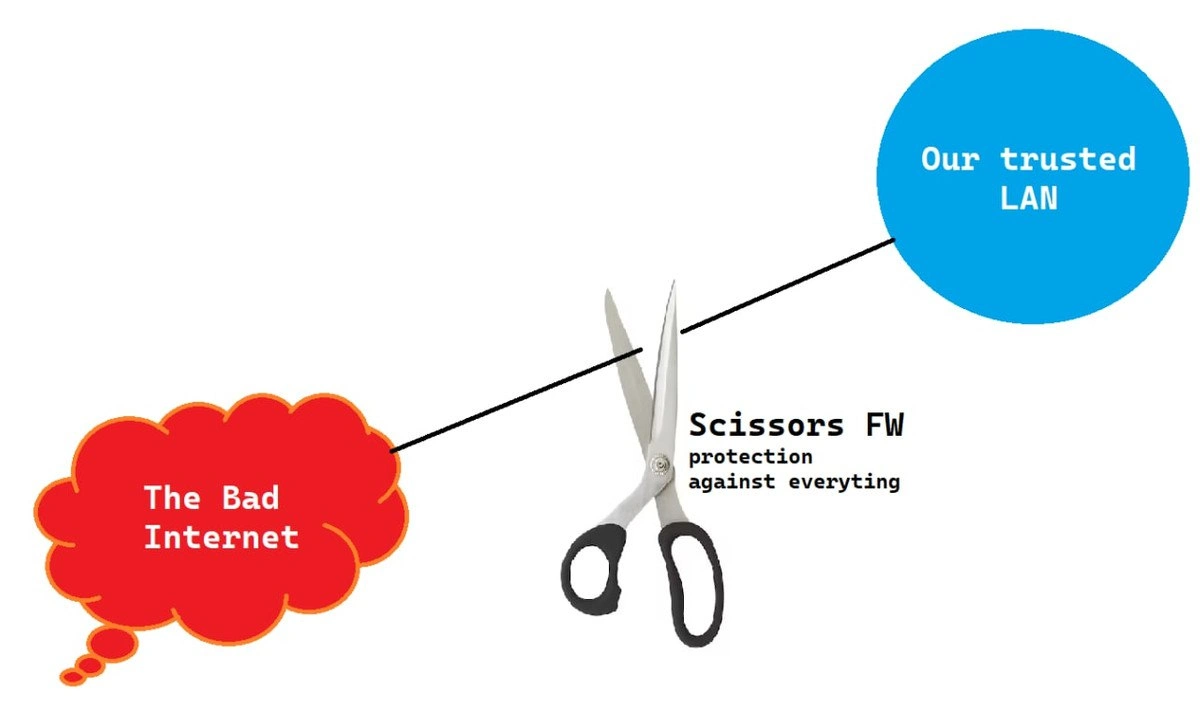
A firewall is usually a device or service that controls which network traffic can pass between two places. One side might be the public internet, and the other might be a company's internal network. The meme labels the dangerous outside as "The Bad Internet" and the supposedly safe inside as "Our trusted LAN."
A LAN, or local area network, is a private network used inside a home, office, lab, or company site. A traditional network diagram often treats the internet as untrusted and the LAN as trusted. Modern security is more cautious, because internal machines can also be compromised, but the old visual shorthand is still easy to understand.
An air gap means the protected system is not connected to the outside network at all. Instead of relying on software rules, intrusion detection, or careful configuration, the system is isolated by the absence of a communication path. The scissors represent the most direct version of that idea: if the cable is cut, remote attackers cannot send traffic through it.
The humor comes from taking a serious concept and making it childish in the best way. In a real workplace, a junior engineer might spend days learning subnets, routing tables, NAT, firewall rules, and change requests. Then this meme walks in and says: what if the best rule was just disconnect?
Level 3: Deny All, Literally
The joke is that the diagram solves network security by refusing to have a network. A black line connects:
The Bad Internet
to:
Our trusted LAN
and in the middle sits an open pair of scissors labeled:
Scissors FW
protection
against everything
That is a brutally literal interpretation of a firewall policy. A normal firewall tries to classify traffic: allow this source, deny that port, inspect this application, log that suspicious session, and pray the rulebase was not last edited during a production emergency. The Scissors FW has a simpler control plane: no packets traverse a cut cable. It is the one security product with perfect uptime as long as nobody wants connectivity.
Experienced infrastructure people recognize the trade-off immediately. Air gaps are real security techniques: isolate a system physically so remote attackers cannot reach it over the network. They are used for sensitive industrial systems, classified environments, offline backups, signing keys, and other places where connectivity is more dangerous than inconvenience. The meme turns that legitimate idea into a cartoon by replacing architecture, governance, and operational discipline with office supplies.
The line through the scissors matters because it is not showing sophisticated packet filtering; it is showing the physical layer. Below IP addresses, TCP ports, TLS certificates, and application firewalls, there is still a medium that carries signals. If the medium is severed, routing policy becomes philosophy. No SYN packet, no exploit chain, no "just open port 443 temporarily," no late-night firewall exception from a project manager who learned the word "blocker" and never looked back.
Of course, "protection against everything" is only true for network-borne threats crossing that line. It does not protect against infected USB drives, malicious insiders, compromised build artifacts, supply-chain attacks, bad backups, weak credentials on adjacent systems, or someone taping the cable back together because the quarterly dashboard stopped loading. Security people call that "residual risk"; everyone else calls it "Tuesday."
Description
A simple network diagram shows a red thought-cloud labeled "The Bad Internet" connected by a black line to a blue circle labeled "Our trusted LAN." In the middle, a photo of open scissors is placed over the line as if cutting the connection. The text beside it reads "Scissors FW" and "protection against everything." The meme reduces network security to a literal physical-layer air gap: if the cable is cut, the trusted LAN is protected from all remote traffic because it is no longer connected.
Comments
3Comment deleted
It is the rare firewall with perfect deny-all semantics and a change-management process involving office supplies.
Best solution against any ddos Comment deleted
https://en.m.wikipedia.org/wiki/Air_gap_(networking) Comment deleted