
Firewall Vendor Backdoors Meme Explained
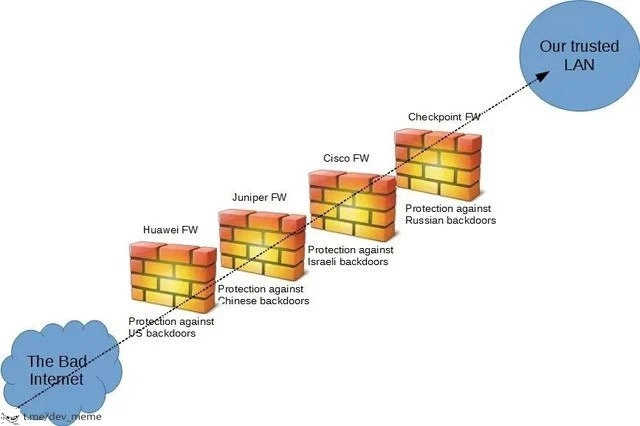
A diagram stacks four brand firewalls so each supposedly blocks another country’s backdoors before traffic reaches the trusted LAN. The deep dive covers defense in depth, supply-chain suspicion, security theater, and why privileged appliances are attack surfaces too.
Level 1: Too Many Locks
This is like putting four locks on your front door because you think each lock company might secretly work for a different sneaky neighbor. It feels safer because there are more locks, but the real joke is that you still have to trust somebody, and nobody in the picture seems fully trustworthy.
Level 2: Backdoors All Around
A firewall is a device or service that controls network traffic. It decides which connections are allowed through based on rules like source address, destination port, protocol, application identity, or threat signatures. In simple terms, it is a gate with a rulebook.
A backdoor is a hidden or unintended way to bypass normal security. It might be deliberately inserted, accidentally created, or added by an attacker after compromise. In the meme, each firewall claims to protect against some other country's backdoors, which is why the joke lands: the protection chain assumes every vendor might be untrustworthy, but also assumes the next vendor can be trusted enough to protect you.
Defense in depth means using multiple layers of protection so one failure does not ruin everything. For example:
- A firewall blocks unwanted inbound traffic.
- Strong authentication protects administrator access.
- Patch management removes known vulnerabilities.
- Monitoring detects strange behavior.
- Network segmentation limits what an attacker can reach.
The meme twists that good idea into security theater. Instead of showing layered controls that solve different problems, it shows four similar-looking brick walls whose real job is emotional reassurance. A junior engineer might first encounter this at a company where the network diagram looks impressively secure, then discover that the firewall rules are full of any any allow exceptions because "the business needed it."
The "trusted LAN" bubble is also a classic old-school assumption. A LAN, or local area network, is the internal network inside an office or organization. Calling it trusted made more sense when most systems lived in one building and attackers were presumed to be outside. Modern security is more skeptical: internal networks can be compromised too, so many teams prefer zero trust ideas where every request still needs verification.
Level 3: Trust Firewall Theater
The diagram is funny because it turns defense in depth into a procurement-driven geopolitical joke. Traffic starts in a cloud labeled:
The Bad-Internet
Then it walks through four brick walls: Huawei FW, Juniper FW, Cisco FW, and Checkpoint FW, each supposedly protecting against a different country's backdoors, before reaching:
Our trusted LAN
In real security architecture, stacking firewalls can make sense when the layers have different policies, failure modes, inspection engines, administrative boundaries, or blast-radius controls. Here, the layers are not separated by protocol role or trust zone. They are separated by suspicion. Each vendor is treated less like a security control and more like an antidote to the previous vendor's alleged national allegiance.
That is the senior-engineer pain point: threat modeling often begins as a sober exercise in adversaries, assets, and attack paths, then gets dragged into vendor politics, compliance theater, and executive folklore. The labels "Protection against US backdoors," "Protection against Chinese backdoors," "Protection against Israeli backdoors," and "Protection against Russian backdoors" satirize the idea that supply-chain risk can be neutralized by buying enough mutually distrusted boxes. Somewhere, an enterprise architect has probably made a diagram only slightly less absurd and called it a reference architecture.
The uncomfortable truth behind the joke is that network appliances are themselves high-value attack surfaces. A firewall sits at a privileged choke point, parses hostile traffic, terminates sessions, may inspect encrypted flows, and often has management access into the very network it protects. If that device is compromised through firmware, update channels, management credentials, or hidden functionality, it can become the most expensive way to invite an attacker inside.
The dotted arrow also matters: it suggests a single clean path from danger to safety. Real networks are messier. There are VPNs, cloud peering links, SaaS integrations, remote admin consoles, forgotten test tunnels, vendor support accounts, and that one "temporary" allow rule from 2017 that became sacred infrastructure. The meme's perfect diagonal line is what diagrams show before reality files a support ticket.
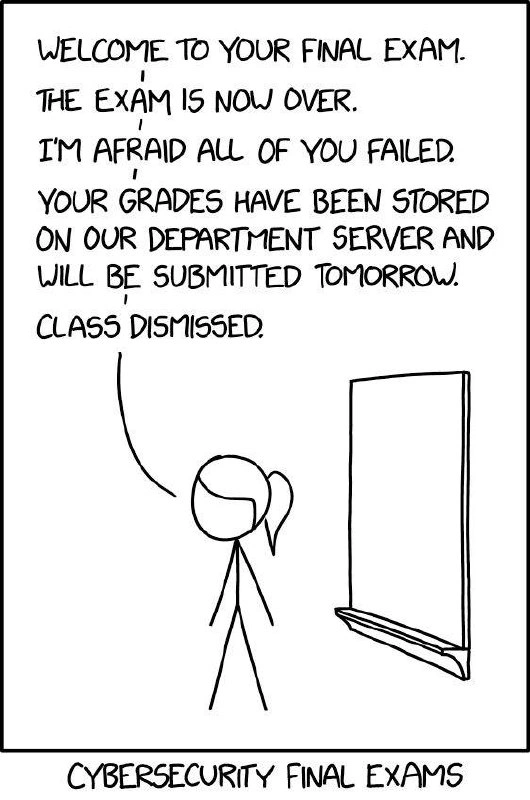

The threat model is solid until procurement asks which nation-state backdoor comes with the best enterprise discount.
And all of those firewall appliances built upon US / UK designed processors. 👌
Excavator FW.
Wake on LAN works only when the system is in hibernate state and not when it's powered off, again the kernel is on at that time and the network traffic is going through the path of OS -> Kernel -> CPU. Is CPU doing any processing on the network traffic's 0s and 1s without the kernel being involved?
South bridge is not a part of the CPU
It's a part of the mobo
Unlike the north bridge which was merged into the CPU some years ago by AMD and all else followed
Stolen
First of all SB is not a part of the CPU
Let's get that off
Thanks
Best meme discussion so far, thanks folks 😂
CPUs: 10900K, 12900K, 5950X
I mean WOL
Thanks for your help
Yeah, we similar one some time ago too 🙂
Kernel is Ring 0. Then you have, Drivers: Ring 1, Hypervisors: Ring 2, Browsers: Ring 3
Things that don't need kernel to operate
Tell me which one?
Not even baremetals