
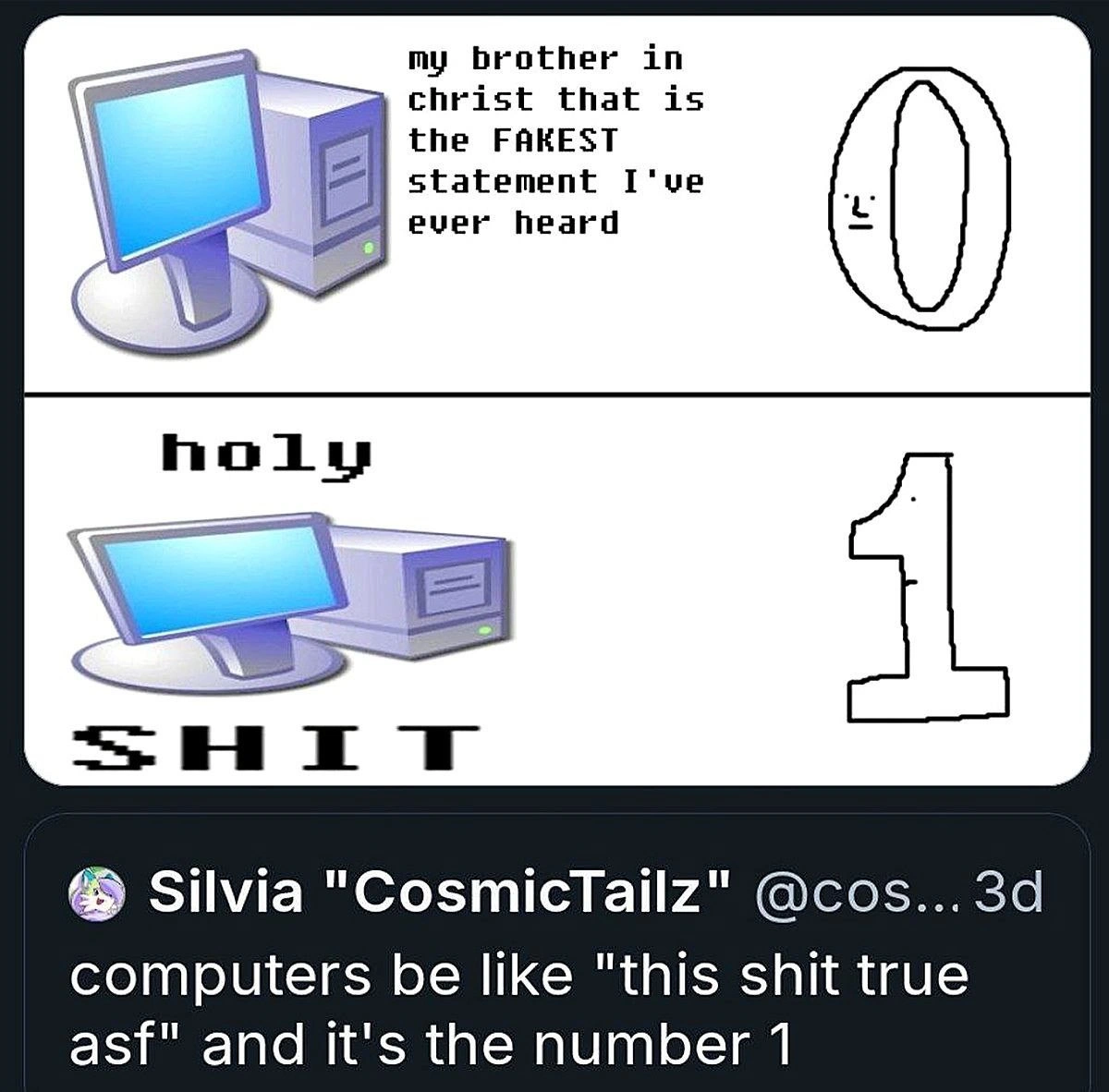
The Binary Gospel: 0 is Fake, 1 is True
Description
This image is a two-panel meme, presented as a screenshot of a tweet. The top panel shows a retro computer icon (a CRT monitor and a tower PC) next to the text 'my brother in christ that is the FAKEST statement I've ever heard' and a crudely drawn number 0 with a face. The bottom panel features the same computer icon with the text 'holy SHIT' and a crudely drawn number 1, also with a face. Below these panels, a tweet from user Silvia 'CosmicTailz' reads, 'computers be like "this shit true asf" and it's the number 1'. The meme humorously personifies a computer's interpretation of binary logic, where the number 0 represents 'false' and the number 1 represents 'true'. The joke lies in applying exaggerated, human emotional reactions to the fundamental and unemotional true/false distinction that underpins all of computing. It's a foundational computer science concept presented through the lens of modern internet slang

Comments
64Comment deleted
The most insidious bugs are when you accidentally assign instead of compare, like `if (err = 0)`. You're not just ignoring the error, you're forcing the computer to accept a blatant falsehood as gospel
Every senior dev knows the pain: months of stakeholder workshops distilled down to if(flag) { /* everything */ }
After 20 years of explaining to stakeholders why their 'simple' feature requires rewriting half the codebase, I finally understand computers' shock at discovering 1 is true - it's the same feeling I get when a PM says 'this should be a quick fix' and it actually is
Ah yes, the fundamental duality of computing: where every architectural decision, every algorithm optimization, and every heated technical debate ultimately reduces to a transistor somewhere deciding between high and low voltage. We've built entire civilizations on top of rocks we tricked into thinking, and their entire philosophical framework is literally '1' or 'not 1.' Meanwhile, we're up here arguing about microservices versus monoliths, when at the end of the day, it's all just very enthusiastic or very unenthusiastic electrons. The computer doesn't care about your elegant abstractions - it just knows if the bit is set or not, and honestly, that's the most honest code review you'll ever get
Hardware gives you one bit of truth; C blesses any nonzero, JS canonizes [], SQL answers NULL - and we still expect consistent feature flags
Holy shit, it's #1... on the cherry-picked synthetic benchmark leaderboard
Two decades of type systems later and truth still rides the zero flag - jz for “fakest,” jnz for “holy” - while a Windows API somewhere insists S_OK == 0, just to keep the congregation humble
Quantum computer: Comment deleted
or "well, it's not that simple..." Comment deleted
#!/bin/bash true echo $? false echo $? Comment deleted
Yeah, bash immediately came to mind as the counter example Comment deleted
"Fakest" implies the existence of different levels of fakeness Comment deleted
1 == 1 && 1 == 0 is not as fake as 1 == 0, I guess. 0 is the fakest of them all Comment deleted
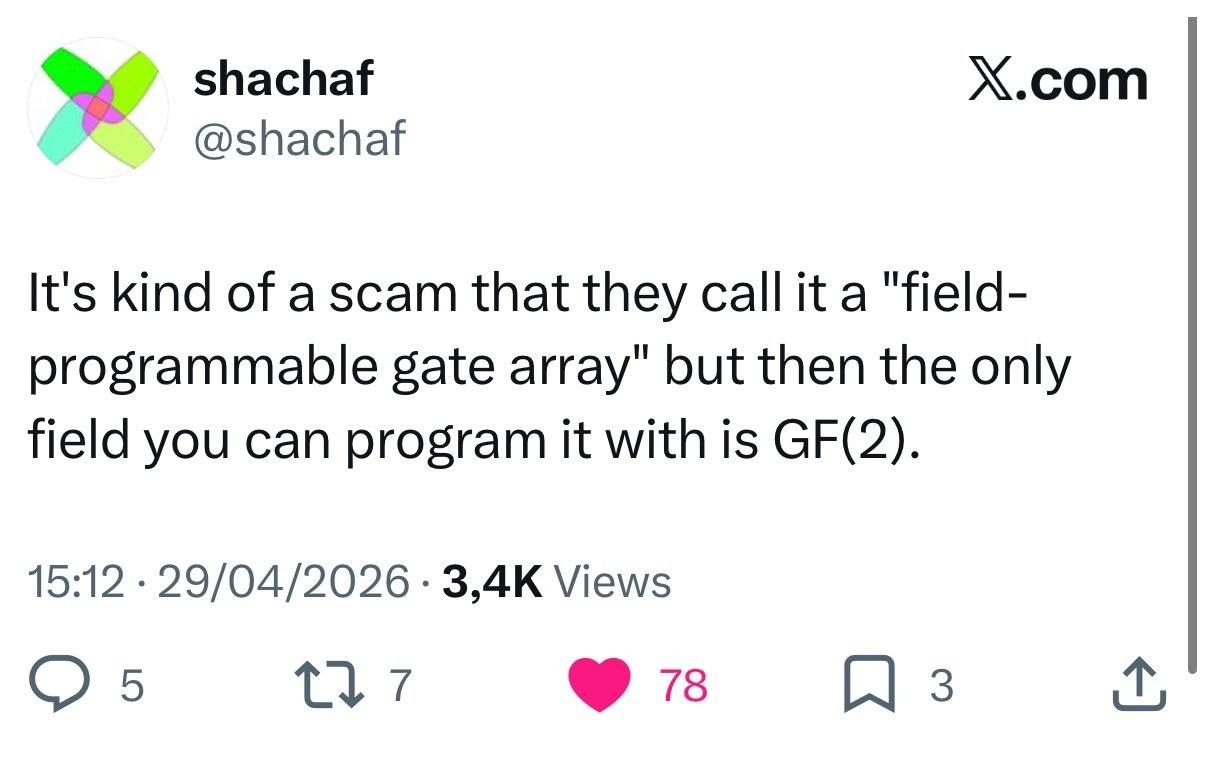
IMO, the greatest fake is 0.2 + 0.1 == 0.3 Comment deleted
IMO, your statement is true Comment deleted
You can’t compare 2 floats for absolute equality as with == , check here: https://www.geeksforgeeks.org/problem-in-comparing-floating-point-numbers-and-how-to-compare-them-correctly/ Comment deleted
Yeah I know that, I said I think "the greatest fake is 0.2 + 0.1 == 0.3" is true... sorry if I wasn't clear Comment deleted
This does work, but only with imprecise floats Comment deleted
and only because of output rounding Comment deleted
AFAIK it's the precision it stores the data with If sum is a 64-bit floating point integer (the default, here), then it does output 0.30000000000000004 Comment deleted
ah, true, 32 bit float's need a different example Comment deleted
for 32-bit ones: 1/13 + 2/13 != 3/13 Comment deleted
tho it's not because of better of worse precision Comment deleted
That checks out! Comment deleted
all floats are imprecise, bruh Comment deleted
And reading comprehension is a b- 😁 I never said any kind of float is precise, just that a less-precise floats do add 0.2 + 0.1 = 0.3 Comment deleted
You're saying "less precise" as if there aren't floats with worse precision like f16 Comment deleted
This has nothing to do with precision Comment deleted
Ah ok. Then what did cause 32 and 64 bit floats to behave differently? Comment deleted
Floats can exactly represent numbers like n / 2^m, i.e. an integer divided by a power of two. (Precision affects just the maximum value of n.) Notably, numbers like 0.1, 0.2, and 0.3 can't be represented like this, because their denominator contains 5. So when those numbers are encoded, the closest representable number is chosen instead. Basically the largest possible m is chosen, and then n is computed as round(0.1 * 2^m) (or 0.2, or 0.3 respectively). This rounding introduces the error, which is at most 0.5. (Again, note that this does not depend on the bitness of the float at all.) Adding up two numbers (0.1 and 0.2, both rounded to the nearest representable float) increases the error of the sum to at most 1. If we were lucky and the result was within 0.5/2^m distance of 0.3, we get true as the result of the comparison, because 0.3 is rounded to the same float; if the distance is a bit higher, we get false. Comment deleted
To sum it up, the difference is due to how the representable numbers are distributed along the real line. As the precision goes up, the representations of 0.1 and 0.2 get more correct, making the sum more precise, but the representation of 0.3 also gets more correct, making it harder to match. These effects counteract each other, so whether you get true or false for a given float bitness is basically up to chance. Comment deleted
I believe even web developers know the drills of safely comparing floats with epsilon Comment deleted
I don't believe they do. Epsilon comparison has become such a cargo cult that it's done without a reason all the time, and then incorrectly in the few places where it does matter Comment deleted
I guess those many cannot try learning Comment deleted
I'm borderline wondering if you know what you're talking about yourself Comment deleted
Not bashing you, of course, but there's quite a few things that seem obvious but aren't Comment deleted
Say, how do you chose the right epsilon to compare with? Comment deleted
usually as a factor of smallest operand Comment deleted
Yeah, that's much better than just a constant, I've seen that too many times 💀💀💀 Comment deleted
Floats are very precise if you use them right. Integers in JavaScript are floats, and no one bats an eye. By the same measure, arithmetic like 123 / 2^32 + 456 / 2^32 = 579 / 2^32 is also valid in floats (64-bit, anyway) Comment deleted
now that's somehow is optimized by the engine I suppose. Was it V8? Comment deleted
Integers are floats as per the specification. As for V8, yeah, it applies some strength reduction like that Comment deleted
Probably only for high-tier JITs? I think the interpret must be working with floats Comment deleted
the last time I tried 0.1 + 0.2 in js it returned precisely 0.3 Comment deleted
It shouldn't have done that. Perhaps some stray rounding? Comment deleted
I don't know much about v8 intricacies, but it sure does a lot if things under the hood. I doubt I would know the reason even if I learned v8 Comment deleted
I think you might just be misremembering Comment deleted
okay, but I want to sleep peacefully without touching that cursed language Comment deleted
i4 is more fuel efficient than v8 Comment deleted
.toFixed(x) is a recommended solution that already includes Number.EPSILON Comment deleted
Exactly, and 64 bit floats store as more data in the RAM, thus can store a much larger binary value and thus a much preciser representation of the decimal value Since 32 bit floats store less data to represent the decimal number, they are less precise This leads to 32 bit floats sometimes cutting off early, and thus representing the value differently than 64 bit floats in some cases Comment deleted
Not all floats are IEEE-754. In C floats are originally integers with "floating point". It stores significant digits and exponent separately, achieving precise representation of small floating point numbers. But the more significant digits you have on the left side of the point, the less will be available for the other side Comment deleted
Perhaps I'm missing something, but what platforms use something other than IEEE-754 these days? Comment deleted
the reason ieee-754 is used is basically performance to precision tradeoff. It can equally store large and small numbers with floating point, without compromising either side of the point and basic operations on it are faster Comment deleted
Are you saying that IEEE-754 is different from floating point? The former is an implementation of the latter, I don't see what this has to do with anything Comment deleted
I just forgot how the other format was called Comment deleted
unums and posits are used in some scientific applications and neural networks because of course it would be used there. implementations exist in hardware and software, for instance https://github.com/artecs-group/PERCIVAL Comment deleted
True that. It's been a while since I heard about them, I thought they were dead Comment deleted
there is a niche :) Comment deleted
Gave me The Legend of Vox Machina vibes Comment deleted
then there's java Comment deleted
it's just different artifacts for different types Comment deleted
I also remembered 32-bit floats had trouble with `0.9` Comment deleted
it is as if you are trying to write 2.19191919191919, the number is rational but cannot be expressed in decimal form. Binary form has the same limitations Comment deleted