The Absolute Zero Optimist
Why is this Mathematics meme funny?
Level 1: Freezing but Fine
Imagine you have a friend who loves science and jokes, and he does something totally crazy like saying: “I made myself as cold as anything can ever get!” That temperature is called absolute zero, which is like the ultimate freezer – so cold that nothing can move at all. It’s about -273°C, unbelievably cold. Of course, if someone actually got that cold in real life, it’d be very bad. 🥶 So your friend’s other friends are super worried about him. But then he grins and says, “Don’t worry, I’ll be 0K!”
Now, hearing that out loud, it sounds like “I’ll be okay.” He’s using “0 K” (zero Kelvin, the scientist’s way to say absolute zero) as a twist on the word “OK.” It’s like a big nerdy pun. Your friend basically took a serious science fact (how cold absolute zero is) and turned it into a goofy way to say “I’m alright.” It’s funny because it’s so extreme and unexpected: he’s freezing at the coldest temperature in the universe, yet he’s joking that he’s “okay.” It’s the kind of humor that makes you groan and laugh at the same time – groan because it’s a dad-joke level pun, and laugh because, well, you probably never heard someone use a physics term instead of the word “okay” before!
So the heart of the joke is this: he’s reassuring his friends with a hidden science reference. It’s as if someone got hurt and said “Don’t worry, I have 0 lives left in this video game – I’m okay!” You’d do a double-take, then chuckle once you get the reference. Here, “0K” is the secret code for “okay.” The emotional payoff is that mix of relief and silliness – he’s fine and he made a clever joke. In the end, we laugh because it’s a harmless, clever bit of wordplay: something very cold sounds like something very comforting, and that surprise connection makes it really cool (pun intended!).
Level 2: 0K, Let’s Explain
Time to break down the science and coding references behind this tech pun. The joke is built on a play of words and numbers between temperature units. Here’s what’s happening:
Absolute Zero (0 K): This is the coldest possible temperature, defined as 0 Kelvin, or -273.15 degrees Celsius. In the Kelvin scale (used by scientists), 0 isn’t just freezing, it’s the bottom of the scale – you literally can’t go lower. At 0 K (that’s “zero kelvin”, no “degrees” symbol used), all molecular motion would stop. It’s a theoretical limit; in practice, we can’t actually reach 0 K (just super close). In Celsius (°C), which is the everyday temperature scale, this magic temperature is about -273.15°. That number is a fixed conversion: to get Kelvin from Celsius you always add 273.15.
Why -273.1°C instead of -273.15°C? The meme’s writer shaved off 0.05 degrees, possibly to keep the joke short and punchy (“-273.1” has one decimal place) or as an extra geeky twist. This slight precision mismatch is something developers recognize: in programming, we often see values rounded or not quite exact due to floating-point precision. An epsilon error (a very small difference) can creep in when, say, a
doublevariable can’t perfectly represent a decimal like 273.15 (since binary can’t neatly hold some fractions). The result? You might get 273.14999 or 273.15001 in calculations – a tiny error, but enough that -273.1 vs -273.15 jumps out to us. It’s a nod to the kind of small errors that can cause big headaches in code if not handled. Seasoned devs often account for this by checking if values are “close enough” rather than exactly equal, because0.0and0.00001are not the same, even if we intended them to be zero.“I’ll be 0K” = “I’ll be OK”: Here’s the fun wordplay. “OK” in everyday language means “okay, all good, no worries.” “0K” in science means “zero Kelvin,” the absolute zero temperature. Visually they look almost identical (just a zero instead of an ‘O’). So when you read “I’ll be 0K”, your brain flips it to “I’ll be OK”. The meme person is basically saying “Don’t worry, I’m fine” in a super nerdy way. It’s like a secret code for science lovers: only if you know about Kelvin and absolute zero does the joke click. This is classic GeekHumor/Wordplay – using a technical term that sounds like a common phrase. Think of other examples like programmers writing
NULLinstead of “no” or saying “It’s not rocket science – it’s linear algebra!” It’s humor that relies on knowing the lingo.Temperature boundary conditions: Absolute zero is a great example of a boundary value — an extreme limit case. In engineering and code, we pay special attention to boundary conditions (like maximums, minimums, or that tricky off-by-one index in an array) because that’s where things often break. By joking about hitting the absolute minimum temperature, the meme tickles that part of a developer’s brain that’s used to checking limits. It’s as if the person in the meme tested the very lowest possible value and came back saying “all good!” In reality, if you tried to reach that boundary in physical terms, you’d have a bad time (you’d be a human ice-pop). But in joke-world, our protagonist survives just to make the pun.
“...in production”: This phrase is tossed in to cement the developer context. Production is what we call the environment where software runs for real users (as opposed to development or testing environments). When someone says “It’s OK in production,” it means the live system is working fine. Here they cheekily say “0K in production” – implying that in the live system everything is absolutely cold (frozen to 0 Kelvin) and therefore absolutely fine. It’s riffing on the dev-team practice of a production freeze (where you freeze deployments to avoid last-minute bugs). They’ve taken freezing quite literally! It suggests that if we could freeze our code and servers to 0 K, there’d be zero chaos, zero bugs – zero everything, problem solved. Of course, that’s not how any real system works, but the absurdity is the point. It’s an exaggeration to make us laugh about how we sometimes wish we could just put our complex systems in a perfect, unchanging state and relax.
In simpler terms, this meme combines a physics fact with a software saying and a dash of mathematical pedantry for spice. You learn a cool constant (absolute zero at -273.15°C), you get a chuckle about a unit conversion turned into a joke, and if you’re a developer, you also nod at the idea of a “freeze” making everything okay. It’s a high-quality nerd cocktail of humor: one part science, one part coding culture, with a twist (of a freezing cold lemon 🍋, perhaps?). And crucially, it’s educational – now you’ll never forget what 0 K means, and why a difference of 0.05 can be a big deal to an engineer!
Level 3: Absolute Zero Tolerance
At the intersection of physics and programming, this meme packs multiple layers of nerdy delight. First off, we have absolute zero, the lowest possible temperature, hiding inside a pun. In science, absolute zero is 0 on the Kelvin scale (written as 0 K), equivalent to -273.15 °C. The meme’s text says “I froze myself to -273.1 °C,” which is just a tad off from the true -273.15 °C. That 0.05 degree difference is tiny, but every seasoned engineer’s brain sparks: hey, that looks like a rounding error! 🤓 This is a classic off-by-epsilon scenario – the kind of minuscule discrepancy that can send spacecraft off-course (remember the Mars orbiter lost to a units mix-up?). In coding, we fight these tiny differences all the time: a float rounding here, a missing decimal there, and suddenly our calculations aren’t exactly 0 when they should be. The meme cheekily mirrors this: -273.1 vs -273.15 is like a subtle floating-point precision bug hiding in plain sight.
Now, the punchline: “My friends were worried, but I’ll be 0K.” Read that aloud: “I’ll be OK.” 🤭 Here the absolute zero 0 K morphs into the familiar “OK” – a playful unit conversion not of temperature, but of language. It’s a wordplay pun that only works if you know the nerdy detail that 0 Kelvin is written as 0K. Developers love this kind of dual-meaning: one part scientific fact, one part everyday phrase. It’s the same energy as naming your variables to spell jokes, or using // comments to hide Easter eggs in code.
What makes experienced devs smirk is also the release joke hiding here. In software teams, when we say we’re doing a “code freeze”, we mean no new changes go to production (often to stabilize before a big launch). This meme takes that idea literally to the extreme – freezing to absolute zero so everything in production is stable, no more movement, no more bugs. At 0 K, nothing moves at all (physics says molecular motion stops). In a way, an absolute freeze would indeed ensure nothing crashes: if your servers were chilled to 0 K, not only would they have zero downtime, they’d have, well, zero of anything (because your data center would be a block of ice 😅). It’s tongue-in-cheek MetaHumor about how far we’d go to hear “yup, it’s all good in prod.” The phrase “everything is 0K in production” riffs on the common reassurance “everything is OK in production.” The humor comes from showing a ridiculously over-engineered solution to guarantee things are OK – as in, freeze the entire system to the ultimate boundary so nothing can go wrong. It’s absurd, it’s GeekHumor, and deep down every developer knows that feeling of wishing we could hit a magical zero-state where no bug or fire drill can occur.
To really appreciate it, you have to love both precise science and tech sarcasm. The meme’s frosty blue ice-crystal background visualizes that -273°C chill, setting the stage for the coolest bug-fix ever (literally freezing it out). And the text’s deadpan delivery (“My friends were worried, but I’ll be 0K”) is that classic engineer humor: serious face, deeply silly idea. In sum, this meme is like a well-crafted code comment: it packs scientific exactitude, a cautionary tale about boundary values, and a cheeky reassurance all into one line. We laugh because we’ve been there – chasing that elusive zero-error state – and because we appreciate a joke that’s 0K on so many levels.
// A quick illustration of the off-by-epsilon humor in code:
double celsius = -273.1;
double kelvin = celsius + 273.15;
if (kelvin == 0.0) {
printf("We hit absolute zero! Everything is 0K.\n");
} else {
printf("Not exactly 0K... keep cooling. Kelvin is %.4f\n", kelvin);
}
// Output: "Not exactly 0K... keep cooling. Kelvin is 0.0500"
//
// The 0.05 K discrepancy here is like the meme's -273.1 vs -273.15 joke – close to absolute zero, but not precisely there.
Description
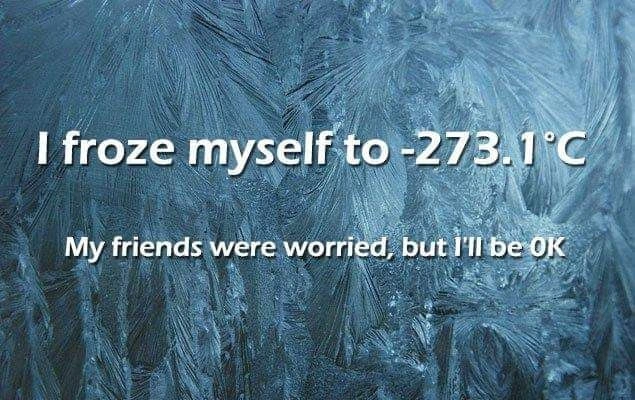
The image displays a background of intricate, feathery ice crystals, tinted in shades of blue and white, creating a visually cold texture. Overlaid on this frosty background is white text with a subtle black drop shadow for readability. The text is a two-line joke. The first line reads, 'I froze myself to -273.1°C'. The second line, acting as the punchline, says, 'My friends were worried, but I'll be 0K'. The humor is a scientific pun based on the Kelvin temperature scale. Absolute zero, the theoretical lowest possible temperature, is -273.15°C, which is precisely 0 Kelvin (0K). The punchline cleverly uses '0K' to sound like the word 'OK', making a nerdy but witty joke that is popular in scientific and technical communities
Comments
18Comment deleted
That's my server when it hits a kernel panic. It's not crashed; it's just achieved a state of minimal thermal and computational entropy. It's perfectly 0K
If only our floating-point rounding bugs would settle at 0 K - then at least the undefined behavior would be perfectly still
This is what happens when you finally achieve zero bugs in production - you reach absolute zero and everything stops moving, including your career progression meetings
At -273.15°C, not only do you achieve absolute zero, but your code finally stops executing - permanently. It's the ultimate freeze, where even your race conditions can't race anymore because time itself has given up. The only thing colder than absolute zero? The look your senior architect gives you when you suggest rewriting the entire legacy system in Rust 'because it's memory-safe.'
Classic: convert °C to K without units types, round to one decimal, and prod reports '0K' - status green, users frozen; strongly typed units would have failed the deploy
The ultimate race condition fix: at absolute zero, no threads have velocity
That moment when your healthcheck returns 'OK' because the Celsius-to-Kelvin conversion was cast to int: -273.1°C became 0 K - classic float/truncation plus units bug
Sorry, where should I laugh? Comment deleted
1. "0K" has two meanings here: - It looks like "OK" (meaning "alright/fine") - It's also the scientific notation for "0 Kelvin" 2. -273.15°C = 0 Kelvin (0K), which is absolute zero 3. So when the image says "I'll be 0K" it's making a pun that works on two levels: - "I'll be okay/fine" - "I'll be at zero Kelvin" This is particularly clever because: - It uses the exact temperature conversion (-273.1°C = ~0K) - The friends being "worried" adds to the humor since reaching 0K is physically impossible - It's a sophisticated science joke that requires knowledge of both the Kelvin scale and temperature conversions to fully appreciate Comment deleted
ChatGPT flavor Comment deleted
People in comments got only 2 genders Comment deleted
0°K = -273.1° C Comment deleted
I seeeee!!! Good joke!! Thank you) Comment deleted
Nice joke Comment deleted
Salom Comment deleted
Nike jok Comment deleted
Cyberpun 2009 Comment deleted
Nike jok good Comment deleted