
Boolean True False Bits Meme Explained
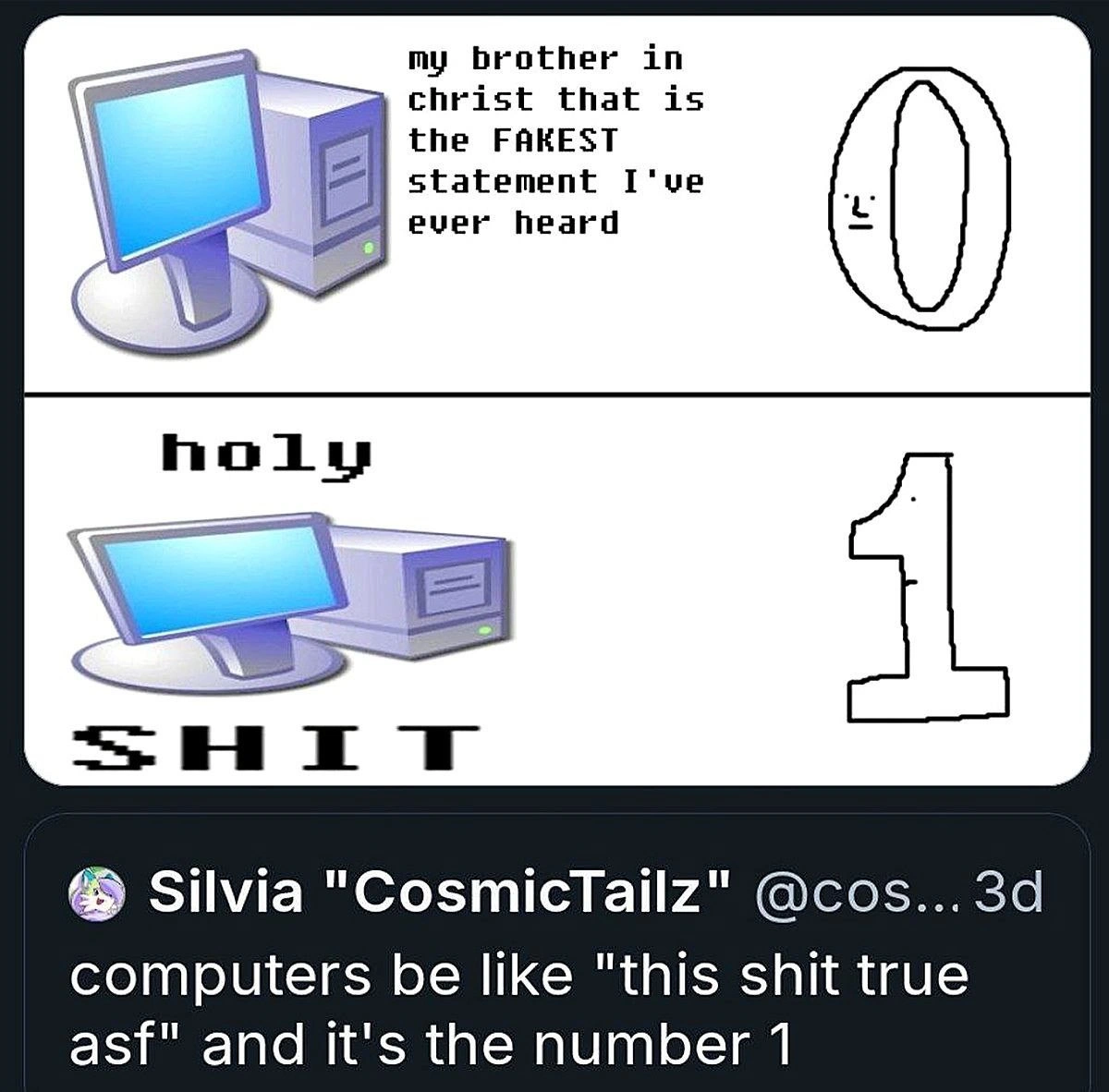
Two-panel clipart PCs brandish a doodled 0 for maximum false and a chunky 1 for gospel true, capped by a tweet about computers saying “true asf.” The deep dive explains Boolean algebra, binary truth values, and why code never does “maybe.”
Level 1: Yes or No Only
Imagine you have a robot friend who can only ever answer yes or no – nothing in between. If you tell your robot a really unbelievable tale, it won’t shrug or say “maybe that’s half-true.” It will flat-out respond, “No, that’s not true at all!” (like giving a big thumbs-down 👎, meaning FALSE). But if you tell the robot something completely correct, it will enthusiastically go, “Yes, absolutely true!” (giving a big thumbs-up 👍, meaning TRUE). This meme is funny because our real friends might say “hmm, that sounds kind of fake” or “that’s almost true,” but a computer (like that robot friend) just doesn’t have a middle answer. It only uses a 0 for “no/false” or a 1 for “yes/true.” The pictures with the old-fashioned computer and the giant 0 and 1 are showing exactly that: the computer either totally denies something with a zero or totally holy-moly agrees with a one. It’s like a light switch that can only be off or on. There’s no dim or “maybe” setting, which makes us laugh because it’s such an extreme, all-or-nothing way to look at the world.
Level 2: No Gray Area
Let’s break down the basics. Computers only understand binary, which means everything inside a computer is represented by 0s and 1s. A Boolean (named after mathematician George Boole) is the fancy CS term for a true/false value. In nearly every programming language, false equals 0 and true equals 1. There’s no “kinda true” or “mostly false” – just these two options. This meme is playing with that idea using silly, exaggerated language.
In the top part of the image, we see an old-school computer (classic monitor and tower clipart) next to text that says:
“my brother in christ that is the FAKEST statement I’ve ever heard”
There’s a big number 0 drawn beside it with a tiny face inside. All that is essentially the computer’s dramatic way of shouting: “Nope! That statement is as false as it gets.” In other words, 0 = false. The bottom part shows the same clunky computer clipart, but now the text exclaims:
“holy SHIT”
And next to it is a giant number 1 (also stylized with a face). This is the computer saying in an equally over-the-top way: “Whoa, this is absolutely true!” So 1 = true. The meme even includes a tweet from the user Silvia (“CosmicTailz”) summarizing the joke: “computers be like ‘this shit true asf’ and it’s the number 1.” In plain terms, the tweet is joking that a computer will label something as “true as ****” simply by putting a 1 on it. (“asf” is internet slang short for “as heck,” emphasizing very true).
So, why is this funny to folks who code? Because we deal with these binary truth values constantly. In code, you might write:
is_raining = False    # False is basically 0
if is_raining:
    print("Take an umbrella!")
else:
    print("No umbrella needed!")
Here is_raining can only be True or False. If it’s False (0), the computer will go to the else branch. If it’s True (1), it goes into the if branch. There’s no gray area — the computer won’t consider “drizzling” as kinda true or interpret anything beyond the explicit value. Every condition in a program, no matter how complex the logic leading up to it, finally boils down to a simple true/false check. This meme exaggerates that by giving the computer a comedic personality that speaks in Gen-Z meme lingo (“my brother in Christ” and “holy $%@!”) to declare something the most false ever (0) or realest truth (1). The contrast between the dramatic human expression and the computer’s deadpan binary decision is what makes it humorous. Essentially, it’s saying: “Computers reduce even our craziest statements to a single bit of truth value.” And the use of that retro Windows-era computer image just adds a goofy visual touch — like the old PC itself is proclaiming these judgements with divine certainty.
For a new developer or someone learning coding, it’s a cheeky reminder of how Boolean logic works. No matter what you’re trying to express, when you ask a computer to evaluate a statement, it’s going to answer with a 0 (false) or 1 (true). Computers don’t do ‘maybe’. This black-or-white logic is one of the first things we learn in programming (often in a CS_Fundamentals class): a condition is either true or false, and that’s that. The meme just illustrates this concept in a memorable, humorous way — with the computer essentially yelling “FALSE!” or “TRUE!” in internet slang. It’s both silly and educational: reminding us that under all the fancy code, a computer’s brain is just a bunch of yes/no switches.
Level 3: Binary Gospel
This meme takes a witty jab at how literal computer logic is. In programming, every grand claim or complex idea we code ultimately receives a binary verdict: false (0) or true (1). The top panel’s text – “my brother in Christ, that is the FAKEST statement I’ve ever heard” – is an over-the-top, hyperbolic way to say “no, that’s completely untrue.” It appears right next to a giant doodled 0, which is, of course, the computer’s way of saying FALSE. The bottom panel flips to the opposite extreme: it shows “holy SHIT” above an oversized 1, as if the machine is exclaiming “this is gospel truth!” In everyday slang, “holy $@$#! true asf” means something is unbelievably true – and the meme humorously equates that to the simple value 1 (meaning TRUE in binary).
To an experienced developer, this contrast is hilariously relatable. We deal with Boolean logic constantly – every if statement, every conditional check in our code reduces a complex real-world question to a single bit. The meme exaggerates that by giving the computer a dramatic personality (“my brother in Christ…” is meme-slang for “dude, seriously…”), yet the punchline is that our solemn, all-knowing computer friend ultimately communicates in just ones and zeros. It’s poking fun at the all-or-nothing mindset of software: there’s no room for “kinda sorta” in a standard boolean. A condition in code doesn’t come back as 0.5 or “50% true” – it’s either a 1 or a 0, true or false, holy truth or faker-than-fake.
This joke resonates as developer humor because we often anthropomorphize computers when debugging or explaining behavior (“the compiler thinks this is invalid”, “the machine says no”). But in reality, the machine isn’t nuanced – it’s embarrassingly binary. The meme uses the silly 1990s desktop clipart aesthetic – that old CRT monitor and tower – to make it even funnier. It’s like the computer itself (straight out of a Windows 95 era clipart collection) is delivering these absurdly exaggerated lines. Seasoned devs appreciate this throwback style; it adds a layer of ironic nostalgia, implying that from the earliest PC days to now, computers have always seen the world in simple 1s and 0s.
On a deeper level, the meme underscores a truth of development: no matter how sophisticated our software becomes, underneath it all, a binary truth check is happening. Business logic, user input validations, complex algorithms – eventually a decision is made that’s as simple as true or false. It’s a reminder (with a chuckle) that our powerful modern machines are fundamentally just super-fast, souped-up yes/no machines. As developers, we often joke about computers being too literal. This is a relatable experience: maybe you’ve written a condition expecting the program to “understand” nuance, only to have it behave rigidly because you didn’t account for something (the computer won’t assume or infer – it only knows exactly what you told it to consider true). The meme captures that rigid honesty: computer says 0 or computer says 1 – nothing in between. It’s the binary gospel according to the CPU.
Level 4: Boolean Bedrock
At the bedrock of computing lies Boolean algebra, the mathematical algebra of truth that only knows two values: true or false. Back in 1854, mathematician George Boole formalized this system of logic using binary truth values (now fittingly named Boolean values). In modern computers, every lofty idea or complex condition you program eventually boils down to this simple duality. A statement in code might feel nuanced to us, but under the hood it’s distilled into a single bit in memory: either 0 (false) or 1 (true). Digital circuits are literally built from tiny switches (transistors) that are on or off – there’s no half-way “maybe” position for a transistor. This binary absolutism is by design: it makes logic deterministic and hardware simpler, but it also means a machine’s notion of truth is brutally literal.
In theoretical terms, one bit of information answers a yes/no question completely – it’s an indivisible unit of truth. All higher-level programming logic, no matter how elaborate, is composed of these binary decisions. Consider a complex condition like if (A && (B || !C)): the computer will evaluate that whole logical expression and ultimately collapse it down to 1 (meaning the condition is satisfied) or 0 (not satisfied). There’s no spectrum in classical Boolean logic; it obeys a crisp truth table where every possible input combination yields an unambiguous True or False. This black-and-white reasoning is powerful – enabling everything from simple conditionals to entire algorithms – but it can be hilariously unsympathetic to human nuance. In fact, computer scientists have explored multi-valued and fuzzy logic (which allow “in-between” values) for specialized applications, but the everyday software we write still relies on this rock-solid two-valued foundation.
The meme leans into this all-or-nothing nature of computation. It jokingly portrays the computer as having a binary verdict system, where even the most exaggerated human statements get reduced to a single bit. The humor is that something as grand as “the FAKEST statement I’ve ever heard” or as emphatic as “holy TRUE” is, to the machine, nothing more than a 0 or 1. It’s shining a light on the Boolean bedrock of our code: no matter how passionate or hyperbolic we humans get, the computer’s answer is effectively a monotone “false” or “true” – nothing more, nothing less.

The most insidious bugs are when you accidentally assign instead of compare, like `if (err = 0)`. You're not just ignoring the error, you're forcing the computer to accept a blatant falsehood as gospel
Every senior dev knows the pain: months of stakeholder workshops distilled down to if(flag) { /* everything */ }
After 20 years of explaining to stakeholders why their 'simple' feature requires rewriting half the codebase, I finally understand computers' shock at discovering 1 is true - it's the same feeling I get when a PM says 'this should be a quick fix' and it actually is
Ah yes, the fundamental duality of computing: where every architectural decision, every algorithm optimization, and every heated technical debate ultimately reduces to a transistor somewhere deciding between high and low voltage. We've built entire civilizations on top of rocks we tricked into thinking, and their entire philosophical framework is literally '1' or 'not 1.' Meanwhile, we're up here arguing about microservices versus monoliths, when at the end of the day, it's all just very enthusiastic or very unenthusiastic electrons. The computer doesn't care about your elegant abstractions - it just knows if the bit is set or not, and honestly, that's the most honest code review you'll ever get
Hardware gives you one bit of truth; C blesses any nonzero, JS canonizes [], SQL answers NULL - and we still expect consistent feature flags
Holy shit, it's #1... on the cherry-picked synthetic benchmark leaderboard
Two decades of type systems later and truth still rides the zero flag - jz for “fakest,” jnz for “holy” - while a Windows API somewhere insists S_OK == 0, just to keep the congregation humble
Quantum computer:
#!/bin/bash true echo $? false echo $?
"Fakest" implies the existence of different levels of fakeness
then there's java
it's just different artifacts for different types
I also remembered 32-bit floats had trouble with `0.9`