
The Definitive Guide to Chasing Compiler Dragons
Description
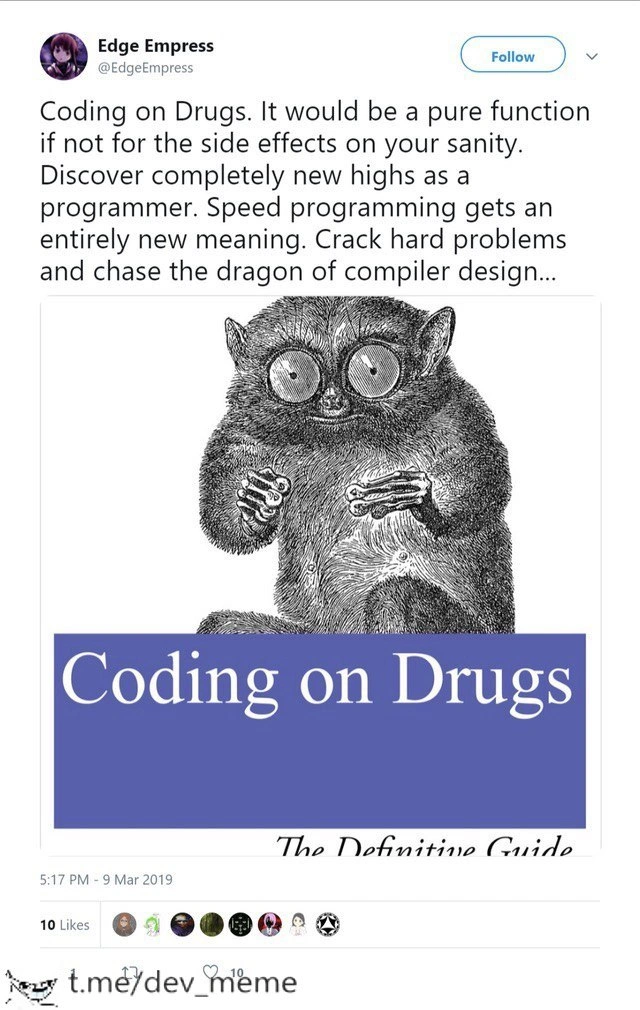
A screenshot of a tweet from the user 'Edge Empress' which includes a parody of an O'Reilly book cover. The tweet humorously suggests 'Coding on Drugs' would be a 'pure function if not for the side effects on your sanity,' and encourages one to 'chase the dragon of compiler design.' The attached image mimics a classic O'Reilly programming book, famous for their animal illustrations. This one features a black-and-white sketch of a Tarsier, an animal with enormous eyes, fitting the 'on drugs' theme. The book's title is 'Coding on Drugs' with the subtitle 'The Definitive Guide.' The meme resonates with experienced developers by using functional programming jargon ('pure function', 'side effects') to describe the intense, sometimes mentally taxing, focus required for deep work, likening it to a narcotic experience. The reference to 'compiler design' is a nod to one of the most complex fields in computer science, framing it as the ultimate intellectual 'high.'



Comments
16Comment deleted
I tried to write a pure function, but after three days of debugging, it had definite side effects: my hair turned grey, my plants died, and I started seeing the ghost of Dennis Ritchie
Who needs psychedelics when you’re tracing a “pure” function’s side effect through twelve layers of lambdas - by the time it hits prod, you’re already seeing compiler dragons
The real irony is that after 15 years of chasing 'pure functions with no side effects,' the only thing that remains pure is our caffeine dependency - everything else has been mutated by scope creep, legacy callbacks, and that one Promise chain from 2016 we're still afraid to refactor
The joke brilliantly plays on functional programming terminology: 'It would be a pure function if not for the side effects on your sanity' - a perfect metaphor for how programming, like a pure function, should be predictable and deterministic, but in reality causes significant side effects on the developer's mental state. The 'chase the dragon of compiler design' reference cleverly parallels the addictive pursuit of the perfect high with the obsessive quest for elegant compiler optimizations - both involve diminishing returns and an ever-elusive ideal state that keeps you coming back despite the toll it takes
“Coding on drugs” is a human runtime hack: throughput spikes, but your personal GC does stop-the-world at 4 AM and you discover the only pure function left is regret - everything else leaks side effects
Pure functions deliver the ultimate high - until side effects in prod turn your monad into a stateful nightmare
Tried “coding on drugs” - my functions stayed pure, but the monad for side effects was ‘self’; enabling -Ofast on the human compiler stripped the sanity checks and we shipped UB to prod
let's implement Radix LSD Sort real quick Comment deleted
Middle out will be awesome. Comment deleted
you have extra words: "Radix" and "Sort" Comment deleted
oh, yeah, sorry. I meant to say "let's do LSD" Comment deleted
Don’t buy into this shit my dudes, you’ll never feel complete coding sober ever again Comment deleted
because somehow you got your IDE to autocomplete random shit when you were high and now you can't turn it off anymore. Comment deleted
Kkkjk Comment deleted
It’s actually cover for book about VIM ) Comment deleted
degeneracy Comment deleted