
CodeQuality Post #4513 · source on Telegram
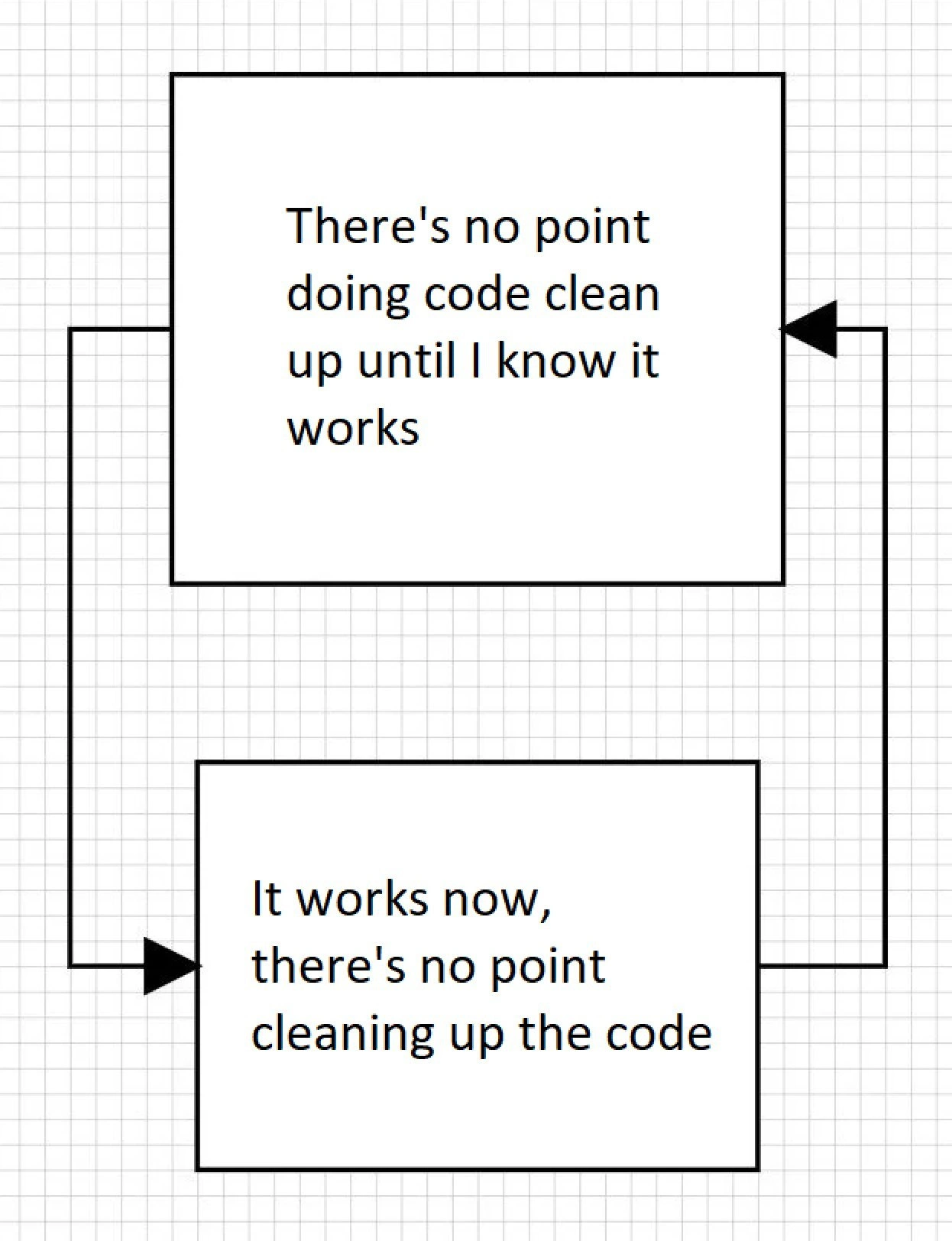
The infinite loop that forever postpones code cleanup and refactoring
Description
The image is a simple two-box flowchart drawn on a light grey, graph-paper grid background. The top rectangle contains the black text: "There's no point doing code clean up until I know it works." A right-pointing arrow exits that box, bends downward, and connects to a lower rectangle. The lower rectangle reads: "It works now, there's no point cleaning up the code." A left-pointing arrow leaves the lower box, travels upward, and reconnects to the side of the first box, forming a closed cycle. Visually the diagram humorously illustrates a developer’s self-justifying loop that delays refactoring, highlighting how technical debt and poor code quality perpetuate themselves in real projects

More like this
More like this in CodeQuality →
Use J and K for navigation
Comments
6Comment deleted
Refactoring is on our roadmap the same way full GC is in production: it only runs when the heap (of hacks) pauses the entire system - until then we just keep allocating excuses
This flowchart is basically a distributed system with perfect consistency - both nodes always agree that refactoring should never happen
This flowchart perfectly captures the 'Schrödinger's Refactoring' paradox that every senior engineer knows intimately: the code exists in a superposition state where it's simultaneously too broken to clean and too functional to touch. It's the architectural equivalent of technical debt compounding at venture capital rates - you know the interest will eventually bankrupt the codebase, but the quarterly delivery pressure makes it rational to keep kicking that can down the road. The real genius move? Convincing yourself this circular reasoning is actually 'pragmatic engineering' rather than what it truly is: a self-sustaining perpetual motion machine of code rot
Our refactoring policy is a two-state FSM: “don’t clean until it works” -> “don’t clean because it works”; tech debt is the invariant and the only exit transition is “rewrite.”
Refactoring budgets: allocated post-next-pivot, executed never
Our refactoring policy is a two-state FSM with a closed loop and 24.99% APR on technical debt