Skip to content
DevMeme
4133 of 7435
The QA vs. Dev Conflict
QA Post #4510, on Jun 21, 2022 in TG

The QA vs. Dev Conflict

Why is this QA meme funny?

Level 1: Fancy Names for the Same Thing

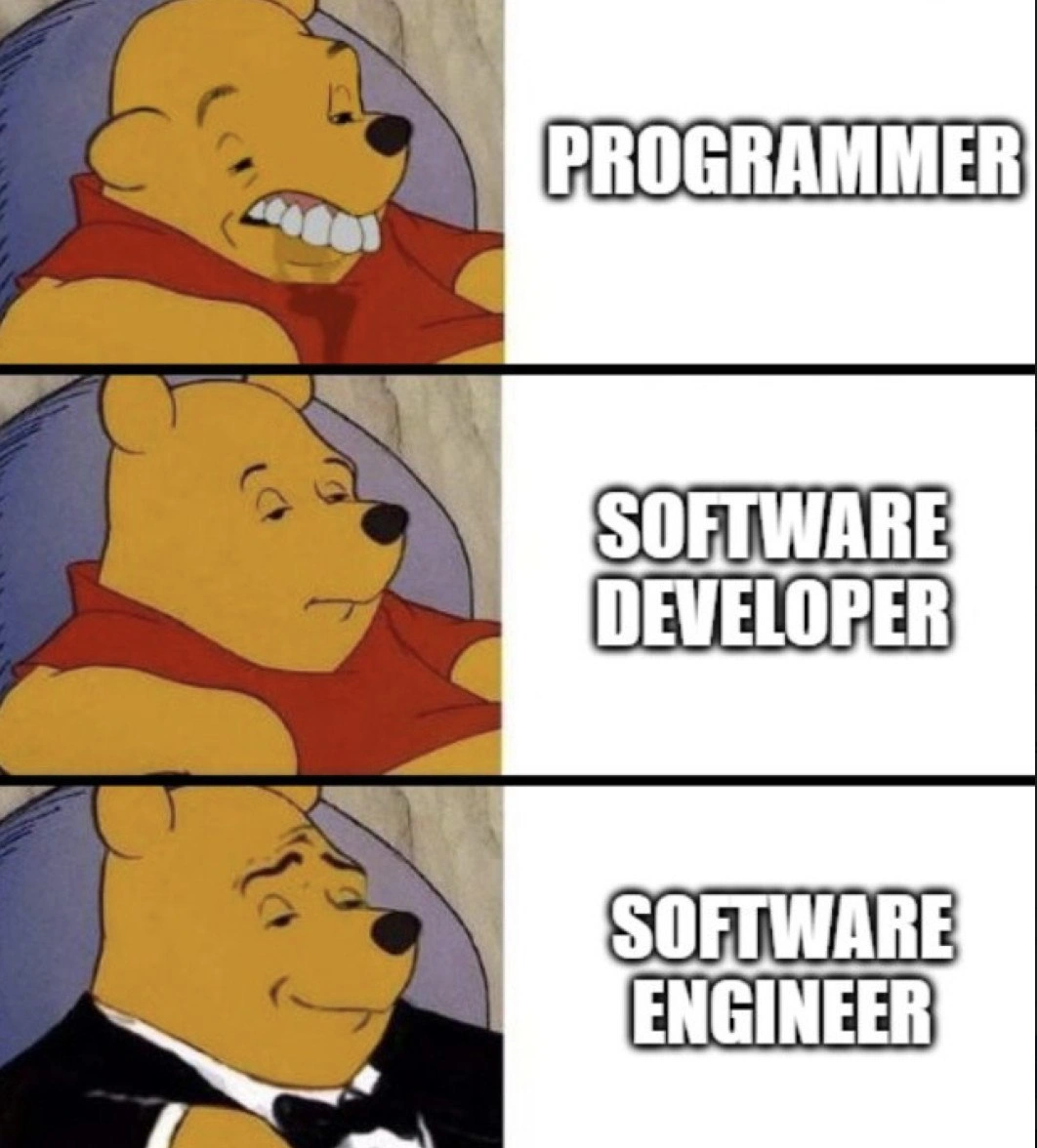
Imagine you have three kids all doing the same chore, like building a sandcastle. One kid says, “I’m a sand shoveler.” The next kid proudly says, “I’m a sandcastle builder.” The last kid sticks out his chest and declares, “I’m a Master Structural Engineer of Sandcastles,” maybe even putting on a toy crown to sound extra important. 😄 But at the end of the day, all three kids are just playing in the sand, doing the same task of building a castle. The longest, fanciest title didn’t change what they were actually doing. It just sounds more grand. That’s exactly why the Pooh Bear picture is funny: whether he’s called a programmer, a software developer, or a software engineer, he’s still the same Pooh doing the same job (writing computer code, like building that sandcastle). The meme makes us laugh because it’s like dressing up a simple thing in a fancy outfit – cute and silly, because we know underneath, nothing really changed except the name.

Level 2: Titles and Tech Talk

Let’s break down the terms and why this meme is funny for someone newer to the scene. In the software world, job titles like Programmer, Software Developer, and Software Engineer often get tossed around interchangeably, which can be confusing. Here’s what they generally mean:

  • Programmer: This typically means a person who writes computer programs – i.e., someone who codes. It’s the straightforward, old-school term. If you write Python, Java, or any code to make a computer do things, you’re programming, and you are a programmer. Back in the earlier days of tech (think 1980s or 1990s), most job ads actually used titles like “Computer Programmer” or “Programmer/Analyst.” It’s a perfectly good title, though in modern usage it might sound a tad plain or dated – like Pooh Bear making a funny strained face, as in the first panel. Older developers might even recall being called simply “coders” or “hackers” (before “hacker” took on security connotations), which all point to the same basic role of writing code.

  • Software Developer: This title became popular as the industry grew. Developer implies someone who not only writes code but also develops software applications – possibly involving a bit more than just typing out code, like working on software design, understanding user requirements, and so on. It’s essentially the same job as programmer, but the wording “developer” sounds broader and maybe more creative. Many companies use “Software Developer” as a generic title for people who build software. In the meme’s second panel, Pooh looks more relaxed with half-closed eyes under this title – as if “software developer” is a step up in fanciness from plain programmer. For a junior dev, hearing “developer” might feel more modern or professional than “programmer”. Functionally though, if you’re a junior software developer, you’ll still be writing and fixing code each day. The computer doesn’t treat your code differently based on the title on your email signature!

  • Software Engineer: Now this is the term you’ll encounter a lot, especially in tech companies and on LinkedIn profiles. An engineer in general is someone who applies scientific principles to design and build complex systems. When we say Software Engineer, it suggests a person who approaches building software in a systematic, engineering-like way. In practice, it usually means the same thing as developer – you design software, write code, fix bugs, and deploy apps. There isn’t a strict exam or license for being a “software engineer” in most countries (unlike civil engineers or electrical engineers who often need certification). It’s more of a job title convention. Many tech companies just call all their coding staff “software engineers” because it sounds sophisticated and standardized. In the meme’s third panel, Pooh is in a tuxedo smirking under “Software Engineer” to poke fun at how this title is seen as the most prestigious. The implication is that people sometimes feel more important calling themselves an engineer. For instance, if you’re new to the industry, you might wonder if an engineer is higher rank than a developer – truth is, it depends on the company or context, but usually they expect the same skills. The meme humorously says: we’re just dressing up the same Pooh bear. No matter the title, the daily work (writing if-else statements, debugging errors, pushing commits) remains very similar.

This tuxedo Pooh meme format is popular for showing an “escalation” or hierarchy of fanciness. Here, it’s applied to job titles. The joke lands because in real life, tech folks have seen titles get longer or more grandiose without a clear difference in role. This is part of the corporate culture in tech: job positions are sometimes named to sound impressive. There’s even the term “Title Inflation” in tech and other industries – like inflation in economy means prices go up, title inflation means job titles get “bigger” over time. For example, some companies might start calling a simple customer support rep a “Customer Experience Specialist”. In software, a programmer became a software engineer over the decades as the preferred term. A junior developer reading job boards might think these are totally separate roles, but experienced folks know they overlap a lot.

So, if you are just starting out: don’t stress too much about what you’re called. Developer vs. Engineer vs. Programmer – they all code and create software. Different companies just have different naming conventions. Some places might stick to “Software Developer” to be modest, while others love “Software Engineer” to mimic traditional engineering field prestige. A few even use quirky titles like “Code Ninja” or “Software Craftsman” (half-jokingly) – but those mean the person writes code too. In the end, this meme is a lighthearted way of saying: changing the name doesn’t change the job. Pooh Bear putting on a tuxedo doesn’t change who he is, right? Similarly, whether you call yourself a programmer or an engineer, you’re still a tech professional building software. The humor comes from recognizing this truth and poking fun at our industry’s sometimes silly obsession with titles and labels.

Level 3: A Coder by Any Name

In the depths of tech industry humor, this meme skewers a classic case of title inflation. The joke is that no matter how fancy your job title gets, you’re still punching out code. Winnie-the-Pooh is our stand-in for the developer: first panel shows plain Pooh grimacing under the label “PROGRAMMER” (the uncouth, old-school title). Next panel, Pooh looks half-asleep under “SOFTWARE DEVELOPER” (a bit more refined, like yeah, I make software). Finally, Pooh dons a tuxedo and a smug grin under “SOFTWARE ENGINEER” – the peak of pretentious nomenclature, as if adding “Engineer” magically confers more prestige (and maybe a higher billing rate). It’s the same bear in each panel, just like it’s the same job beneath each title. The humor crackles from that contrast: same work, fancier packaging.

Seasoned devs see this and smirk knowingly. We’ve watched our corporate culture churn out ever-grander labels for the same roles. One year you’re a Programmer II, then HR rebrands everyone as Software Engineer because it sounds more high-brow (perhaps the company thinks it’ll attract better talent or justify consulting rates). Did your daily routine change? Not one bit. You still slog through git merge conflicts, still debug why the legacy legacy code falls over when $day_of_week == "Monday". As a battle-worn coder, you learn that a title is often just a coat of paint. Call a bug “an incident” or call it “a sev-1 critical anomaly” – it’s still a bug that wakes you up at 3 AM. Likewise, call yourself Programmer or Software Engineer – you’re still googling “how to invert binary tree in-place” when crunch time hits.

Why is this meme too real? Because it jabs at an industry truth: we’ve grown obsessed with job title prestige. It’s an open secret among experienced devs that companies sometimes hand out inflated titles in lieu of raises or to boost morale. You might meet a “Principal Software Engineer” whose actual work is writing the same CRUD app any “Programmer” could. Title hierarchy becomes a game: Junior DeveloperSoftware DeveloperSoftware EngineerSenior Software Engineer, and so on, up to absurdities like “Distinguished Engineer” (which always makes me imagine someone coding in a monocle and top hat). The meme uses Pooh’s increasingly posh demeanor as a perfect visual metaphor for this prestige escalation. We laugh because we’ve met that Pooh – someone (maybe even ourselves) who got a fancier title and momentarily felt as sophisticated as Pooh in a tux.

There’s also a sly nod to the developer identity crisis. Are we engineers in the same vein as civil or electrical engineers? The term “Software Engineer” was adopted to suggest rigor and professionalism (back in 1968, computer folks started using “engineering” to tackle the software crisis, hoping to bring structure to chaotic coding practices). Fast forward, and now everyone writing JavaScript on a web app is an “engineer.” Traditional engineers raise an eyebrow because, hey, real engineers often need licenses and don’t typically debug at 2 AM in production. But in tech, we use the title loosely. The meme exaggerates this by equating adding a tux with adding “Engineer” to your title – it feels more important, but doesn’t change what you do. As the cynical veteran would tell you: the compiler doesn’t care what your business card says. When production is on fire, the alert pings whoever’s on-call, not whoever has the fanciest designation. In short, this meme nails the satirical truth that in our field, titles may change, but the code stays the same. Fancy name, same old bugs.

  • Same Work, Fancier Title: The core joke is that “Programmer”, “Software Developer”, and “Software Engineer” often describe identical roles. We chuckle because we’ve seen companies give the exact same job a loftier title to pretend something changed. It’s putting Pooh in a tuxedo and expecting us to applaud.
  • Corporate Cosmetics: This meme riffs on corporate culture where image can trump substance. Changing “IT Guy” to “Infrastructure Engineer” or “Software Peon” to “Software Engineer” is mostly HR theater – no new skills magically bestowed. Developers share this humor as a subtle eye-roll at how management tries to buff up roles with grandiose naming.
  • Ego and Esteem: Let’s admit it, being called an engineer strokes some egos. The tuxedo Pooh smirking represents that self-satisfied feeling. But it’s ironic: you can don the title like a tux, yet you’re still Pooh Bear underneath – still writing Python scripts to parse CSVs. The meme hits on the collective developer experience of realizing a shiny title doesn’t make the code any easier or the job any cushier.

Ultimately, experienced devs laugh because we’ve lived it. We know a developer by any name – programmer, engineer, code ninja, tech wizard – is still digging into the same logical problems day and night. The job title hierarchy is a bit of a running joke, a form of title inflation in tech that this meme neatly skewers. As one might dryly remark, “Call me Lord High Software Engineer if you want – I’ll be over here fixing null pointer exceptions all the same.”

Description

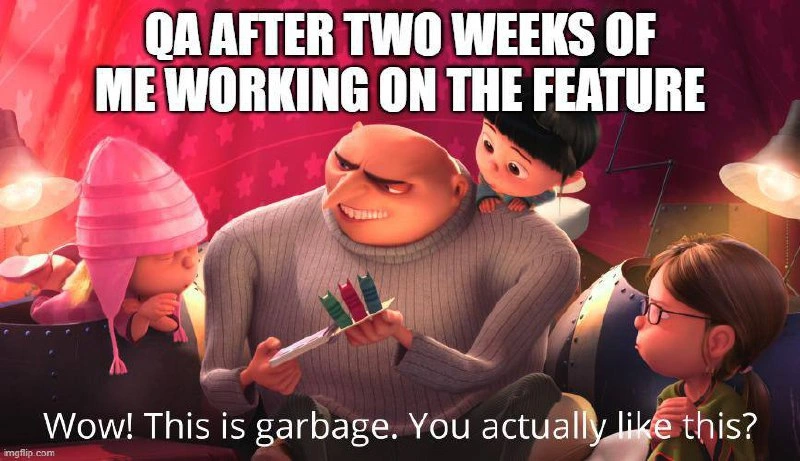
This meme likely portrays the classic adversarial relationship between developers and QA engineers. It might use a format like the 'Tom and Jerry' meme, where the developer (Tom) is constantly being thwarted by the QA engineer (Jerry) who finds bugs in their code. The humor comes from the shared experience of this friendly (and sometimes not-so-friendly) rivalry. Developers want to ship code, and QA wants to ensure it's high-quality. This tension is a fundamental part of the software development lifecycle
Comments

7
Anonymous ★ Top Pick A developer's code is like a Schrödinger's cat. It's both working and broken until a QA engineer opens the box
  1. Anonymous ★ Top Pick

    A developer's code is like a Schrödinger's cat. It's both working and broken until a QA engineer opens the box

  2. Anonymous

    Give it one more reorg and we’ll all be re-badged as “Distributed Systems Artisan IV” while still spelunking the same 2005 monolith - title scalability is the only thing we’ve truly decoupled

  3. Anonymous

    The only difference between these titles is how much you can charge for the same YAML configuration mistakes

  4. Anonymous

    This meme perfectly captures the tech industry's obsession with title inflation - where three engineers doing identical work (writing CRUD APIs and fixing production bugs at 2 AM) will insist on different business cards. The real joke? We all know the 'Software Engineer' still has to explain to their parents that yes, they're basically a programmer, and no, they can't fix the printer. The tuxedo doesn't change the fact that we're all just professional Stack Overflow consultants with imposter syndrome and a caffeine dependency

  5. Anonymous

    Programmer fixes bugs, Developer ships features, Engineer justifies the tech debt as 'strategic architectural decisions'

  6. Anonymous

    Same job, fancier title: at “software engineer” you don’t fix the bug - you write an ADR explaining it’s an eventual-consistency trade-off and negotiate the SLO

  7. Anonymous

    Three titles, same stack traces - the only thing that scales is blast radius and comp band

Use J and K for navigation