
Onboarding a New Hire to the Legacy Codebase
Description
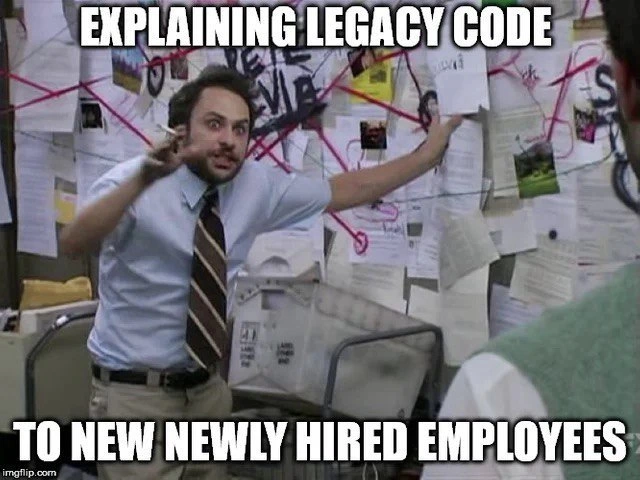
This image uses the famous 'Pepe Silvia' or 'Charlie Day Conspiracy Board' meme format from the TV show 'It's Always Sunny in Philadelphia'. It shows the character Charlie Kelly looking manic, with wild eyes and a cigarette, frantically gesturing at a wall covered in papers, notes, and photos connected by a complex web of red string. The top caption reads, 'EXPLAINING LEGACY CODE', and the bottom caption says, 'TO NEW NEWLY HIRED EMPLOYEES'. The meme perfectly captures the feeling of trying to explain a complex, poorly documented, and convoluted legacy system to a newcomer. For experienced engineers, the conspiracy board is a painfully accurate metaphor for the tangled dependencies, arcane business logic, and historical 'quick fixes' that make up old codebases. The humor lies in the shared experience of this chaotic knowledge transfer, where the explanation sounds less like a technical walkthrough and more like a rambling conspiracy theory
Comments
11Comment deleted
This part of the code is the way it is because of a server outage in 2008 and a temporary fix by a contractor named Dave who we can no longer contact. Any questions?
Those red strings aren’t decoration - they mark the precise ticks when the 2006 monolith, the “temporary” microservices, and that one mission-critical Excel macro accidentally achieve eventual consistency
The AbstractSingletonProxyFactoryBean was deprecated in 2009 but if we remove it, the entire payment system stops working and nobody knows why - including Dave, who wrote it and is now our CTO
Explaining legacy code to new hires is like trying to rationalize a 15-year-old monolith where the original architects have long since departed, the design docs exist only as folklore, and every module is held together by a Jenga tower of monkey patches that nobody dares refactor because 'it works in production.' You find yourself saying things like 'this singleton was necessary because of a threading issue in Java 1.4' to someone who's never seen a world without async/await, while internally screaming because you know the real reason is that Bob from 2009 just really liked singletons
Onboarding here is just Kahn’s topological sort on the red-string wall - fails immediately because the only DAG in this company is the org chart
Explaining legacy code to new hires: here’s the architecture diagram - red yarn is synchronous calls, blue yarn is cron, and anything with a pushpin runs as root on a server we’re afraid to reboot
Legacy code's true dependency graph: less UML, more red yarn proving that 'self-documenting' was always a cruel joke
it's ezier to rewrite the whole thing from scratch Comment deleted
Breaks backwards compatibility Comment deleted
every day, starting from scratch Comment deleted
some memes here are kinda cringe because they’re so conventional Comment deleted