
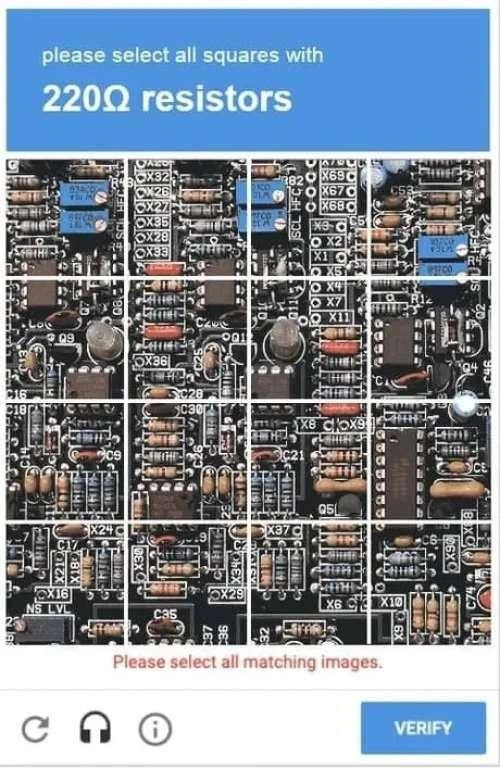
reCAPTCHA escalates: select every 220-ohm resistor or remain a bot
Description
The meme mimics Google’s image-grid reCAPTCHA. A bright blue banner at the top says, “please select all squares with 220Ω resistors.” Beneath it is a 4×5 grid overlaying a densely populated circuit board packed with through-hole resistors, ICs, capacitors, and trim-pots - every tile looks nearly identical except for subtle resistor color bands. The typical reCAPTCHA footer appears in grey: “Please select all matching images,” flanked by the headphone, info, and refresh icons, plus a blue “VERIFY” button. Visually, it’s almost impossible for a human to spot each 220-ohm part, satirizing how CAPTCHA challenges sometimes cross the line from simple security check to expert-level pattern recognition, especially for anyone who’s ever memorized resistor color codes while debugging embedded hardware


Comments
6Comment deleted
Somewhere, an accessibility engineer just rage-quit after realising Ohm’s law is now part of the Turing test
After 15 years of debugging race conditions and distributed consensus failures, the hardest problem I've faced is still explaining to product why we can't just 'add AI' to read resistor values from a CAPTCHA. Though to be fair, our ML model would probably just return '220Ω' for everything and still achieve better accuracy than our junior's code reviews
Finally, a CAPTCHA that proves you're not a bot - you're just a hardware engineer who forgot their multimeter. Because nothing says 'human verification' like asking someone to identify resistor values from a photo where the color bands are smaller than a pixel and the SMD codes require electron microscopy. At least when the backend crashes, we can blame it on someone selecting the wrong 220Ω resistor
CAPTCHA finally respects EE skills: thumbnail resistor codes or bust - no magnifier, no click
Proof-of-human vNext: decode 220Ω as red-red-brown through JPEG compression while the real bot just posts to /oauth/token
Finally, a CAPTCHA that enforces “full stack” - no Jira until you can mentally decode red‑red‑brown ±5%